Which Digital RV Surge Protector Stops Bad Pedestal Power
Progressive Industries EMS-PT50X leads for 50-amp rigs with full electrical management and a wireless interior display. Hughes Autoformers Power Watchdog PWD50-EPO adds Bluetooth app alerts for phone-based monitoring. Southwire Surge Guard 34930 covers 30-amp rigs at a lower cost while still catching open ground, open neutral, and reverse polarity faults.
Progressive Industries EMS-PT50X suits 50-amp motorhomes needing full electrical management and a wireless interior display. Open ground, open neutral, and reverse polarity all trigger an automatic shutdown before power reaches your panel. Bulk and cost run higher than basic plug-in units, so smaller rigs on tight budgets may want a lighter pick.
Amperage, fault coverage, and monitoring style vary widely across these seven units, which makes specs easy to mix up between models. We compared manufacturer specs, owner reports of pedestal fault catches, and setup type across 30-amp and 50-amp rigs to rank them here.
Our top picks

Progressive Industries EMS-PT50X
This 50-amp electrical management system pairs a wireless remote display with continuous voltage and amperage monitoring. Automatic shutdown fires on open ground, open neutral, reverse polarity, or voltage outside a safe range. Owners mount the display inside the rig, so checking pedestal status never requires stepping outside.
Pros
- Full EMS shutdown covers multiple fault types
- Interior display shows pedestal status without a walk outside
- Handles voltage swings common at older campgrounds
Cons
- Costs more than surge-only plug-in units
- Bulkier housing than portable models

Progressive Industries EMS-PT30X
Built for 30-amp travel trailers and smaller motorhomes, this EMS shares the wireless display from its 50-amp sibling. Continuous voltage monitoring cuts power before spikes or miswired pedestals reach onboard electronics. Several owners report catching bad campground wiring before it damaged appliances.
Pros
- Same wireless display as the 50-amp model, sized for 30-amp service
- Automatic shutdown on unsafe voltage
- Compact housing fits tighter pedestal boxes
Cons
- Steps down from the 50-amp EMS, so larger rigs need a different unit
- Adds one more component to mount inside the rig

Hughes Autoformers Power Watchdog PWD50-EPO
Bluetooth links this 50-amp unit to a smartphone app that streams live voltage, amperage, and fault alerts. Event logging lets owners review pedestal history after the fact. Its compact body plugs straight into the pedestal, skipping a separate wired remote.
Pros
- App shows live power data and stores fault history
- No wired remote display to mount separately
- Compact plug-in body saves pedestal space
Cons
- Bluetooth range limits monitoring to near the RV
- A dead phone cuts off access to live data
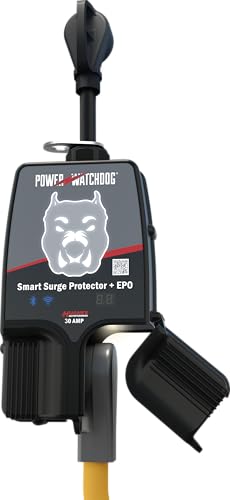
Hughes Autoformers Power Watchdog PWD30-EPO
This 30-amp Power Watchdog delivers the same Bluetooth app monitoring in a smaller footprint. Real-time voltage and amperage tracking flags miswired or unstable pedestal power as it happens. Cost sits below the 50-amp EMS units while covering identical core fault types.
Pros
- Lower cost than full 50-amp EMS models
- App alerts arrive without a separate display unit
- Small enough for an outside storage compartment
Cons
- 30-amp only, with no upgrade path to 50-amp
- App reliability depends on ongoing phone OS support

Southwire Surge Guard 44280
Full-time RVers at unfamiliar campgrounds get continuous protection from this 50-amp EMS. A digital display shows real-time voltage and amperage while a time-delay restart shields compressors from rapid cycling. Hardwired or plug-in mounting adapts to different rig setups.
Pros
- Time-delay restart protects air conditioner compressors
- Works hardwired or as a plug-in unit
- Full fault coverage suited to frequent site changes
Cons
- Hardwired install needs an electrician or RV tech
- Larger housing than portable-only units

Southwire Surge Guard 34930
Core fault protection comes without the app-connected EMS price tag in this 30-amp plug-in surge guard. A digital display shows voltage at a glance, confirming the pedestal is safe before appliances connect. No hardwired install is needed, since it plugs straight into the pedestal.
Pros
- Lower price than app-connected or hardwired EMS units
- Plug-in setup takes seconds at the pedestal
- Digital display confirms voltage before you connect
Cons
- No smartphone app or remote monitoring
- 30-amp only, not sized for larger rigs

Camco 55233 Power Defender
Moving between campgrounds suits this 50-amp portable surge protector better than staying mounted at one pedestal. A digital display reports voltage and fault status, and rugged housing withstands outdoor weather. Since it detaches rather than staying wired in, owners can bring it inside the RV overnight to deter theft.
Pros
- Detachable design allows overnight indoor storage
- Rugged housing holds up to outdoor exposure
- Simple plug-in setup at any 50-amp pedestal
Cons
- No app or wireless remote monitoring
- Easy to forget to bring in, unlike hardwired units
What matters most
What a digital surge protector actually checks Campground pedestals are not always wired correctly, even at established parks. A digital surge protector checks incoming power before any of it reaches your RV. It looks for open ground, open neutral, reverse polarity, and voltage outside a safe range. Automatic shutdown cuts power the moment it finds a fault, rather than letting bad wiring hit your panel. Live voltage readings on the display go beyond a simple pass or fail light.
Matching amperage: 30-amp vs 50-amp rigs Amperage must match your RV’s shore power cord, not the campground pedestal itself. Travel trailers and smaller motorhomes typically run 30-amp service. Larger fifth wheels and Class A motorhomes usually need 50-amp coverage. A mismatched unit simply will not connect, so check your power inlet before ordering. A properly sized EMS avoids the extra step of adapting between the two.
Full-time RVers face more wiring variety Owners who move sites every few weeks encounter more wiring problems than seasonal campers. Older parks and remote hookups carry a higher risk of miswiring or unstable voltage. Continuous monitoring from a hardwired or plug-in EMS catches these issues at each new stop. App or wireless remote alerts flag trouble without a trip outside to check the display. That convenience matters most for anyone changing pedestals weekly.
Stopping pedestal theft without losing protection Plug-in units left at the pedestal can attract theft at busy or unmonitored campgrounds. Portable models that detach and store inside overnight remove that risk completely. Some owners run a cable lock through a hardwired unit’s mounting bracket instead. Checking campground reviews for theft reports before booking adds another layer of caution. Either approach keeps protection active without leaving hardware exposed overnight.
The lineup, side by side
| # | Model | Amperage | Best for | Score | Price |
|---|---|---|---|---|---|
| 1 | Progressive Industries EMS-PT50X | 50A | Best overall | 9.4 | Check price |
| 2 | Progressive Industries EMS-PT30X | 30A | Best for 30-amp rigs | 9.1 | Check price |
| 3 | Hughes Autoformers Power Watchdog PWD50-EPO | 50A | Best for wireless app monitoring | 8.9 | Check price |
| 4 | Hughes Autoformers Power Watchdog PWD30-EPO | 30A | Best value | 8.6 | Check price |
| 5 | Southwire Surge Guard 44280 | 50A | Best for full-time RVers | 8.3 | Check price |
| 6 | Southwire Surge Guard 34930 | 30A | Best budget | 8.1 | Check price |
| 7 | Camco 55233 Power Defender | 50A | Best for theft-prone pedestals | 8.0 | Check price |
Common questions
How does a digital RV surge protector work?
It checks pedestal power for spikes, drops, and wiring faults before your RV connects. A fault triggers automatic shutdown. The digital display then shows the live voltage reading.
What is the difference between a surge protector and an EMS?
A basic surge protector only absorbs voltage spikes. An EMS also checks open ground, open neutral, reverse polarity, and abnormal voltage, then cuts power on any fault.
Which amperage do I need, 30-amp or 50-amp?
Match the unit to your RV’s shore power cord, not the pedestal. Most travel trailers run 30-amp. Larger fifth wheels and Class A motorhomes typically need 50-amp.
Can a surge protector prevent damage from a miswired pedestal?
Yes. EMS-level units detect open ground, open neutral, and reverse polarity, then cut power before it reaches your electrical system.
Is a portable surge protector as effective as a hardwired one?
Portable plug-in units cover the same core faults as hardwired models. Hardwired versions add permanent installation and often an interior display, while portable units trade that for quick setup and theft protection.
What does the digital display actually show?
Most digital models show live voltage and amperage, plus fault codes when a problem appears. Wireless remote versions move that readout inside the RV.
How do I stop someone from stealing my surge protector at a campground?
Pick a portable model you can detach and store inside overnight. A hardwired unit can be secured with a cable lock through its mounting bracket.
Can I monitor RV power remotely with an app?
Yes. Lines like the Hughes Autoformers Power Watchdog connect over Bluetooth to a phone app that shows live power data and fault history.
Is a digital surge protector worth it for occasional camping trips?
Occasional campers still benefit, since one miswired pedestal can damage electronics in a single stay. A basic plug-in model like the Southwire Surge Guard 34930 covers core faults at low cost.
Final word
Progressive Industries EMS-PT50X remains the strongest pick for 50-amp rigs, pairing full fault coverage with a wireless display that full-time RVers rely on daily. Owners running 30-amp trailers on a tighter budget should choose the Southwire Surge Guard 34930 instead, since it covers the same core wiring faults for less. Anyone wanting phone alerts without a wired remote fits better with the Hughes Autoformers Power Watchdog line.
Tony Russo
Tony trained as an automotive technician and spent years in service and parts retail before moving into writing. He focuses on garage tools, car care products and accessories from a hands-on maintenance perspective.

