How To Pick An RV Battery Monitor That Reads True Charge
Victron’s BMV-712 Smart leads this comparison through shunt-based accuracy paired with Bluetooth app history. Renogy’s 500A monitor delivers similar shunt accuracy at a lower cost for budget-focused owners. The Bogart TriMetric TM-2030-RV suits solar-heavy rigs that need deeper charge-history logging to judge panel performance over time.
Watching a dash voltage needle and hoping the battery still has charge left? Voltage swings with load and temperature, so it never reveals true usable capacity. Victron’s BMV-712 Smart solves that with a shunt that measures real amp-hour flow, best for owners who want Bluetooth history graphs, though it costs more than a basic gauge. Renogy’s 500A monitor brings similar shunt accuracy to tighter budgets. Solar-heavy rigs get more from the Bogart TriMetric’s deeper charge-history logging.
Comparing these monitors is tricky because every brand claims accuracy without defining how they tested it. We compared shunt rating, current sensing method and owner reports on drift and install difficulty to rank these seven.
Before you buy
Why a dash voltage gauge misleads RV owners Voltage reacts to load and temperature, so a battery under heavy draw can read low even with plenty of charge left, and one fresh off the charger can read artificially high. A shunt sits in the negative battery cable and measures actual current flow, which is what real state-of-charge math requires. A voltage gauge works for a rough glance, but only a shunt shows real usable capacity.
Bluetooth app monitors compared with wired display panels Victron’s BMV-712 and SmartShunt send readings and history graphs to a phone from anywhere near the rig. Wired panels like the Xantrex LinkLite or Bogart TriMetric need no phone at all, which suits guests unfamiliar with an app. Rigs with multiple drivers sometimes install both, a wired display for simplicity and Bluetooth for deeper history.
How to match shunt rating to your battery bank A 500A shunt covers most RV and van battery banks, including lithium setups running a large inverter. Smaller single-battery or starter setups can use a lighter shunt, like the 100A or 350A options some AiLi kits ship with. Undersizing a shunt against a large inverter’s peak draw produces inaccurate readings exactly when accuracy matters most.
What installing a shunt-based monitor actually involves Every monitor on this list requires wiring the shunt into the battery’s negative cable rather than simply tapping a voltage line. All load current passes through the shunt except a thin sense wire, so a wiring mistake throws off every reading afterward. Plan for an hour or two on a first install, longer if existing cabling needs rerouting.
Our top picks
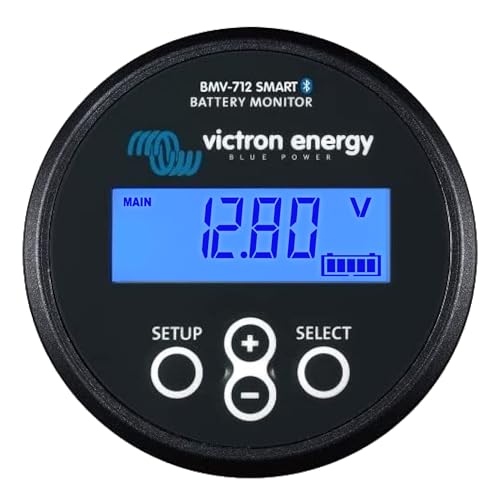
Victron Energy BMV-712 Smart Battery Monitor
A precision shunt reads current flowing both into and out of the battery, giving a state-of-charge number that voltage alone cannot match. Built-in Bluetooth pairs directly with the VictronConnect app, so history graphs need no extra dongle. Owners switching from a dash gauge often say this is the first reading that matched their battery’s real usable capacity.
Pros
- Shunt measurement tracks true state of charge, not just voltage
- VictronConnect app graphs charge and discharge history over time
- Firmware updates and support remain strong years after purchase
Cons
- Costs more than a basic voltage-only gauge
- Running shunt wiring intimidates first-time installers

Victron Energy SmartShunt 500A
No physical display sits on this unit, since every reading routes through Bluetooth straight to a phone. Panel space stays free in tight RV layouts where cutting a new hole is not an option. The same shunt hardware as the BMV-712 keeps accuracy identical between the two.
Pros
- Skips the panel cutout since there is no display to mount
- Matches BMV-712 accuracy using the same shunt design
- Two-wire installation keeps wiring simple
Cons
- A phone must be nearby to check any reading
- No standalone screen for guests or a quick glance
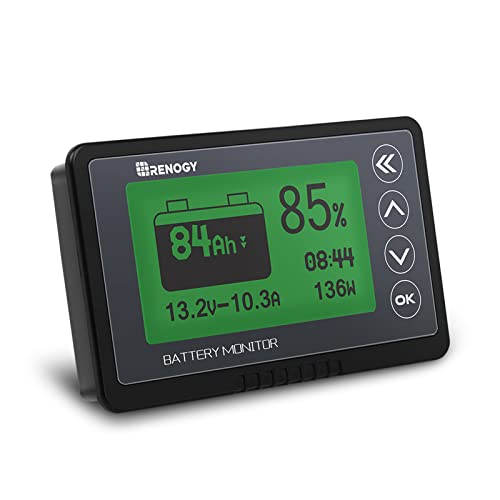
Renogy 500A Battery Monitor
Color LCD screen displays voltage, current and remaining amp-hours without needing a phone at all. Shunt-based sensing matches the core accuracy of pricier monitors while costing meaningfully less. Owners running Renogy solar charge controllers report smooth integration between the two systems.
Pros
- Costs less than premium shunt monitors from Victron
- Built-in display works without any app or phone
- Pairs cleanly with existing Renogy solar equipment
Cons
- App experience feels less refined than VictronConnect
- Fewer years of field data than established competitors
Bogart Engineering TriMetric TM-2030-RV Battery Monitor
Charge and discharge history logs in more depth here than on most competing monitors, useful for tuning a solar array over months. A separate shunt wires into the battery negative cable, the same method used across this list. Boondockers rely on it to confirm whether solar panels keep pace with daily power draw.
Pros
- Detailed logging helps diagnose underperforming solar arrays
- Long-standing reputation among off-grid and boondocking owners
- Rugged casing withstands rough travel over washboard roads
Cons
- No built-in Bluetooth or app on the base model
- Interface design looks dated next to newer screens

Xantrex LinkLite Battery Monitor
Voltage, current and amp-hours show on one clean screen, without menus to dig through for a basic reading. A shunt still handles the actual current sensing behind that simple display. Families handing the rig off to less technical drivers mention this as the easiest monitor to explain in one sentence.
Pros
- Minimal menu structure keeps the display easy to read
- Shunt-based sensing stays reliable without extra calibration steps
- Non-technical users pick up the interface almost immediately
Cons
- No Bluetooth or app option is available
- Logs fewer history data points than the TriMetric

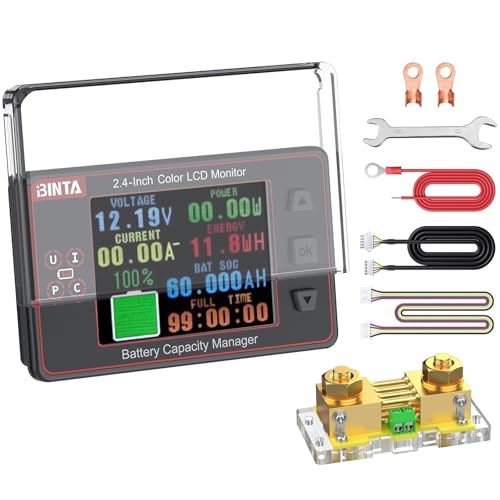
AiLi Battery Capacity Monitor
A small screen suits camper vans and single-battery banks where panel space runs short. Voltage, current and percentage capacity read through a compact shunt sized for lighter loads. Owners of smaller rigs point to the low cost as the main draw for a starter or single house battery.
Pros
- Compact size fits panels too small for larger monitors
- Percentage readout is simple to check at a glance
- Lower price than most shunt-based competitors here
Cons
- Lower current rating limits it to smaller battery banks
- Build quality varies more between individual units
Renogy One Core Battery Monitor
Core voltage and current tracking covers the essentials without extra app features layered on top. A real shunt drives the readings here, not a voltage estimate, despite the lower price than Renogy’s display model. First-time RV owners upgrading from a stock dash gauge mention it as an affordable starting point.
Pros
- Lowest price among the shunt-based monitors on this list
- Wiring stays straightforward for a first-time install
- Delivers accurate voltage and current readings without extras
Cons
- No Bluetooth or app connectivity is offered
- Basic screen skips the history graphs pricier units include
Compared at a glance
| # | Model | Shunt rating | Best for | Score | Price |
|---|---|---|---|---|---|
| 1 | Victron Energy BMV-712 Smart Battery Monitor | 500A, 50mV | Best overall | 9.4 | Check price |
| 2 | Victron Energy SmartShunt 500A | 500A, 50mV | Best for minimal panel space | 9.1 | Check price |
| 3 | Renogy 500A Battery Monitor | 500A | Best value | 8.8 | Check price |
| 4 | Bogart Engineering TriMetric TM-2030-RV Battery Monitor | Compatible with 500A shunt | Best for solar-heavy setups | 8.6 | Check price |
| 5 | Xantrex LinkLite Battery Monitor | 500A | Best for simple digital readout | 8.4 | Check price |
| 6 | AiLi Battery Capacity Monitor | Typically 100A or 350A depending on kit | Best for compact single-battery setups | 8.2 | Check price |
| 7 | Renogy One Core Battery Monitor | 500A | Best budget | 8.0 | Check price |
Frequently asked questions
What is the most accurate type of RV battery monitor?
Shunt-based monitors are the most accurate option, since they measure real current flow instead of estimating from voltage. Victron’s BMV-712 and SmartShunt get cited often for staying accurate and drift-free over years of daily use.
Do I really need a shunt for accurate battery monitoring?
Yes, for true state-of-charge tracking. Voltage-only monitors only estimate, since voltage moves with load and temperature independent of the battery’s actual remaining charge. A shunt wired into the negative cable is what makes amp-hour tracking possible.
Can one battery monitor work with both lithium and lead-acid batteries?
Most shunt-based monitors support either chemistry, but the state-of-charge calibration differs, since lithium holds a flatter voltage curve during discharge than lead-acid. Check the settings menu for a lithium profile before trusting the percentage readout.
Is Bluetooth monitoring worth paying extra for?
Bluetooth adds convenience by letting owners check charge status from inside the rig or across a campsite. It also usually unlocks history graphs for spotting charging problems. Accuracy itself comes from the shunt, so Bluetooth is a comfort feature rather than a requirement.
How do you install a shunt-based RV battery monitor?
The shunt wires directly into the battery’s negative terminal cable, carrying all load current, while a thin sense wire runs to the display or Bluetooth module. Most kits ship with the shunt, cabling and mounting hardware included. Basic comfort with 12V wiring helps, or a mobile RV technician can handle the install.
Why does my battery monitor show a percentage that seems wrong?
A calibration cycle usually fixes this. Fully charge the battery until the charger drops to float, then let the monitor reset itself to 100 percent. Peukert’s exponent and capacity settings also need to match the actual battery bank for the percentage to read correctly.
What size shunt does an RV battery monitor need?
Match the shunt to the highest expected current draw, not just total battery capacity. A 500A shunt covers the large majority of RV setups, including those running a big inverter. Smaller single-battery systems without a large inverter can use a lower-rated shunt instead.
Do digital battery monitors drain the battery they are monitoring?
They draw a small amount of current to operate, usually a few milliamps, which is negligible against a house battery bank. A backlit display left on constantly draws more, so many owners set an auto-dim or auto-off timer in the menu.
Which RV battery monitor works best without a smartphone?
The Xantrex LinkLite and Renogy 500A both use a wired physical display, so nothing depends on pairing a phone. That makes them a better fit for guests or less technical drivers who just want a number on a screen.
Best RV battery monitor for solar-heavy setups?
The Bogart TriMetric TM-2030-RV logs charge and discharge history in more depth than most competitors, which helps confirm whether solar panels keep pace with daily power use in an off-grid rig.
Our take
Owners done guessing at remaining charge should install the Victron BMV-712 Smart, since its shunt and Bluetooth app combination gives the clearest true reading available here. Buyers who want the same shunt accuracy without the premium price can choose the Renogy 500A monitor instead. Off-grid rigs leaning heavily on solar get more long-term value from the Bogart TriMetric’s deeper charge-history logging, while anyone on a tight budget and comfortable skipping an app should look at the Renogy One Core.
Tony Russo
Tony trained as an automotive technician and spent years in service and parts retail before moving into writing. He focuses on garage tools, car care products and accessories from a hands-on maintenance perspective.