Digital Tire Pressure Gauges for Home Garages
JACO ElitePro takes first place for home garages, pairing a stated accuracy of 1 percent with a swivel chuck that seals on recessed alloy valves. AstroAI 150 PSI covers trucks and trailers for less outlay. Accutire MS-4021B stays the easiest gauge to keep in a glovebox and read at night.
JACO ElitePro is the gauge to keep on the garage wall. Its stated 1 percent accuracy, rubber guard and angled swivel chuck make monthly checks quick on cars and light trucks. Its 100 PSI ceiling rules out heavy truck and RV work, which is the one real limit.
Digital gauges vary in the details that matter: how the chuck seats, whether the display lights up, and how much air escapes each reading. We compared stated accuracy, pressure range, chuck style, backlight and shutoff behaviour across current Amazon listings. Owner reports on drifting readings and battery access separated the close finishers.
The shortlist, ranked

JACO ElitePro Digital Tire Pressure Gauge
A 45 degree swivel chuck reaches valve stems behind alloy spokes without bending the stem. The listing states accuracy within 1 percent, which is tighter than most consumer gauges claim. A rubber sleeve absorbs the drops that eventually kill bare plastic bodies.
Pros
- Angled chuck seats cleanly on recessed valve stems
- Lighted nozzle helps in a dark driveway
- Rubber guard survives dropping on concrete
Cons
- 100 PSI ceiling is short for heavy truck tires
- Larger than pocket sized gauges

AstroAI Digital Tire Pressure Gauge 150 PSI
Its 150 PSI range covers passenger cars, pickups and utility trailers from one tool. Four unit modes switch between PSI, BAR, KPA and kg/cm2 for imported vehicles and bicycles. The plastic body is light, so store it in a drawer rather than a toolbox tray.
Pros
- Single gauge covers cars, trucks and trailers
- Four unit modes suit imported vehicle placards
- Auto shutoff preserves the battery
Cons
- Plastic housing feels less solid than metal bodied rivals
- Straight chuck struggles on deeply recessed stems

Accutire MS-4021B Digital Tire Gauge
This pistol shaped gauge has been a parts store staple for years and reads in 0.5 PSI steps. Its angled head fits most car valve stems and the rubber coating keeps it from sliding off a seat. Battery replacement needs a small screwdriver.
Pros
- Fits a glovebox or door pocket easily
- Simple one button operation
- Clear digits in low light
Cons
- Screwdriver needed to change the battery
- No pressure release valve for bleeding air

Rhino USA Heavy Duty Digital Tire Pressure Gauge
Solid brass internals and a rubber armoured shell suit a garage where tools land on concrete. A wide LED backlight plus a lighted nozzle make night checks straightforward. Its 75 PSI ceiling covers cars and most light trucks, but not commercial rigs.
Pros
- Rubber armour handles drops onto concrete
- Bright backlight and nozzle light for night use
- Ergonomic grip works with gloves on
Cons
- 75 PSI range excludes RV and trailer tires rated higher
- Heavier than pocket gauges
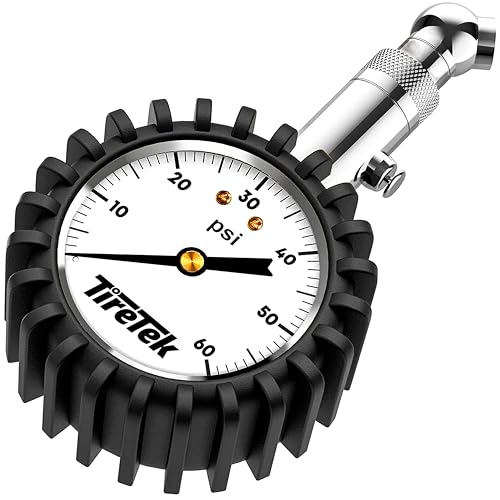
TireTek Digital Tire Pressure Gauge
A 150 PSI span means one gauge serves a pickup, a boat trailer and a camper. The dual angled chuck seats on inner and outer wheels of dual rear axle trucks. Readings settle a beat slower than the JACO, so hold the chuck steady.
Pros
- Reaches inner wheels on dual rear axle pickups
- Wide range suits trailers and campers
- Coin cell swaps without tools
Cons
- Takes an extra moment to settle on a reading
- Bulky for in car storage

Slime 20017 Digital Tire Gauge
One tool moves between a car, a mower and a bike, since the range starts at 5 PSI and runs to 150. Its lighted tip lines up with valve stems tucked behind brake calipers. Presta valves still need an adapter, which is not included.
Pros
- Low start point suits mower and wheelbarrow tires
- Lighted tip helps behind brake calipers
- Compact enough for a bike bag
Cons
- Presta valve adapter sold separately
- Straight chuck needs a steady hand on angled stems

TEKTON 5941 Digital Tire Gauge
Nothing here beyond a clear reading, which is the point at this level. A lighted display and a straight chuck handle standard passenger car stems. Range tops out at 100 PSI, so trailer owners should look higher up this list.
Pros
- Simple to hand to anyone in the household
- Lit display readable at night
- Small enough for a door pocket
Cons
- No swivel chuck for recessed stems
- Plain plastic body with no protective sleeve
How they stack up
| # | Model | Range | Best for | Score | Price |
|---|---|---|---|---|---|
| 1 | JACO ElitePro Digital Tire Pressure Gauge | 0 to 100 PSI | Best overall | 9.4 | Check price |
| 2 | AstroAI Digital Tire Pressure Gauge 150 PSI | 0 to 150 PSI | Best value | 9.2 | Check price |
| 3 | Accutire MS-4021B Digital Tire Gauge | 5 to 150 PSI | Best for the glovebox | 9.0 | Check price |
| 4 | Rhino USA Heavy Duty Digital Tire Pressure Gauge | 0 to 75 PSI | Best build quality | 8.8 | Check price |
| 5 | TireTek Digital Tire Pressure Gauge | 0 to 150 PSI | Best for trucks and trailers | 8.6 | Check price |
| 6 | Slime 20017 Digital Tire Gauge | 5 to 150 PSI | Best for mixed vehicles | 8.3 | Check price |
| 7 | TEKTON 5941 Digital Tire Gauge | 0 to 100 PSI | Best budget | 8.0 | Check price |
What matters most
What to look for in a digital tire pressure gauge Accuracy claims come first. Look for a stated tolerance, ideally around 1 percent, rather than vague wording. Range should clear the highest pressure you check by a comfortable margin, since gauges are least accurate at the top of their span. Chuck design decides whether you can even reach the valve, so angled or swivel heads matter on alloy wheels. A backlight and a lighted nozzle turn a frustrating night check into a thirty second job.
Matching range to what you actually inflate Passenger cars usually sit between 30 and 36 PSI, which any gauge here covers. Light truck and SUV tires reach the mid 40s when loaded. Utility trailers, campers and boat trailers often run 50 to 80 PSI, and some LT tires are rated higher still. AstroAI 150 PSI and TireTek Digital cover those without strain, while Rhino USA stops at 75 PSI. Bicycle road tires sit above most car gauges, so check the top of the range before buying one tool for both.
Checking pressure correctly in a home garage Read pressures cold, before driving, because rolling heat adds several PSI. Press the chuck straight onto the stem in one motion, since a partial seal hisses and reads low. Compare the result to the placard inside the driver door, not the number moulded into the tire sidewall. Repeat the reading once to confirm. Keep a gauge in the garage and a second in the car, which is where compact picks like the Accutire MS-4021B earn their place.
Digital or dial: which suits your garage Digital gauges resolve to half a PSI and light their own display, which matters at 6am on a dark driveway. Dial gauges need no battery and shrug off drops, though they are harder to read precisely. For most home garages a digital unit like the JACO ElitePro is the better daily tool, with a dial gauge as a backup. Anyone storing a vehicle for months should keep a dial gauge in the boot, since a coin cell can die unnoticed.
Questions worth asking
How accurate are digital tire pressure gauges?
Consumer models typically claim within 1 to 2 percent. JACO ElitePro states 1 percent, which is among the tighter figures on the consumer market.
What PSI should my tires be?
Use the placard on the driver door jamb or in the owner manual. The number on the tire sidewall is the maximum the tire can hold, not the pressure the vehicle needs.
Are digital tire gauges better than dial gauges?
Digital gauges read to half a PSI and light up, which helps in dim garages. Dial gauges never need a battery, so many owners keep one of each.
Can one gauge cover a car, a trailer and a bike?
A 150 PSI model such as the AstroAI or the Slime 20017 comes closest. Road bicycle tires can exceed that, and Presta valves need an adapter.
Should I check tire pressure hot or cold?
Cold, meaning before driving or at least three hours after. Heat from rolling adds roughly 3 to 5 PSI and will make an underinflated tire look correct.
Why does my gauge read differently to the gas station?
Public air machines see heavy use and are rarely recalibrated. A protected home gauge such as the Rhino USA is usually the more reliable of the two.
How often should tire pressure be checked?
Monthly, plus before any long trip. Tires lose roughly one PSI a month naturally, and more as outside temperatures fall.
Do digital tire gauges need calibration?
They cannot usually be recalibrated at home. Replace the battery when readings wander, then compare against a second gauge to confirm the unit is still trustworthy.
The bottom line
JACO ElitePro is the gauge to buy for a home garage, thanks to its stated 1 percent accuracy, swivel chuck and rubber armour. Owners towing a camper or trailer should choose the AstroAI 150 PSI or TireTek instead, since both clear the higher pressures those tires need. Keep the compact Accutire MS-4021B in the car so a slow leak never goes unchecked on a trip.
Tony Russo
Tony trained as an automotive technician and spent years in service and parts retail before moving into writing. He focuses on garage tools, car care products and accessories from a hands-on maintenance perspective.


