How to Choose a Die Grinder for Metalwork and Detailing
Makita’s GD0601 is the corded workhorse for steady bench and fabrication work. DEWALT’s DCG426B is the most practical cordless option for site use. Ingersoll Rand’s 301B remains the classic air grinder for shops already running a compressor. Power source matters more than brand here.
Makita’s GD0601 does the most with the least fuss for general fabrication and metalwork. DEWALT’s DCG426B frees you from an outlet for site use, and Ingersoll Rand’s 301B remains the long standing air option for shops with a compressor already running. Milwaukee’s M12 and M18 FUEL grinders cover tight access and higher cordless power respectively.
Die grinder shopping really comes down to power source, and each option carries a trade felt every day. Air tools stay light, cheap and small but only perform as well as the compressor behind them. Corded grinders run indefinitely at consistent speed but tether you to an outlet, while cordless models add battery weight right where control matters most. We compared free speed, collet sizes, air consumption in cubic feet per minute, body diameter and switch type, plus what owners report about vibration and runtime.
Before you buy
Air, corded or cordless: how to choose Air grinders stay the lightest and smallest for a given power output and cost the least upfront, but they demand a compressor supplying roughly 4 to 6 cubic feet per minute continuously, more than many home units deliver. Corded electric grinders run indefinitely at consistent speed with no air supply worries, at the cost of dragging a cable around. Cordless models have closed most of the performance gap and excel at site work and vehicle repair, though the battery adds weight exactly where precision matters. Base the choice on what infrastructure is already in the shop.
Matching speed and collet size to the accessory Most die grinders spin around 22,000 to 25,000 rpm free speed, suiting carbide burrs and small mounted stones. What trips people up is the accessory rating: every burr, stone and wire wheel carries a maximum safe rpm, and exceeding it risks the accessory coming apart. Variable speed tools earn their premium with wire wheels, larger sanding drums and plastics, all of which want lower speeds. Check whether a tool ships with both 1/4 inch and 1/8 inch collets, since many smaller burrs need the latter.
Ergonomics, vibration and switch type A die grinder gets held like a pen for long stretches, so barrel diameter and balance matter more than on a bigger tool. Slimmer bodies stay easier to control for detail work, while larger ones absorb more vibration. Switch design carries real safety weight: paddle switches stop the tool instantly on release, while slide and lever switches can stay on if the tool gets dropped. Extended sessions with any high speed rotary tool call for attention to hand arm vibration exposure and regular breaks.
Air supply, maintenance and safe operation Going the air route means sizing the compressor for continuous duty rather than peak output, adding a water separator, and using an inline oiler unless the tool is specified oil free. Neglected air tools fail from moisture and grit long before they wear out mechanically. Eye protection rated for impact matters regardless of power source, since burr fragments leave at high speed, and overhead work calls for a face shield too. Hearing protection matters as well, since most of these tools sit well above safe prolonged exposure levels.
What we recommend

Makita GD0601 1/4-Inch Die Grinder
Makita’s GD0601 shows up in most working shops for good reason, pairing a slim barrel with a 3.5 amp motor that holds speed under load. A slide switch stays easy to operate with gloves on, and labyrinth construction keeps grinding dust out of the bearings. Owners report years of service with nothing more than the occasional brush change.
Pros
- Holds speed under load better than most rivals
- Slim barrel stays comfortable through long sessions
- Sealed construction resists grinding dust
Cons
- Corded design limits reach on job sites
- No variable speed control
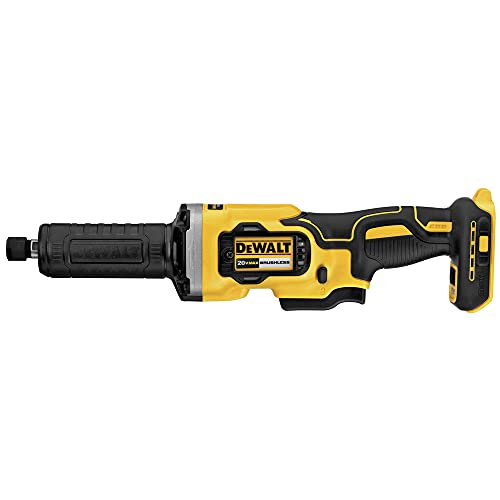
DEWALT DCG426B 20V MAX XR Cordless Die Grinder
A brushless motor and paddle switch bring real capability to DEWALT’s cordless platform, useful for site work, vehicle repair and anywhere a cord gets in the way. Letting go of the paddle stops the tool instantly, a meaningful safety feature at 25,000 rpm. Runtime, based on specifications, becomes the main constraint during sustained work.
Pros
- Complete freedom from cords and air hoses
- Paddle switch stops the tool the instant you release
- Brushless motor extends both runtime and lifespan
Cons
- Sold as a bare tool without a battery included
- Battery pack adds weight and bulk to the grip

Ingersoll Rand 301B Air Die Grinder
Ingersoll Rand’s 301B has been the default shop air grinder for decades, staying light, small and simple enough to rebuild with a kit rather than replace. Free speed of 25,000 rpm handles deburring, porting and weld cleanup well, provided the compressor keeps pace. Owners report air supply limits the tool far more often than the tool itself does.
Pros
- Very light and compact in the hand
- Rebuildable design instead of disposable construction
- Generates no motor heat during extended sessions
Cons
- Requires a compressor sized for continuous duty
- Needs inline oiling and moisture control to last

Milwaukee 2485-20 M12 FUEL Die Grinder
Milwaukee’s M12 FUEL grinder stays remarkably small for a cordless tool, ideal for reaching inside an engine bay or a tight weldment. Variable speed lets you dial back for carbide burrs and wire wheels. Based on specifications, it trades some raw power for access, and that trade often pays off.
Pros
- Fits spaces larger grinders cannot reach
- Variable speed suits burrs and wire wheels alike
- Ships with both 1/4 inch and 1/8 inch collets
Cons
- Less power available for heavy stock removal
- Small batteries need frequent swapping during long jobs

Milwaukee 2836-20 M18 FUEL 1/4 in. Die Grinder
The M18 version steps up to genuinely corded-equivalent power, with variable speed and a brushless motor that holds rpm under load. Sustained metal removal suits this grinder better than occasional touch up work. Owners report it runs noticeably larger and heavier than the M12, an expected trade for the added power.
Pros
- Cordless power that rivals a corded tool
- Variable speed spans a genuinely useful range
- Holds rpm well as the burr loads up
Cons
- Bulkier in hand than compact grinders
- Battery and charger are separate purchases

Astro Pneumatic Tool 219 Mini Die Grinder
Astro’s mini air grinder is built around access, pairing a slim body with a small head that reaches spots a full sized tool cannot. Detail work, deburring and porting suit it well as a second grinder in the kit. Based on specifications, it stays a light duty tool best treated as a precision instrument rather than a stock remover.
Pros
- Slim body reaches confined areas easily
- Inexpensive addition to an existing air tool set
- Light enough for long detail sessions
Cons
- Not built for heavy stock removal
- Build quality trails premium air tools

DEWALT DWMT70783 Air Die Grinder
DEWALT’s air grinder covers everyday shop jobs like weld cleanup, deburring and light porting, with a composite housing that stays comfortable in cold weather. A safety lever guards against accidental starts. Owners report it suits a home garage well rather than a production floor.
Pros
- Composite housing stays comfortable in cold conditions
- Safety lever throttle reduces accidental starts
- Solid value for occasional shop use
Cons
- Lower free speed than premium air grinders
- Still demands a properly sized compressor
How they compare
| # | Model | Power source | Best for | Score | Price |
|---|---|---|---|---|---|
| 1 | Makita GD0601 1/4-Inch Die Grinder | Corded, 3.5 amp motor | Best overall | 9.4 | Check price |
| 2 | DEWALT DCG426B 20V MAX XR Cordless Die Grinder | 20V MAX battery, brushless | Best cordless | 9.2 | Check price |
| 3 | Ingersoll Rand 301B Air Die Grinder | Air, 90 psi | Best air tool | 9.0 | Check price |
| 4 | Milwaukee 2485-20 M12 FUEL Die Grinder | M12 battery, brushless | Best for tight spaces | 8.8 | Check price |
| 5 | Milwaukee 2836-20 M18 FUEL 1/4 in. Die Grinder | M18 battery, brushless | Best cordless power | 8.6 | Check price |
| 6 | Astro Pneumatic Tool 219 Mini Die Grinder | Air, 90 psi | Best budget air tool | 8.3 | Check price |
| 7 | DEWALT DWMT70783 Air Die Grinder | Air, 90 psi | Best value air tool | 8.0 | Check price |
Good to know
What is a die grinder used for?
Deburring metal, cleaning up welds, porting cylinder heads, enlarging holes, shaping wood and removing rust in confined areas all fall to a die grinder. It is essentially a high speed rotary tool sized for metalworking, running carbide burrs, mounted stones, sanding drums and small cutoff wheels.
How much air does a die grinder actually need?
Expect around 4 to 6 cubic feet per minute at 90 psi for continuous use. Many small home compressors cannot sustain that output, which shows up as the tool slowing under load. Check a tool’s rated consumption against your compressor’s continuous output rather than its peak figure.
Are cordless die grinders powerful enough for real work?
Modern brushless models are, for most tasks. An M18 or 20V class grinder handles sustained metal removal well, while compact 12V tools trade power for access. Runtime remains the practical limit, so keep spare batteries on hand for continuous jobs.
Die grinder vs angle grinder: what’s the difference?
A die grinder spins small accessories at very high speed for precise shaping and deburring. An angle grinder spins large discs at lower speed for cutting and heavy stock removal. Think of them as complementary tools rather than substitutes for each other.
Can a Dremel replace a die grinder?
For light work on wood, plastic and small hobby projects, often yes. Sustained metal removal calls for a die grinder’s greater torque, sturdier bearings and stiffer spindle. Rotary hobby tools tend to bog down and overheat on work a die grinder handles with ease.
Which collet size do I actually need?
One quarter inch covers most die grinder burrs and mounted stones. An eighth inch collet opens up smaller detail burrs and many hobby accessories. Tools that include both collet sizes offer the most flexibility, and adapters exist for tools that ship with only one.
What safety gear should I wear with a die grinder?
Impact rated eye protection is the minimum, with a face shield added for overhead or heavy work since burr fragments travel fast. Hearing protection, snug gloves that will not catch in the spindle, and a respirator for coated or galvanized material round out the setup.
Why do burrs chatter during use?
Chatter usually points to too much pressure, the wrong speed, or a dull burr. Let the burr do the work with light pressure, keep the tool moving, and match speed to the accessory being used. A carbide burr with loaded flutes chatters too, so clean it with a brass brush regularly.
Is a cordless or air die grinder better for automotive work?
Cordless grinders win for automotive work since there is no hose to drag around a vehicle or drop into an engine bay. Air tools still make sense in a fixed shop bay with a compressor already piped in nearby.
Our take
Makita’s GD0601 suits anyone who wants one grinder that simply works day after day near an outlet. DEWALT’s DCG426B fits vehicle work and job sites where cords are impractical, worth the battery weight for real freedom. Ingersoll Rand’s 301B remains the lightest, most repairable choice when a properly sized compressor is already running.
Jake Monroe
Jake worked as a residential contractor for over a decade before shifting to full-time writing. He evaluates power tools, hand tools and workshop gear through the lens of someone who has actually used them on job sites, not just read the box.