Cricket Bats That Balance Power and Control at the Crease
SS Ton Player Edition ranks as the top cricket bat overall, pairing Grade 1 English willow with a balanced pickup that suits all-format batting. Kookaburra Ghost Pro delivers more power for aggressive hitters, while SG Cobra Xtreme offers durable Kashmir willow at a lower outlay for newer players building technique.
SS Ton Player Edition suits most club batters who need a bat that works across every format, without the specialised power bias of heavier blades. Kookaburra Ghost Pro rewards players who hit through the line and want extra mass behind the shot. SG Cobra Xtreme covers beginners and juniors who need durable Kashmir willow before committing to English willow spending.
Two numbers on a listing, willow grade and weight, rarely explain how a bat actually feels in hand. Balance point, spine height and edge thickness shift the pickup more than a few grams ever could. We compared willow grade and grain, weight range, edge profile, handle construction and what owners report after knocking each bat in.
What matters most
What does willow grade actually mean? English willow is graded from Grade 1 down to Grade 4 based on appearance and grain straightness. More, straighter grains generally signal a cleaner, more responsive blade. Kashmir willow is a different species altogether, denser, heavier and less springy, but noticeably tougher. Grade affects feel and performance, not legality, so a Grade 3 English bat can still outperform a top Kashmir blade.
How much does pickup matter compared to weight? Two bats at an identical stated weight can feel completely different in hand. Mass distribution decides that, not the number on the label. A high spine paired with a low sweet spot feels heavier than a balanced blade of the same weight. Shadow-batting in a shop, when possible, reveals more than any spec sheet. Buying online favors makers known for balance, such as Gray-Nicolls, when the weight range sits at the upper end.
How do you knock in a new cricket bat? A new English willow bat needs several hours of mallet work, starting gently on the edges and face before building up pressure. Old balls in the nets should follow once the surface hardens. Skipping this step risks cracking on the first serious hit. Kashmir willow bats, including the SG Cobra Xtreme, need far less preparation, which explains their appeal for juniors.
Which sweet spot suits your home pitch? Low, slow pitches favor bats with a low sweet spot, since the ball often arrives around ankle height. Hard, bouncy tracks reward a higher sweet spot, like the one on the MRF Genius Grand Edition. Mid sweet spot bats, such as the SS Ton Player Edition, remain the safer choice across a season of varied grounds. Surface familiarity, more than any single spec, should guide this decision.
The top picks, ranked

SS Ton Player Edition English Willow Cricket Bat
Grade 1 English willow gives this blade straight, tight grains and a mid blade sweet spot. Despite thick edges, the pickup stays light enough for quick bat speed. Owners report it needs proper knocking in, but the payoff is a responsive middle across formats.
Pros
- Light pickup despite thick edges
- Handles both front foot and back foot shots
- Straight-grain Grade 1 willow construction
Cons
- Requires thorough knocking in before match use
- Costs more than Kashmir willow alternatives

Kookaburra Ghost Pro English Willow Cricket Bat
A pronounced spine and heavy edges push the sweet spot lower on this blade, matching players who hit through the line. Kookaburra’s white face graphic makes it easy to spot in a kit bag. Based on specifications, the Ghost Pro trades the SS Ton’s light pickup for extra mass behind the shot.
Pros
- Large hitting area through the middle of the bat
- Strong on pull shots and drives
- Durable face graphic protects against surface wear
Cons
- Feels heavier in hand than the SS Ton
- Lower sweet spot suits back foot batters less

Gray-Nicolls Vapour English Willow Cricket Bat
Gray-Nicolls built the Vapour range around balance rather than bulk. That suits technically orthodox batters who play the ball late and rely on timing. English willow versions carry a lower outlay than the maker’s flagship models, and owners report an easy pickup for players stepping up from a starter bat.
Pros
- Light, balanced pickup
- Rewards timing-based, orthodox technique
- More accessible entry into English willow
Cons
- Less raw power than heavier profiles
- Grain count varies between individual bats

MRF Genius Grand Edition English Willow Cricket Bat
MRF’s Genius range carries a reputation for classical stroke play, and the Grand Edition keeps a traditional profile. A slightly higher sweet spot helps on bouncier surfaces. Shot placement matters more than raw force here, and owners report consistent finish and pressing quality across the range.
Pros
- Higher sweet spot suits bouncy pitches
- Traditional profile rewards clean technique
- Consistent pressing quality reported by owners
Cons
- Edges are not the thickest in this group
- Less forgiving on low, slow pitches

New Balance DC 480 Kashmir Willow Cricket Bat
Kashmir willow makes the DC 480 denser and less springy than English willow, but far more tolerant of hard balls and rough handling. It arrives close to match-ready, which suits juniors and casual players unwilling to spend two weeks knocking in a bat. Sizing runs down through junior specifications as players grow.
Pros
- Minimal preparation needed before play
- Junior sizes available for growing players
- Tolerant of rough school and club conditions
Cons
- Less responsive off the bat than English willow
- Feels heavier in hand than its stated weight

SG Cobra Xtreme Kashmir Willow Cricket Bat
Durability explains why the Cobra Xtreme sells in high volume as an entry bat. Kashmir willow, a reasonable profile and a fitted toe guard come at a modest outlay. It suits someone playing a handful of matches a season, and owners report it holds up under regular leather ball club cricket.
Pros
- Leather ball capable at a modest outlay
- Toe guard fitted from new
- Durable under regular practice sessions
Cons
- Noticeably less rebound than English willow
- Pickup feels heavier than the weight suggests
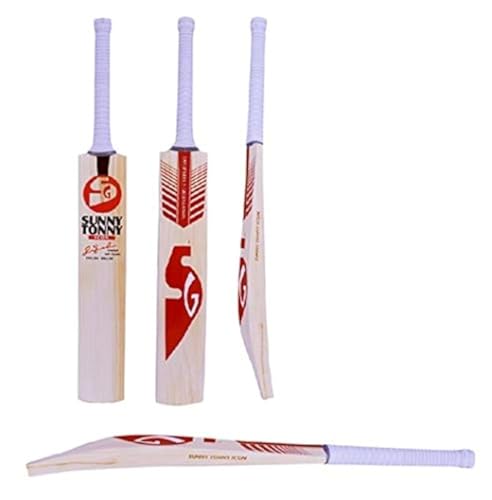
SG Sunny Tonny Kashmir Willow Cricket Bat
Park cricket, tape ball games and net sessions call for a bat you will not worry about damaging, and the Sunny Tonny fills that role. Stiff and heavy for its size, it holds up well under casual, repeated use. Flagship performance is not the goal here, but as a spare bat that lives in the car, it earns its keep.
Pros
- Extremely durable under casual, repeated use
- Lowest outlay in this comparison
- Doubles well as a spare or net bat
Cons
- Not built for serious match cricket
- Rebound is dull compared with English willow
How they stack up
| # | Model | Willow | Best for | Score | Price |
|---|---|---|---|---|---|
| 1 | SS Ton Player Edition English Willow Cricket Bat | Grade 1 English willow | Best overall | 9.4 | Check price |
| 2 | Kookaburra Ghost Pro English Willow Cricket Bat | English willow, Grade 1 on Pro versions | Best for power hitting | 9.2 | Check price |
| 3 | Gray-Nicolls Vapour English Willow Cricket Bat | English willow, grade varies by model | Best value in English willow | 9.0 | Check price |
| 4 | MRF Genius Grand Edition English Willow Cricket Bat | English willow | Best for stroke play | 8.8 | Check price |
| 5 | New Balance DC 480 Kashmir Willow Cricket Bat | Kashmir willow | Best for juniors and beginners | 8.6 | Check price |
| 6 | SG Cobra Xtreme Kashmir Willow Cricket Bat | Kashmir willow | Best budget | 8.3 | Check price |
| 7 | SG Sunny Tonny Kashmir Willow Cricket Bat | Kashmir willow | Best for tape ball and casual games | 8.0 | Check price |
Questions worth asking
English willow vs Kashmir willow: which is better?
English willow weighs less for its size and rebounds better off the bat, so regular leather ball players usually prefer it. Kashmir willow is heavier, stiffer and considerably tougher, and it costs less, which makes it the practical pick for juniors, beginners and casual tape ball games.
How much does grain count matter on a cricket bat?
Grain count offers a rough guide to how a bat will perform over time. Six to twelve straight grains sits in the usual range. Fewer grains often means a slower start but a longer life, while more grains can mean quicker performance and a shorter one. Grain count alone never decides overall quality.
What weight cricket bat should I use?
Most adult club players do well with a bat between 2lb 8oz and 2lb 11oz. Hold it out in front of you, one handed, for a few seconds, then try a controlled straight drive. If a heavier bat slows your bat speed noticeably, the extra mass is not worth the trade.
How long does knocking in a cricket bat take?
Plan on six to eight hours of mallet work across several sessions for a Grade 1 English willow bat. Follow that with a couple of net sessions using old balls before any match use. Pre-prepared bats shorten this process, though extra work on the edges and toe still helps.
Do I need bat tape or a face protector?
An anti-scuff face sheet and edge tape cost little and extend the life of an English willow bat, especially where cracking tends to start. A toe guard matters just as much, since moisture damage at the toe ends more bats than impact ever does.
Are thicker edges always better on a cricket bat?
Not necessarily. Thick edges add hitting area, but they also add mass, and a bat you cannot swing quickly loses that advantage. Manufacturers scoop the back of the blade to offset the weight, though there is a limit to how far that helps. Pickup should come first, with edge size as the tiebreaker.
How do I stop a cricket bat from cracking?
Knock the bat in fully before match use, and keep it away from damp conditions and extreme heat. Avoid hard new balls in early sessions, and oil sparingly with raw linseed oil unless the face is pre-sealed. Small surface cracks are normal and usually repairable with glue and a clamp.
What size cricket bat does a junior need?
Junior sizes run from size 1 up through Harrow, chosen by height rather than age. As a rough guide, the handle should reach around hip height when the bat stands upright beside the player. The New Balance DC 480, sold in junior sizes, makes this sizing process easier than adapting an adult bat.
How do I know if a cricket bat’s pickup suits me?
Pickup depends on where the weight sits, not just the total figure on the label. A bat that feels light when swung through a shadow shot, despite a higher stated weight, usually has better balance. Testing a straight drive and a pull shot in store reveals more than the spec sheet alone.
Our take
SS Ton Player Edition remains the most complete bat here for regular club cricket, pairing thick edges with a pickup that does not cost bat speed. Power hitters should look at the Kookaburra Ghost Pro, while orthodox, timing-based batters fit better with the Gray-Nicolls Vapour. Juniors and newcomers get more value from the SG Cobra Xtreme or the New Balance DC 480 while technique is still developing.
Derek Holt
Derek has a background coaching recreational and amateur athletes and has worked the sales floor at specialty fitness retailers. He focuses on equipment durability, ergonomics and realistic use cases rather than marketing claims.


