Which countertop water dispenser suits your kitchen?
Avalon’s A5 bottleless cooler leads here. It plumbs into a cold line, so deliveries and lifting stop. Where specific contaminants worry you, AquaTru’s countertop reverse osmosis purifier reduces more and publishes its certifications. Small kitchens that run on tea suit the Waterdrop N1, which heats to preset temperatures on demand.
Buy the Avalon A5 Countertop Self-Cleaning Bottleless Water Cooler if a cold water line runs within reach of the worktop. Water is drawn from the supply, filtered in two stages and chilled or heated on demand. An ozone cycle sanitises the tank on a timer. Installation is the limit, since a tee fitting has to go in under the sink.
Three very different machines share the countertop dispenser label, and their filtration claims rarely compare like for like. We compared filter stages, published NSF and ANSI certifications, hot and cold capacity, footprint and installation demands. Owner reports on leaks, drip tray height and cartridge availability settled the close calls.
How to choose
What to look for in a countertop water dispenser Start with the water source, because it sets everything else. Bottle-fed coolers need storage for spares and someone able to lift them. Bottleless units need a cold line and a tee fitting. Countertop reverse osmosis sits between the two and fills from any tap. After that, measure counter depth against the body plus its rear tank or bottle collar. Check drip tray height against your tallest mug. Last, confirm replacement cartridges are still stocked for that exact model, since a discontinued filter turns a working machine into scrap.
Bottle-fed vs bottleless vs countertop reverse osmosis Bottle-fed coolers such as the Brio, Primo and Igloo move house easily and need no tools. Deliveries and the overhead lift are their running cost. Bottleless models like the Avalon A5 delete both, then tie the machine to one spot near plumbing. Reverse osmosis units from AquaTru and Waterdrop filter deepest without touching a pipe, at the cost of waste water you empty by hand. Lightest touch of all is a carbon system like the Brita Hub, which improves taste and chlorine while leaving minerals alone. Pick by which chore you mind least.
Hot and cold output, and the safety locks that matter Hot tanks on bottle-fed coolers usually land between 185F and 200F. That brews black tea acceptably and sits short of a rolling boil. Green tea wants closer to 175F, which is where preset heaters like the Waterdrop N1 pull ahead of guesswork with a kettle. Cold tanks matter in a different way: recovery time decides whether the second glass is still cold. Every hot tap in this group has a lock or catch, and it should stay engaged in any home with small children. If a full boil is non-negotiable for your brewing, keep the kettle and buy the dispenser for volume.
Best for small kitchens, offices and rented flats Counter depth is the real constraint in a small kitchen. Measure wall to edge, then subtract several inches for the rear fill tank or bottle collar. Renters should skip the plumbed Avalon and take the AquaTru or Waterdrop, since neither touches the plumbing and both pack back into a box. Offices are the opposite case: a 5 gallon bottle-fed cooler beats refilling a tank by hand thirty times a day. Hard water areas add one more job, because hot tanks scale up whatever filter sits upstream. Budget for descaling every few months and the machine lasts years longer.
The best picks, ranked
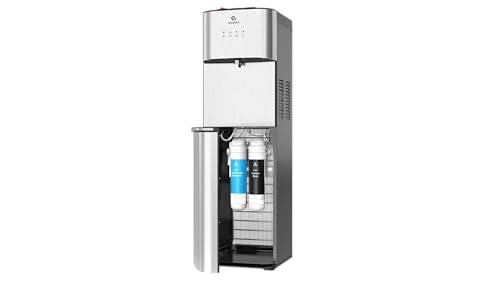
Avalon A5 Countertop Self-Cleaning Bottleless Water Cooler
Water comes straight off a cold supply line, so nothing needs lifting or reordering. Two stages handle sediment first, then taste and chlorine. An ozone cycle sanitises the internal tank without any disassembly, and a child lock sits on the hot tap.
Pros
- No bottles to lift, store or reorder
- Ozone cycle cleans the tank without disassembly
- Child lock fitted to the hot tap
Cons
- Needs a water line and a tee fitting to install
- Not portable once plumbed in

AquaTru Countertop Reverse Osmosis Water Purifier
Four reverse osmosis stages sit inside a sealed countertop box with no drilling involved. Fill the rear tank from any faucet, then draw from a clean tank holding roughly three quarts. NSF and ANSI certifications back the contaminant reduction claims, which is firmer ground than a lab figure quoted without a standard.
Pros
- Reverse osmosis with no plumbing work
- Published third party certifications
- Both tanks lift out for cleaning
Cons
- Neither hot nor cold dispensing is included
- Every purification cycle sends some water to waste

Waterdrop N1 Countertop Reverse Osmosis System
Reverse osmosis and an instant heater share one housing, so a kettle becomes optional. Presets cover green tea near 175F, coffee and baby bottle temperature. A five litre rear tank refills from any tap, though the drain reservoir fills faster than most owners expect.
Pros
- Temperature presets replace a kettle for most drinks
- No plumbing or drilling to install
- Compact footprint for a reverse osmosis unit
Cons
- Drain reservoir fills quickly and needs emptying
- No chilled water output
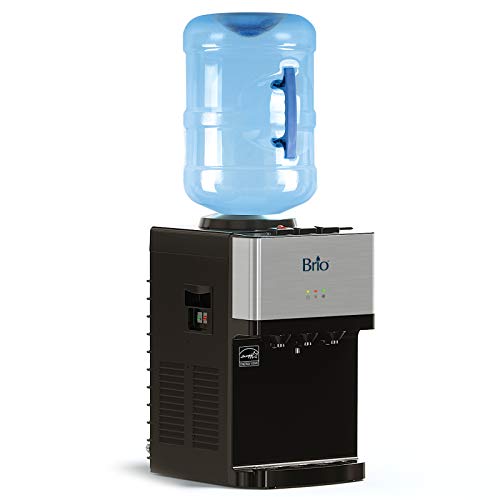
Brio Limited Edition Countertop Top Loading Water Cooler
Standard 3 and 5 gallon bottles load on top and feed separate hot and cold taps. Stainless steel tanks inside avoid the stale plastic taste that builds in cheaper reservoirs. Lifting a full bottle above counter height is the daily cost, so leave clear space overhead.
Pros
- Stainless tanks avoid plastic taste over time
- Takes the standard delivery bottle sizes
- Hot output covers tea and instant noodles
Cons
- Loading a full bottle overhead is awkward
- Tall body rules out most under-cabinet spots

Brita Hub Countertop Water Filter System
A diverter on the faucet feeds this one, so filtered water arrives on demand instead of from a waiting jug. Each carbon block cartridge runs to roughly 87 gallons, several months in a two-person household. Nothing heats or chills, which keeps the body narrow enough for a crowded worktop.
Pros
- Fills on demand without a holding jug
- Long cartridge life between changes
- Smallest footprint of the filtering units here
Cons
- No hot or cold dispensing
- Diverter does not fit pull-out spray faucets

Primo Countertop Water Dispenser
Mechanical push taps replace the touch panels on pricier coolers, leaving fewer parts to fail on a machine that runs constantly. A removable drip tray clears a tall travel mug. Filtration is absent, so output quality tracks whatever bottled water goes in on top.
Pros
- Mechanical controls with little to go wrong
- Drip tray clears a tall travel mug
- Compact for a bottle-fed dispenser
Cons
- No filtration built in
- Cold tank recovers slowly after heavy use

Igloo Countertop Water Dispenser
Plastic housing makes this the lightest hot and cold unit here, easy to carry into a dorm room or a rented flat. It accepts the same 3 and 5 gallon bottles as the Brio and Primo coolers. Hot output runs below the stainless tank models, so check the temperature if strong black tea matters.
Pros
- Lowest entry point for hot and cold on a counter
- Light enough to move between rooms
- Uses the same standard bottle sizes
Cons
- Hot output runs cooler than stainless tank units
- Plastic housing marks and stains over time
The lineup, side by side
| # | Model | Water source | Best for | Score | Price |
|---|---|---|---|---|---|
| 1 | Avalon A5 Countertop Self-Cleaning Bottleless Water Cooler | Direct cold water line connection | Best overall | 9.4 | Check price |
| 2 | AquaTru Countertop Reverse Osmosis Water Purifier | Four stage reverse osmosis | Best for filtration | 9.2 | Check price |
| 3 | Waterdrop N1 Countertop Reverse Osmosis System | Reverse osmosis | Best for instant hot water | 9.0 | Check price |
| 4 | Brio Limited Edition Countertop Top Loading Water Cooler | 3 or 5 gallon, top loading | Best for 5 gallon bottles | 8.7 | Check price |
| 5 | Brita Hub Countertop Water Filter System | Carbon block cartridge | Best for filtered water on demand | 8.5 | Check price |
| 6 | Primo Countertop Water Dispenser | 3 or 5 gallon, top loading | Best value | 8.2 | Check price |
| 7 | Igloo Countertop Water Dispenser | 3 or 5 gallon, top loading | Best budget | 8.0 | Check price |
Questions worth asking
What is a countertop water dispenser?
It serves drinking water on a worktop instead of from a full-height floor cooler. Some models take a 3 or 5 gallon bottle on top. Others connect to a cold water line, and a third group filters tap water poured into a rear tank.
Do countertop water dispensers need plumbing?
Only bottleless ones do. The Avalon A5 taps a cold water line through a tee fitting. Brio, Primo and Igloo units need nothing but a bottle, and reverse osmosis systems like the AquaTru fill from any faucet by hand.
How hot does the water get on a countertop dispenser?
Most hot tanks deliver 185F to 200F, enough for tea and instant food but below a rolling boil. Preset heaters change that picture. Waterdrop’s N1 heats on demand and includes lower settings for green tea and baby bottles.
Is reverse osmosis better than a carbon filter?
They solve different problems. Carbon targets taste, odour and chlorine, which is exactly what the Brita Hub is built for. Reverse osmosis removes a far wider range of dissolved contaminants, and AquaTru publishes NSF and ANSI certifications covering that work.
How often should you change the filter?
Carbon cartridges in the Brita Hub last around 87 gallons, several months for two people. Reverse osmosis membranes typically run one to two years, with pre-filters swapped more often. Bottleless cooler filters are usually an annual job.
Can a countertop dispenser take a 5 gallon bottle?
Yes. Brio, Primo and Igloo units all accept standard 3 and 5 gallon bottles. Remember that a full 5 gallon bottle weighs over 40 pounds and has to clear counter height during loading.
Bottleless or bottled: which is less hassle over time?
Bottleless wins on effort, with nothing to order, store or lift. Bottled wins on flexibility, moving rooms or homes without a plumber. Filter changes become the recurring task once bottles disappear.
Are countertop water dispensers safe around children?
Choose a hot tap lock and keep it engaged. Avalon and Brio units include a child lock, and the Igloo uses a safety catch. Set the dispenser back from the counter edge so the taps sit out of easy reach.
Is a countertop water dispenser worth it in a small kitchen?
It earns its space if you drink several hot or cold glasses a day. Households already happy with a kettle and a fridge jug gain less. Where counter room is tight, the faucet-fed Brita Hub takes the least depth of anything here.
The bottom line
Take the Avalon A5 when a cold water line sits within reach, because it ends bottle handling and cleans its own tank on a schedule. Renters, and anyone chasing specific contaminants, are better served by the AquaTru, which needs no plumbing and publishes real certifications. Tea and coffee drinkers with little counter to spare should choose the Waterdrop N1 for its preset temperatures. Skip all three if you only want cold filtered water, and spend less on the Brita Hub.
Dana Whitfield
Dana spent eight years buying and merchandising for a regional kitchenware retailer before moving into editorial work. She has handled thousands of SKUs across cookware, small appliances and kitchen organization, and focuses on the practical differences that matter once a product is actually in daily use.
You might also need

Do Water Softener Systems Actually Protect Kitchen Appliances Long Term?

Portable Air Fryers Compared for Small Kitchens and RVs

Top Water Filter Cartridges for Clean, Great-Tasting Water
