Which Truck Battery Tester Reads 24 Volt Systems?
FOXWELL BT705 leads here for truck work. It reads 12 and 24 volt systems, covers 100 to 2000 CCA, and prints a ticket at the vehicle. ANCEL BA101 suits a single pickup. Autel MaxiBAS BT506 sends results to a shop tablet over Bluetooth.
FOXWELL BT705 is the pick for anyone whose work list includes both pickups and heavy trucks. Dual voltage support means one tool handles a 12 volt light duty battery and a 24 volt series pair. Thermal paper for the printer becomes a consumable you reorder.
Voltage ceiling, CCA range and the presence of cranking and charging tests decide what a unit can actually diagnose. We compared those specifications across current listings, along with clamp jaw size, supported rating standards and how results get exported. Owner reports on clamp fit over corroded stud terminals broke the close calls.
The shortlist, ranked
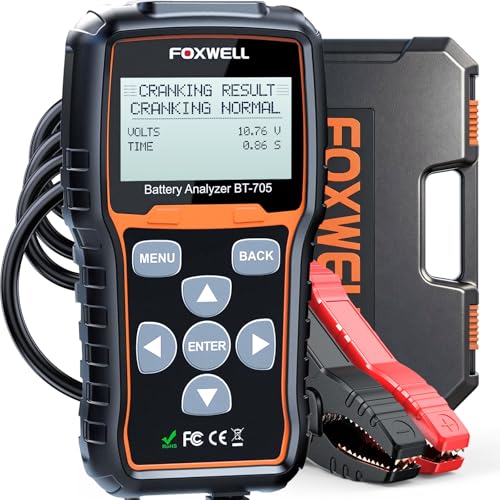
FOXWELL BT705
Dual voltage coverage is why this one sits at the top. A pickup at 12 volts and a tractor unit at 24 both connect without a second tool. Cranking and charging tests separate a tired battery from a failing alternator, and the thermal printer hands a customer proof before the argument starts.
Pros
- Covers 12 and 24 volt systems
- Prints results at the vehicle
- Checks alternator output as well
Cons
- Thermal paper is an ongoing consumable
- Bulkier than pocket testers

ANCEL BA101
Three buttons run the entire flow, so a helper can test a battery without coaching. Flooded, AGM and gel chemistries are all supported, and the menu accepts CCA, JIS, DIN, EN and IEC ratings for imported batteries. Twelve volts is the ceiling, which keeps this one on pickups and light trucks.
Pros
- Reads several battery rating standards
- Works with AGM and gel chemistries
- Clear backlit readout in a dark bay
Cons
- No 24 volt support
- No printing or data export

Autel MaxiBAS BT506
Results travel over Bluetooth into the phone app or an Autel scan tool, landing in the job record with no retyping. Adaptive conductance grades a worn battery more consistently than a fixed load setting. Each battery in a 24 volt pair still has to be tested on its own.
Pros
- Wireless results straight into the app
- Stores test history per vehicle
- Pairs with Autel diagnostic tablets
Cons
- No native 24 volt mode
- Depends on a charged phone or tablet

TOPDON BTMobile
No screen sits on this clamp module at all. Your phone handles the display, the storage and the sharing, and every test saves as a timestamped report for a customer or a fleet manager. Palm sized hardware rides in a door pocket, though a flat phone ends testing for the day.
Pros
- Smallest unit in this roundup
- Saves shareable timestamped reports
- No screen to crack in a toolbox
Cons
- Useless without a charged phone
- 12 volt systems only
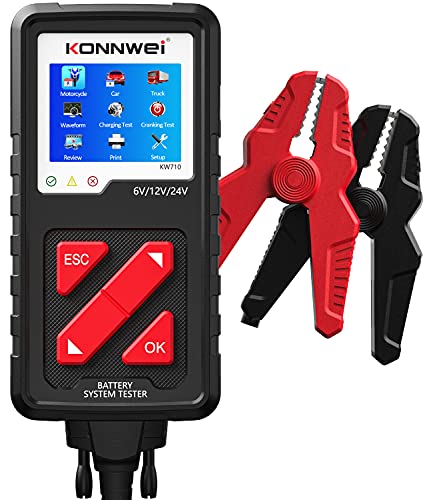
KONNWEI KW710
Twenty four volt capability arrives here in a handheld small enough for a jacket pocket. One clamp on returns battery health, cranking voltage and charging voltage in sequence on a color screen. Jaw size is modest for heavy truck posts, and the plastic body feels light next to the FOXWELL.
Pros
- 24 volt support without a bulky unit
- Three tests from one connection
- Menu is quick to learn
Cons
- Clamps are small for heavy truck posts
- Plastic body feels light in the hand

Schumacher BT-100
Carbon pile load testing pulls a genuine 100 amps and shows the voltage sag on an analog dial. Surface charge fools conductance meters; a real load does not. Heat builds quickly, so tests run in short bursts with pauses between, and 6 volt batteries are covered as well.
Pros
- Applies a true load rather than estimating
- No electronics or firmware to fail
- Handles 6 volt batteries too
Cons
- Case gets hot during testing
- No 24 volt mode and no printing
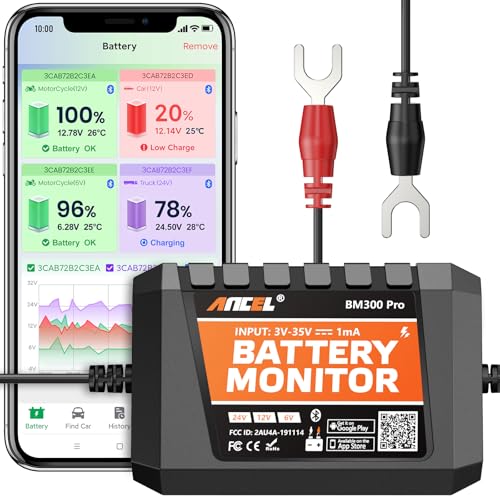
ANCEL BM300
Bolt this one to the terminals and leave it there. Voltage history streams to a phone app within about 10 meters, so parasitic drain shows as an overnight slide instead of a guess. Cranking and charging data logs too, yet a pass or fail call still needs a handheld tester.
Pros
- Tracks voltage across days and weeks
- Exposes slow parasitic drain
- Hands free once installed
Cons
- Not a pass or fail tester
- Adds a small constant draw
How to choose
What a truck battery tester needs to do Three jobs separate a useful unit from a novelty. It must grade battery health against the CCA rating printed on the label. It must read cranking voltage while the starter turns. And it must show charging voltage with the engine running. Resting voltage alone tells you almost nothing, because a dying battery can sit at 12.6 volts and still collapse under load. Clamp jaws matter on trucks, since stud and side post terminals defeat small alligator clips.
12 volt vs 24 volt truck systems Pickups and light duty trucks run 12 volts. Class 7 and Class 8 rigs, along with many buses, wire two 12 volt batteries in series for 24. Connect a 12 volt only tester to that pair and it either refuses or reports nonsense. Dual voltage units such as the FOXWELL BT705 and KONNWEI KW710 detect the system automatically. Working around the limit is possible: break the series link, then test each battery on its own. That takes longer but the readings hold up.
Conductance vs load testing: which is more accurate Cold cranking amps describe current delivered at 0F for 30 seconds. Conductance testers estimate that number from internal resistance, finishing in seconds without discharging anything. Carbon pile units like the Schumacher BT-100 pull a real 100 amps and watch voltage sag, which runs slower and hotter but resists being fooled. Sulfated batteries are where the two disagree most. Whichever method you use, enter the CCA figure from the label, because a wrong entry skews every result that follows.
Best for fleets and record keeping Past a handful of vehicles, the record matters more than the reading. BT705 prints a ticket per test, which suits roadside calls and customer facing work. Autel BT506 and TOPDON BTMobile log to an app instead, building searchable history by vehicle. For a truck that sits idle between jobs, an ANCEL BM300 left on the terminals catches the slow drain that kills batteries in winter. Skip the monitor if every truck runs daily, since a handheld covers that pattern fine.
The lineup, side by side
| # | Model | Voltage | Best for | Score | Price |
|---|---|---|---|---|---|
| 1 | FOXWELL BT705 | 12V and 24V | Best overall | 9.4 | Check price |
| 2 | ANCEL BA101 | 12V | Best value | 9.2 | Check price |
| 3 | Autel MaxiBAS BT506 | 12V | Best for workshops | 9.0 | Check price |
| 4 | TOPDON BTMobile | 12V | Best cordless for quick checks | 8.7 | Check price |
| 5 | KONNWEI KW710 | 12V and 24V | Best budget dual voltage | 8.5 | Check price |
| 6 | Schumacher BT-100 | Carbon pile load tester | Best for load testing | 8.3 | Check price |
| 7 | ANCEL BM300 | 12V | Best for ongoing monitoring | 8.0 | Check price |
Good to know
Which battery tester works on 24 volt trucks?
FOXWELL BT705 and KONNWEI KW710 read 24 volt systems directly. Twelve volt units require disconnecting the series link and testing each battery separately.
What CCA reading means a truck battery is failing?
A result well under the label rating, roughly below 70 percent, alongside cranking voltage dipping under about 9.6 volts. Either finding on its own warrants a full recharge and a retest.
Can a battery tester check the alternator too?
Yes, on any unit with a charging test. Those read system voltage with the engine running and under electrical load, which exposes a weak alternator or a slipping belt.
Is a conductance tester as accurate as a load tester?
For daily work, yes, and it is faster and cooler. Load testers still win on deeply sulfated batteries that show acceptable resistance but fold under real current.
Do battery testers need their own batteries?
Most handhelds draw power from the battery under test, which is why they work on a pack too flat to crank. Schumacher BT-100 needs no power source at all.
How do you test a battery that is completely dead?
Charge it fully, rest it a few hours, then test. Reading straight off a charger picks up inflated surface charge and passes batteries that should fail.
Should you disconnect the battery before testing?
Not for a routine health check, since in place testing is standard. Do disconnect when checking one battery of a 24 volt pair, so the other does not influence the result.
Is a Bluetooth battery tester worth it over a handheld?
It is when records matter. App based units such as TOPDON BTMobile and Autel BT506 save timestamped results per vehicle, something a screen only handheld cannot do.
What clamp size do truck battery posts need?
Look for jaws that open wide enough for stud terminals and marine style posts. Small alligator clips slip on corroded truck hardware and produce low readings that look like a failed battery.
Which tester is best for a fleet manager?
FOXWELL BT705 if paper tickets go with the vehicle, Autel BT506 if the history should live in a searchable app. Both grade against the same CCA range.
The verdict
FOXWELL BT705 is the buy for anyone working on trucks, since dual voltage plus cranking and charging tests covers the whole diagnosis in one connection. Own a single pickup? ANCEL BA101 does the same core health check for far less tool. Chasing an intermittent no start across a fleet is a different problem: fit an ANCEL BM300 to the offending truck and watch the drain happen overnight.
Tony Russo
Tony trained as an automotive technician and spent years in service and parts retail before moving into writing. He focuses on garage tools, car care products and accessories from a hands-on maintenance perspective.



