Which Cordless Battery Charger Suits a Home Garage?
NOCO GENIUS10 handles the widest range of garage jobs, pushing 10 amps into 6V or 12V packs and running a repair pass on sulfated plates. For starting with no outlet, NOCO Boost Plus GB40 cranks most gas engines from lithium. Battery Tender Plus holds stored batteries.
NOCO GENIUS10 suits a garage that mixes daily drivers with stored vehicles. Ten amps refills a car battery overnight, then tapers safely for weeks of float. Force mode wakes packs that sit below the detection threshold of most smart chargers. Lithium, AGM, gel and flooded profiles share one button. Deeply dead truck batteries still take most of a day.
Cordless covers two different tools in this category. Lithium jump starters need no outlet and live in a trunk. Smart chargers still plug into a wall, yet free you from watching a dial. We compared rated output, chemistry lists, peak cranking figures and cable gauge. Owner feedback on clamp grip and multi year reliability broke the close calls.
The shortlist, ranked

NOCO GENIUS10 Smart Battery Charger
Ten amps lands in the useful middle for home use. A car battery recovers in a few hours, and the same unit can stay connected for weeks without cooking plates. Force mode pushes current into packs that read too flat for automatic detection, and chemistry selection spans lithium, AGM, gel and flooded lead acid.
Pros
- Force mode revives batteries a standard charger skips
- One unit covers lithium and AGM without a second charger
- Float stage allows months of connected storage
Cons
- Ten amps crawls on a large truck battery
- Leads are short enough to need an extension cord in a wide bay
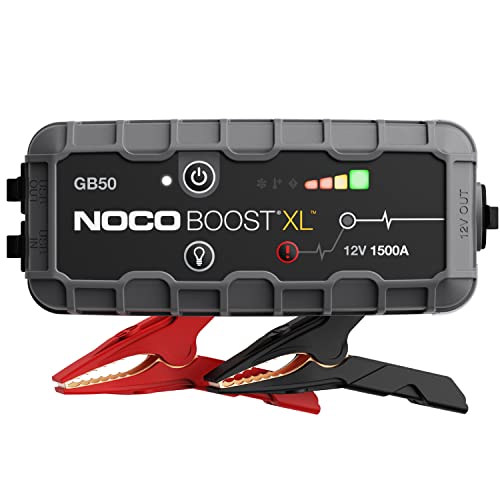
NOCO Boost Plus GB40 Jump Starter
A lithium pack roughly the size of a paperback delivers 1,000 peak amps, enough for gas engines up to six liters. Reverse polarity protection lets clamps go on either way without a spark, which helps anyone jump starting for the first time. USB output and a 100 lumen light make it useful beyond dead batteries.
Pros
- Starts an engine on a driveway with no power nearby
- Spark proof clamps forgive a reversed connection
- Sits in a trunk for months and still cranks
Cons
- Cranks an engine but puts no real charge back
- Short cables leave it balanced on the engine bay

Battery Tender Plus 12V 1.25A Charger
One and a quarter amps rules out fast recovery, and that is the point. Four stage float charging keeps a motorcycle, mower or weekend car ready through a cold season without boiling electrolyte. Ring terminal leads let you wire a permanent pigtail behind a bumper panel.
Pros
- Ring terminal pigtail turns reconnection into a two second job
- Float stage holds voltage for months without overcharging
- Hangs on a pegboard hook and weighs almost nothing
Cons
- Too slow to bring a flat car battery back the same day
- Lead acid only, with no lithium profile

CTEK MXS 5.0 Battery Charger
Charging splits into eight steps here, including a desulfation pass and an AGM program that lifts voltage slightly for those plates. Cold weather mode adjusts the profile for a garage below freezing. IP65 sealing lets the case survive a damp workshop floor.
Pros
- AGM program matches the higher voltage those plates want
- Sealed IP65 case tolerates a cold damp garage
- Recond step pulls back mildly sulfated batteries
Cons
- Under 5 amps stretches a full charge across most of a day
- Replacement leads cost more than rival brands

Schumacher SC1281 Battery Charger and Engine Starter
Thirty amp boost cuts a flat battery from an overnight job to roughly an hour, while 100 amp engine start moves a car without a second vehicle. Voltage detection switches between 6V and 12V on its own. Wheels and a steel case suit a garage that handles several vehicles a week.
Pros
- Engine start mode replaces the second car in a jump start
- Thirty amp boost gets a dead battery usable in about an hour
- Wheels move a heavy unit between bays without lifting
Cons
- Needs a wall outlet, so it never helps at the roadside
- Bulky next to a wall mounted smart charger

GOOLOO GT4000S Jump Starter
Four thousand peak amps covers big gas V8s and most diesels, the point where 1,000 amp packs run short. USB C handles input and output, so a laptop charger refills it between uses. Weight climbs with the output, which makes this a trunk tool rather than a glovebox one.
Pros
- Cranks diesels that stall a compact lithium pack
- USB C input skips the proprietary charging brick
- Doubles as a large power bank on camping trips
Cons
- Heavier and bulkier than a 1,000 amp starter
- More capacity than a small commuter car needs
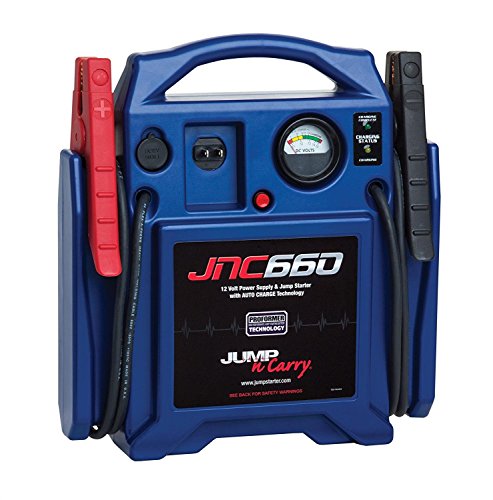
Clore Automotive Jump N Carry JNC660 Jump Starter
Clore skips lithium and fits a sealed AGM battery built for repeated deep cycling in a working shop. Cables run 46 inches, long enough to reach a trunk mounted battery without perching the unit on a radiator. Around 18 pounds and a recharge after every use buy that durability.
Pros
- Forty six inch cables reach batteries in awkward positions
- AGM pack absorbs repeated starts through a full workday
- Replaceable battery extends the life of the unit
Cons
- About 18 pounds, far heavier than a lithium pack
- Wants recharging promptly after each start
How they stack up
| # | Model | Output | Best for | Score | Price |
|---|---|---|---|---|---|
| 1 | NOCO GENIUS10 Smart Battery Charger | 10A at 6V and 12V | Best overall | 9.4 | Check price |
| 2 | NOCO Boost Plus GB40 Jump Starter | 1,000 A | Best cordless jump starter | 9.2 | Check price |
| 3 | Battery Tender Plus 12V 1.25A Charger | 1.25A at 12V | Best value maintainer | 9.0 | Check price |
| 4 | CTEK MXS 5.0 Battery Charger | 4.3A at 12V | Best for AGM and winter storage | 8.8 | Check price |
| 5 | Schumacher SC1281 Battery Charger and Engine Starter | 6A charge, 30A boost, 100A engine start | Best for fast charging | 8.6 | Check price |
| 6 | GOOLOO GT4000S Jump Starter | 4,000 A | Best for large engines | 8.3 | Check price |
| 7 | Clore Automotive Jump N Carry JNC660 Jump Starter | 1,700 A | Best for heavy daily use | 8.0 | Check price |
What to look for
What a garage battery charger needs to do Three situations account for most garage battery work. A car sits for a month and then cranks slowly. A motorcycle or mower waits out the cold season on a trickle. Or a battery is flat this morning and the vehicle has to move. Smart chargers solve the first two, jump starters solve the third, and owning one of each usually beats one compromise unit.
How many amps do you need? Under 2 amps is maintenance only, aimed at bikes and mowers over winter. Five to ten amps recovers a car battery in a few hours and still tapers for storage. Thirty amps or more shortens that to about an hour, with more heat, which is why boost units carry fans and steel cases. Match amperage to battery capacity instead of chasing the biggest number on the box. Charge current near 10 percent of the amp hour rating keeps plates comfortable.
Jump starter vs smart charger Lithium jump starters deliver a huge burst for a few seconds, then stop. No meaningful charge goes back into the battery, so the alternator does that work on a drive. Peak amps should track engine size: 1,000 amps handles most gas cars, while diesels above three liters want 2,000 or more. Shops starting several vehicles a day are better served by an AGM unit such as the JNC660. Anyone needing a jump every cold morning has a charging fault, not a jump starter problem.
Keeping stored vehicles ready through winter Batteries self discharge in a cold garage, and sulfate forms as resting voltage drops. Capacity lost that way does not come back on its own. Float maintainers prevent it for a few cents of electricity a month. Wire a ring terminal pigtail once, as the Battery Tender Plus allows, and reconnection takes seconds each time. AGM owners should pick a charger with a dedicated AGM program, since those plates want slightly higher voltage than flooded cells.
Questions worth asking
Can a battery charger work without an outlet?
Chargers need mains power, but lithium jump starters run from their own pack. A NOCO Boost Plus GB40 cranks an engine on a driveway with no power at all. Refilling that pack still needs a USB source eventually.
How long does it take to charge a car battery?
At 10 amps, a typical 60Ah battery takes about six to eight hours from deeply flat. Thirty amps drops that to roughly an hour for a usable charge. Maintainers under 2 amps are built to hold a full battery, not refill an empty one.
Is it safe to leave a smart charger connected all winter?
Yes, as long as the unit has a float or maintenance stage, which the GENIUS10, CTEK MXS 5.0 and Battery Tender Plus all include. Old unregulated chargers boil electrolyte and should never be left running. Confirm the manual allows unattended use before walking away.
How many peak amps does a jump starter need?
One thousand peak amps starts most gas engines up to six liters. Diesels and large V8s want 2,000 amps or more for cold cranking. Peak figures describe a brief burst, so treat cranking amps as the more meaningful number where a listing states it.
Which battery chargers work with lithium batteries?
Only chargers with a specific lithium mode, such as the NOCO GENIUS10. Lead acid profiles hold a higher absorption voltage that can damage a lithium pack. Read the chemistry list before clipping anything to a lithium starter battery.
Do AGM batteries need a different charger?
AGM cells accept a slightly higher charging voltage than flooded lead acid. Most modern smart chargers offer an AGM setting, and the CTEK MXS 5.0 makes it a dedicated program. Running a flooded profile on AGM leaves it undercharged over time.
Can a charger fix a battery that will not hold a charge?
Repair and desulfation modes recover mildly sulfated batteries that sat flat for a season. Nothing restores a shorted cell or physical plate damage. Voltage that collapses under load after a full charge means the battery is finished.
Should a jump starter live in the garage or the car?
Lithium packs hold charge for months, so keeping one in the trunk is practical. Summer heat and deep winter cold both shorten lithium life, which argues for the garage in harsh climates. Top it up every three to six months either way.
What is the difference between a trickle charger and a smart charger?
Trickle chargers push a fixed low current and keep pushing whether the battery needs it or not. Smart chargers read voltage, move through stages and drop to float when the battery is full. That difference decides whether a unit can stay connected for months safely.
Our take
GENIUS10 is the single purchase that covers the most garage situations, since 10 amps recovers a flat battery and the float stage guards a stored one. Pair it with the Boost Plus GB40 when a car has to start away from any outlet. Owners who only store a motorcycle or classic through winter can wire in the Battery Tender Plus and stop there.
Tony Russo
Tony trained as an automotive technician and spent years in service and parts retail before moving into writing. He focuses on garage tools, car care products and accessories from a hands-on maintenance perspective.