Commercial Grade Cordless Drills That Survive Daily Use
DeWalt’s DCD800 wins on torque-to-size ratio and parts availability, making it the safest single-drill buy for most crews. Milwaukee’s M18 FUEL 2904 hits harder in masonry and heavy framing. Makita’s XFD131 suits shops already running 18V LXT batteries. Metabo HPT’s DV18DBL2 covers budget fleet buying.
Most commercial crews should carry the DeWalt DCD800. It puts out 650 unit watts, grips bits in a ratcheting all-metal chuck, and runs on packs stocked in nearly every supply house. Wood, metal and hole saws up to about 1-1/2 inches are comfortable territory. Concrete is not, since there is no hammer mode, so masonry work needs a second tool.
Peak spec numbers rarely decide a commercial purchase. Downtime, replacement parts and local battery stock drive the real cost of owning a drill. We compared published torque figures, chuck construction, motor type and platform depth across the seven models here. Owner reports on clutch drift and chuck slip after months of daily use settled the close calls.
How to pick the right one
What makes a cordless drill commercial grade Brushless motors sit in almost every drill now, so treat them as a baseline rather than a selling point. Durability lives in the chuck, the clutch and the housing. An all-metal chuck still grips round-shank bits after a thousand cycles. A good clutch repeats the same torque at setting 7 in month ten. Housings matter because drills fall off ladders and into mud. Battery platform depth decides the rest, since a drill is dead weight on Monday if nobody local stocks the pack. Service turnaround is the final filter, and it explains why DeWalt and Milwaukee fill so many crew boxes.
How to compare torque ratings across brands Manufacturers publish different units, which makes cross-brand math messy. DeWalt quotes unit watts out, a combined speed and torque figure. Milwaukee, Makita and Metabo HPT quote inch-pounds of fastening torque instead. Anything above 500 inch-pounds drives structural screws and 1 inch spade bits without complaint. Past 1000 inch-pounds you are buying stall resistance for hole saws and self-feed bits. Weight climbs alongside it, so ask whether your daily work actually bogs down a mid-range drill before paying that penalty in your wrist.
Best cordless drill for electricians and mechanical trades Length and weight settle this branch faster than torque does. Repetitive overhead drilling punishes anyone holding a full-size 18V tool all day. Many electricians carry a compact 12V drill such as the M12 FUEL 3403 and leave the bigger tool in the van. Where only one drill fits the pouch, the 6.9 inch DCD800 covers the middle ground. Before buying a third drill, try a right-angle attachment. It solves most joist-bay access problems and weighs a fraction of another tool.
Do you need hammer mode, or a rotary hammer? Hammer drills handle anchors up to roughly 1/2 inch in cured concrete and block. Past that diameter, an SDS rotary hammer drills faster and spares the gearbox. Crews setting Tapcons every day are the real audience for the Bosch GSB18V-490 or the Milwaukee 2904. Everyone else gains length and weight on a tool that mostly drives screws. If concrete work amounts to a few anchors a month, skip hammer mode entirely and rent a rotary hammer for the occasional big job.
The best picks, ranked
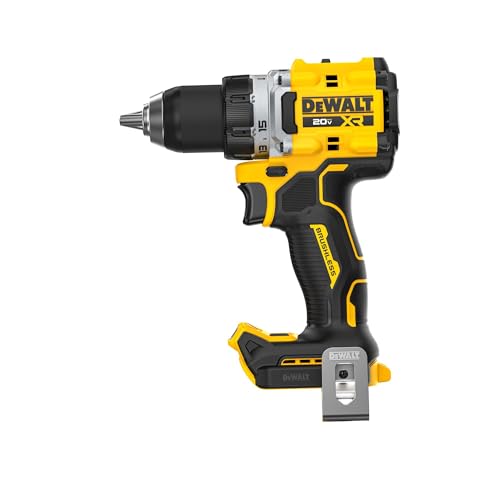
DeWalt DCD800B 20V MAX XR Brushless Drill/Driver
Rated at 650 unit watts out, this two-speed drill tops out near 2000 RPM in high gear. Electricians and finish carpenters gravitate to it because the nose measures about 6.9 inches front to back. A ratcheting all-metal chuck holds round-shank bits without walking under load.
Pros
- Short nose clears studs and joist bays
- Metal chuck grips hex and round shanks without slipping
- 20V MAX packs sit on the shelf at almost every supply house
Cons
- No hammer mode, so concrete anchors need another tool
- Low-mounted LED throws a shadow behind long bits

Milwaukee M18 FUEL 2904-20 Hammer Drill/Driver
About 1400 inch-pounds of fastening torque plus a hammer mode covers structural and masonry work in one body. An auto-stop clutch reads bind-up and kills the motor before the tool twists your wrist. Weight and length climb accordingly, which you feel during overhead runs.
Pros
- Hammer mode covers Tapcons and small concrete anchors
- Kickback control earns its keep on 2 inch hole saws
- One-Key tracking helps tool cribs log fleet tools
Cons
- Heaviest drill here once a High Output pack is fitted
- Length makes cabinet and joist-bay work awkward

Makita XFD131 18V LXT Brushless Driver-Drill
Makita packs 530 inch-pounds of torque into a body measuring 6-1/2 inches nose to tail. Dual LEDs light the bit from both sides, which kills the shadow that ruins ceiling work. Kits arrive with a 3.0 Ah pack and rapid charger, so a shop can stand up the LXT platform in one order. Large auger bits sit outside its comfort zone.
Pros
- Dual LEDs remove bit shadow during ceiling work
- Ships as a kit with a 3.0 Ah pack and rapid charger
- LXT batteries run more than 275 Makita tools
Cons
- Torque ceiling sits below the DeWalt and Milwaukee
- Plastic chuck collar wears faster than all-metal designs
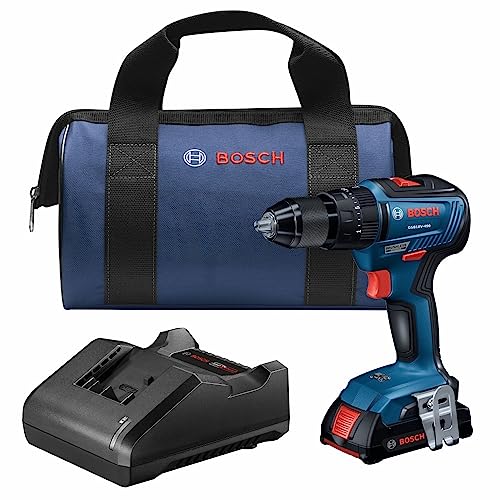
Bosch GSB18V-490B12 18V Brushless Hammer Drill
Bosch tunes this one around anchor setting. A fast hammer rate drives 1/4 inch Tapcons into cured concrete without stalling. Metal chuck jaws stand up to masonry bits that grind plastic collars down. General wood drilling feels coarser here than on the DCD800.
Pros
- Hammer action geared to small-diameter anchors
- Compact body for a two-mode hammer drill
- Bosch 18V platform reaches into corded-class rotary hammers
Cons
- US dealer network trails DeWalt and Milwaukee
- Clutch steps are coarse for delicate fastening

Milwaukee M12 FUEL 3403-20 Drill/Driver
Roughly 6.2 inches long and near 2 pounds bare, this 12V drill turns inside cabinet boxes where an 18V tool jams. Output lands around 400 inch-pounds, which covers screws, small spade bits and self-drillers. Treat it as the second drill in the bag rather than a crew’s only drill.
Pros
- Fits inside cabinet boxes and mechanical chases
- Light enough for a full day of overhead drilling
- M12 packs slide into a pouch pocket
Cons
- Stalls on hole saws past about 2 inches
- Adds a second battery platform to charge and track

Flex FX1271T 24V Brushless 2-Speed Hammer Drill
Flex builds this around a 24V stacked-cell pack that holds voltage under sustained load. Thinset mixing and 2 inch self-feed bits are where the extra headroom shows. Bulk is the trade, along with a battery range few supply houses carry.
Pros
- Holds RPM under load where 18V tools sag
- Side handle comes in the box, not as an accessory
- Turbo mode suits paddle mixing in mortar and thinset
Cons
- Battery platform is thin outside big-box retail
- Too bulky for repetitive fastening

Metabo HPT DV18DBL2 18V Brushless Hammer Drill
Three modes, a brushless motor and reaction force control land in one body at the entry tier. Torque sits around 620 inch-pounds behind a 1/2 inch metal chuck. Shops replacing several drills at once also pick up a lifetime tool warranty.
Pros
- Kickback protection is rare at this tier
- Lifetime tool warranty absorbs fleet attrition
- Three modes in one body cuts what crews carry
Cons
- Accessory and battery range lags the big three
- Trigger control is less progressive at low speed
How they compare
| # | Model | Power | Best for | Score | Price |
|---|---|---|---|---|---|
| 1 | DeWalt DCD800B 20V MAX XR Brushless Drill/Driver | 650 UWO | Best overall | 9.4 | Check price |
| 2 | Milwaukee M18 FUEL 2904-20 Hammer Drill/Driver | About 1400 in-lbs | Best for heavy daily use | 9.2 | Check price |
| 3 | Makita XFD131 18V LXT Brushless Driver-Drill | 530 in-lbs | Best value | 9.0 | Check price |
| 4 | Bosch GSB18V-490B12 18V Brushless Hammer Drill | Drill and hammer | Best for masonry anchors | 8.8 | Check price |
| 5 | Milwaukee M12 FUEL 3403-20 Drill/Driver | About 400 in-lbs | Best for tight spaces | 8.6 | Check price |
| 6 | Flex FX1271T 24V Brushless 2-Speed Hammer Drill | 24V | Best for mixing and large-diameter holes | 8.3 | Check price |
| 7 | Metabo HPT DV18DBL2 18V Brushless Hammer Drill | Around 620 in-lbs | Best budget fleet buy | 8.0 | Check price |
Common questions
What makes a cordless drill commercial grade?
An all-metal chuck, a brushless motor, a repeatable clutch and a battery platform with local stock and service. Housing materials and bearing quality outrank headline torque, because daily use kills chucks and gearboxes long before motors fail.
Is 18V or 20V MAX more powerful?
Neither. Both labels describe identical lithium-ion packs, with 20V MAX quoting peak voltage and 18V quoting the nominal figure. Compare torque, motor type and amp-hours instead of the number printed on the battery.
How much torque do I need in a cordless drill?
Around 500 inch-pounds covers structural screws, 1 inch spade bits and general driving. Push toward 1000 or more only if hole saws, self-feed bits or mixing paddles are part of the daily routine.
DeWalt vs Milwaukee: which platform suits a commercial crew?
Milwaukee leads on raw torque and kickback control. DeWalt leads on size, weight and supply availability. Whichever platform your crew already owns usually wins, because battery cost outweighs any spec gap between these two.
Which cordless drill is best for concrete anchors?
Bosch’s GSB18V-490 and Milwaukee’s 2904 are the two hammer drills here tuned for small-diameter anchors. Both hold speed while the carbide bit bites, which is exactly where slower hammer drills stall in cured concrete.
Can a 12V drill handle professional work?
For fastening, self-drillers and small bits, yes. Modern 12V brushless drills such as the M12 FUEL produce what full-size tools managed a decade ago. Large hole saws still stall them, so most trades carry one as a companion tool.
What size battery do I need for jobsite drilling?
Compact 2.0 Ah packs keep the drill balanced for driving and overhead work. Move to 5.0 Ah or larger when running hole saws, self-feed bits or a mixing paddle, where sustained current draw beats saving a pound.
How long do commercial drill batteries last?
Owners commonly report three to five years of daily service before runtime drops noticeably. Charge cycles and heat drive that number, so storing packs at partial charge in a cool van stretches their life.
Are brushless drills worth it for daily use?
Yes, on a jobsite. Brushless motors run longer per charge, generate less heat and skip brush replacement, which matters when a drill runs several hours a day. Occasional users see far less benefit.
Should a crew standardise on one battery platform?
Standardising cuts chargers, spare packs and confusion in the van, and it is why most crews stay put once committed. Adding a compact 12V line is the one exception worth making, since no full-size drill fits inside a cabinet box.
Our take
Buying one drill for a crew? Take the DeWalt DCD800. It stays compact, handles everyday structural work and sits on the deepest parts network in the trades. Shops setting anchors or running large hole saws daily should spend up for the Milwaukee M18 FUEL 2904 and accept the weight. Crews already invested in 18V LXT have no reason to switch, since the Makita XFD131 covers the same ground without a new charger shelf.
Jake Monroe
Jake worked as a residential contractor for over a decade before shifting to full-time writing. He evaluates power tools, hand tools and workshop gear through the lens of someone who has actually used them on job sites, not just read the box.