Which Concrete Outdoor Planters Survive Hard Frost?
Kante Lightweight Concrete Round Planter leads, because fibre reinforcement delivers cast stone texture at a liftable weight. Kante’s tall square column suits bamboo and clipped evergreens. LuxenHome’s MgO planter is the one to buy when a hydrangea or dwarf tree needs a wide, stable root run.
Kante Lightweight Concrete Round Planter fits most gardens, especially anyone who wants stone mass without a two-person lift. Fibreglass strands let the walls run thin, so one person repositions a mid-size pot alone. Thin walls chip on impact, and solid cast cement still wins for wind stability in an exposed plot.
Three materials share the word concrete: solid cast cement, fibre-reinforced concrete and magnesium oxide composite. Labels rarely spell out which one is in the box. We compared stated mixes, wall construction, drainage provision and published frost claims. Owner feedback covered the rest, from hairline cracks after a freeze to how each finish fades under strong sun.
The best picks, ranked

Kante Lightweight Concrete Round Planter
Fibreglass strands run through the cement mix, so walls stay thin and weight drops to roughly a third of solid cast stone. A drainage hole arrives pre-drilled in the base, and the unsealed grey surface weathers instead of flaking. Thin walls are what pay for that weight saving, so a drop onto a stone step will chip the rim.
Pros
- One person can reposition a mid-size pot when empty
- Grain reads as quarried stone, not moulded plastic
- Unsealed surface takes on moss and patina outdoors
Cons
- Rim chips on hard impact with paving
- Light enough to tip in gusts once planting goes top-heavy

Kante Tall Square Lightweight Concrete Planter
Tapered square sides give root depth rather than width, which suits bamboo, boxwood cones and clipped laurel. Height lifts the centre of gravity, so a gravel layer in the base earns its place before compost goes in. Same fibre-reinforced mix as the round Kante pots keeps the empty weight manageable for one person.
Pros
- Depth suits deep-rooted screening plants
- Flat sides sit tight against a wall or fence line
- Finish matches the round Kante pots for mixed groupings
Cons
- Needs gravel ballast to resist wind once planted tall
- Narrow footprint holds less compost than a bowl shape

LuxenHome Gray MgO Concrete Planter
Magnesium oxide composite behaves like cement in the hand but flexes marginally through freeze and thaw cycles. Wide mouths in this range swallow a hydrangea or dwarf acer root ball without root spiralling. Surface texture reads smoother and more uniform than cast concrete, which suits porcelain paving and rendered walls.
Pros
- Wide mouth takes a genuine shrub root ball
- Composite copes with repeated freezing better than plain cement
- Even tone works against modern paving and render
Cons
- Smooth face lacks the grain of cast stone
- Larger diameters need two people once compost goes in
Christopher Knight Home Lightweight Concrete Planter
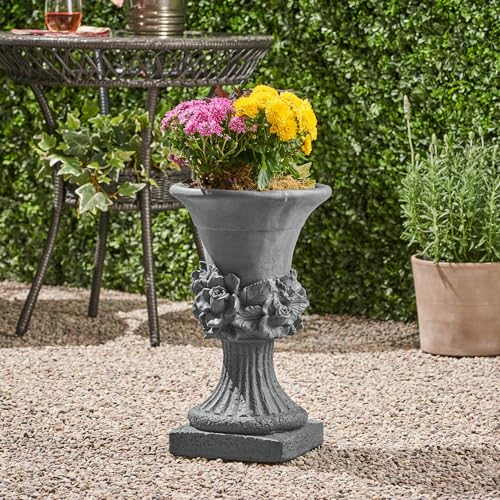
Matched pairs in simple tapered cylinders aim this range squarely at flanking a front door or a run of steps. Colour and texture arrive consistent between the two pots, which is the thing that fails when people buy singles twice. Lightweight concrete keeps porch handling reasonable, though the finish scuffs if you drag rather than lift.
Pros
- Both pots share the same tone and casting texture
- Tapered profile reads as symmetry either side of a door
- Weight stays sane for carrying up porch steps
Cons
- Few size options within the range
- Finish scuffs when dragged across paving

Sunnydaze Fiber Clay Outdoor Planter
Clay, fibreglass and cement combine into a wall that gives slightly instead of splitting when trapped water freezes. This is not solid concrete, and the listing says as much, yet the matte grey tone lands close. Weight sits well under cast stone at the same diameter, so seasonal rearranging stays a one-person job.
Pros
- Handles long freezing spells better than plain cement
- Light enough to shuffle around a patio each season
- Matte surface avoids any plastic sheen
Cons
- Texture differs subtly from true cast concrete
- Grey lightens over several summers in strong sun

Mkono Cement Planter with Drainage Hole
Small diameters and genuinely solid cement walls define Mkono’s outdoor pots. Density gives them real ballast, so a windy balcony or an exposed step will not knock one over. Capacity caps the planting at herbs, succulents and small annuals rather than perennials or shrubs.
Pros
- Solid cement walls at balcony scale
- Stays upright on an exposed rail or step
- Removable plug lets the same pot move indoors
Cons
- Too shallow for shrubs or established perennials
- Thick solid walls crack if left holding frozen water

POTEY Cement Plant Pot with Saucer
Every pot ships with a matching cement saucer that keeps run-off off decking boards and painted sills. Drainage is a proper open hole rather than a decorative dimple, so succulent roots never sit in water. Outdoors, treat the saucer as optional, because a full one cancels the drainage during a storm.
Pros
- Saucer stops watering marks on timber decking
- Open drainage suits drought-loving planting
- Compact enough for a kitchen step or window ledge
Cons
- Saucer collects rainwater if left in place outside
- Porous cement holds damp and dries slowly after storms
Side by side
| # | Model | Material | Best for | Score | Price |
|---|---|---|---|---|---|
| 1 | Kante Lightweight Concrete Round Planter | Fibre-reinforced concrete | Best overall | 9.4 | Check price |
| 2 | Kante Tall Square Lightweight Concrete Planter | Fibre-reinforced concrete | Best for tall plants | 9.2 | Check price |
| 3 | LuxenHome Gray MgO Concrete Planter | MgO composite with concrete finish | Best for large shrubs | 9.0 | Check price |
| 4 | Christopher Knight Home Lightweight Concrete Planter | Lightweight concrete blend | Best for a matching pair | 8.8 | Check price |
| 5 | Sunnydaze Fiber Clay Outdoor Planter | Fibre clay with concrete finish | Best for frost resistance | 8.6 | Check price |
| 6 | Mkono Cement Planter with Drainage Hole | Solid cement | Best budget | 8.3 | Check price |
| 7 | POTEY Cement Plant Pot with Saucer | Cement | Best for herbs and succulents | 8.0 | Check price |
How to choose
What to look for in a concrete planter Three different materials hide behind the word concrete. Solid cast cement is heaviest, most textured and hardest to knock over. Fibre-reinforced concrete, the Kante approach, keeps that grain while cutting weight sharply. MgO and fibre clay composites give up a little texture in exchange for freeze tolerance. Check that the base hole is drilled rather than moulded as a dimple, since opening cured cement means a masonry bit, dust everywhere and a ruined afternoon.
How to size a planter to the plant Root volume decides the pot, not how tall it looks on a shelf. Hydrangeas, roses and dwarf trees want a wide mouth like the LuxenHome. Bamboo and columnar evergreens want depth instead, which is where the Kante tall square earns its keep. Leave two to three inches between root ball and wall for fresh compost. Herbs and succulents actually prefer small cement pots, because porous walls wick moisture away from the roots.
Weight, placement and balcony load limits A filled large planter is effectively furniture, so choose the spot before adding compost. Lightweight concrete lets one person shift a medium pot alone, which explains most of Kante’s appeal. On roof terraces and balconies, check the load rating before committing to solid cement. Filling the lower third with gravel or broken tile cuts weight and sharpens drainage at the same time. Pot feet add a second benefit: airflow under the base prevents a stained ring on paving.
Will a concrete planter crack in winter? Water expands as it freezes, and trapped water inside dense cement is what splits a pot. Keep the drainage hole clear, raise the pot on feet, and never leave a saucer standing full through winter. Fibre clay and MgO flex marginally, so Sunnydaze and LuxenHome ride out repeated freezing better. Mkono’s small pots sit at the opposite end, with thick solid walls and nowhere for ice to expand. Planted pots fare better than empty ones, since damp compost buffers the swing in temperature.
Questions worth asking
Are concrete planters good for outdoor plants?
Yes, since the mass insulates roots against temperature swings and the weight resists wind. Porous cement also wicks surplus moisture, which suits rosemary, lavender and other Mediterranean planting. Weight and frost cracking are the two real drawbacks.
Do concrete planters crack in winter?
They can, whenever water pools inside the pot or under it and then freezes. Clear drainage plus pot feet prevents most failures. Composites such as the Sunnydaze fibre clay and LuxenHome MgO tolerate freeze cycles better than solid cement.
What is lightweight concrete, and is it real concrete?
Fibreglass or similar reinforcement goes into the cement mix, letting the walls run thinner. Cement content is genuine, so the surface still looks and feels like stone. Weight can fall to around a third of a solid cast pot of matching size.
Should I seal a concrete planter?
Sealing is optional, and most gardeners skip it. An unsealed pot builds a patina and lets the wall breathe. Seal the inside only if you want to slow moisture loss or stop staining on pale limestone paving.
How do I stop a tall planter blowing over?
Add gravel or broken tile to the base before any compost goes in. That drops the centre of gravity and improves drainage in one move. Tall columns such as the Kante square need this most once planted with bamboo.
Can concrete planters stay outside all year?
In most climates yes, provided water drains freely at all times. Hard freeze regions call for empty saucers, raised bases and small dense pots moved under cover. Compost in a planted pot buffers the freeze, so planted beats empty.
Which concrete planter is best for a small balcony?
Mkono cement pots, because solid walls give wind resistance at a small diameter. Confirm the balcony load limit before lining up several. Where weight is restricted, a Kante round pot delivers the same look for far less mass.
Concrete vs fibre clay planters: what is the difference?
Cement is heavier, more textured and steadier in wind. Fibre clay weighs less, flexes a fraction and resists frost cracking. Pick cement for a permanent position, fibre clay for pots you move with the seasons.
How heavy is a large concrete planter once filled?
Most of the load is rain-soaked compost, not the pot itself. Treat any large filled planter as a two-person lift, and use a sack trolley where paving allows. Position it empty, then fill it in place.
Final word
Kante’s Lightweight Concrete Round Planter is the pick for most gardens, since cast stone texture arrives without a two-person lift. Gardeners planting bamboo or clipped evergreens should take the tall Kante square and ballast the base with gravel. Where winters run long and wet, Sunnydaze fibre clay is the safer buy, while Mkono suits a windy balcony where stability matters more than capacity.
Sierra Daniels
Sierra's background is in landscape design and nursery retail. She focuses on lawn and garden equipment, outdoor furniture and gear durability, weighing published specs against how materials actually hold up outside.