How to Pack More Using Compression Travel Bags
Bagail Compression Packing Cubes balance capacity, zip strength and price for most travelers. The Eagle Creek Pack-It Isolate set is the durable choice for frequent flyers. Spacesaver roll up bags save the most volume on bulky winter clothing and bedding.
Bagail Compression Packing Cubes are the sensible default for most trips. Frequent flyers get more mileage from the sturdier Eagle Creek Pack-It Isolate set. Spacesaver roll up bags earn their keep on genuinely bulky items such as coats and duvets.
Compression bags come in two forms that people compare as if they were the same. Zip cubes squeeze air out gradually and hold a rigid shape that stacks neatly. Vacuum and roll up sacks remove far more air but leave a dense, awkward brick that can wrinkle clothes. We compared compression method, achievable volume reduction, zip and seam construction, added weight and what owners report about long-term durability.
The shortlist, ranked

Bagail Compression Packing Cubes
A second zip runs around each cube to compress the load once packed. Mesh top panels show what is inside without unzipping. The set spans several sizes, so shirts, underwear and bulkier layers each get a dedicated cube.
Pros
- Compresses well without a pump or vacuum
- Mesh panels reveal contents at a glance
- Graduated sizes cover a full suitcase
Cons
- Zips need care when a cube is overstuffed
- Fabric is lighter than premium travel brands

Eagle Creek Pack-It Isolate Compression Cube Set
Reinforced seams and heavier zips survive frequent packing and unpacking. Odour-resistant fabric treatment helps when a cube holds worn clothes for a week. A manufacturer lifetime warranty backs the whole set.
Pros
- Stronger zips and seams than budget sets
- Odour-resistant fabric suits longer trips
- Backed by a lifetime manufacturer warranty
Cons
- Costs considerably more than generic sets
- Slightly heavier per cube than lightweight rivals

Peak Design Packing Cube
An internal divider splits the cube into two chambers, one for clean clothing and one for worn. An external zip expands or compresses the whole cube in a single motion. Weatherproof recycled nylon matches the rest of Peak Design’s travel line.
Pros
- Divider keeps clean and worn clothes apart
- Expands for extra room on the way home
- Material quality leads this group
Cons
- Compression is gentler than dedicated compression cubes
- Sold individually, not as a full set

Gonex Compression Packing Cubes
Dual zip compression runs across a size range similar to Bagail’s set. Lightweight nylon adds very little weight to a packed case. Owners report the cubes hold their shape when packed to a sensible level rather than crammed.
Pros
- Adds almost nothing to your baggage weight
- Full multi size set at a low price
- Zips run smoothly when not overfilled
Cons
- Thin fabric shows wear sooner than premium cubes
- Cubes sag some when only partly filled

Veken 6 Set Compression Packing Cubes
A laundry pouch and a shoe bag join the compression cubes in one set, covering the awkward items that otherwise contaminate the rest of a case. The cubes use the same secondary zip approach as the leaders here. Double handles on the larger cubes make lifting a packed case easier.
Pros
- Includes shoe and laundry bags most sets skip
- Handles simplify lifting packed cubes from a case
- Water resistant shell handles damp swimwear
Cons
- Compression trails dedicated vacuum sacks
- Colour choices are limited compared with rivals

Spacesaver Premium Travel Roll Up Bags
A one-way valve lets you roll air out without a pump. Puffer jackets, fleeces and bedding lose far more volume than any zip cube can manage. The tradeoff is a dense block that creases clothing and sits awkwardly in a hard shell case.
Pros
- Removes the most air of anything here
- Needs no pump or power, just rolling
- Excellent for coats, bedding and winter layers
Cons
- Creases clothing badly compared with cubes
- Plastic film eventually punctures and stops sealing
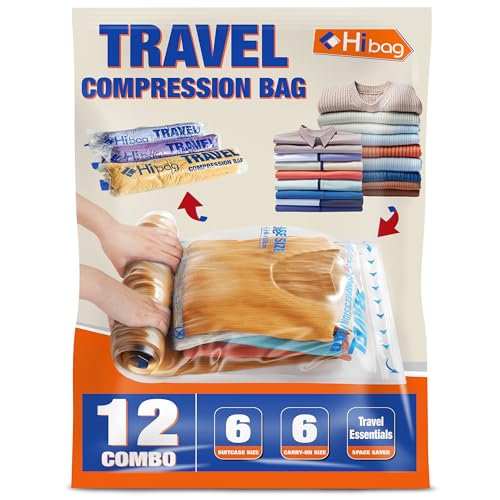
Hibag Compression Bags for Travel
The same roll-and-seal valve as Spacesaver comes at a lower price. Assorted sizes in each pack cover different garment types. Longevity is the tradeoff, so treat these as a one-trip solution rather than a long-term system.
Pros
- Cheapest route to serious volume reduction
- Assorted sizes cover different garment types
- Useful for sealing off wet or dirty items
Cons
- Seals fail sooner than premium roll up bags
- Film tears easily against zips and buckles
Before you buy
How much space do compression bags actually save? Zip cubes reduce a stack of clothing by a useful margin rather than a dramatic one. Their real benefit is organisation and a consistent shape that stacks tightly in a case. Roll up vacuum sacks remove far more air but produce dense, oddly shaped blocks. Neither reduces weight, since airline limits are measured in kilograms, not litres.
Packing cubes or roll up bags: which fits your trip? Shirts, trousers and everyday clothing do best in zip cubes, which keep creasing manageable and let you pull out one category at a time. Bulky, air-heavy items such as puffer jackets, ski layers and bedding are where roll up sacks earn their keep. Most of their volume is trapped air rather than fabric. Many experienced travelers use both: cubes for daily clothing, one roll up sack for the coat.
What makes packing cube zips fail? The compression zip fails first because it gets pulled across a bulging cube under tension. Look for a chunky zip with a robust puller and reinforced stitching at the corners. Overstuffing is the most common cause of failure, so use a size range instead of forcing everything into one large cube. Sets with lifetime warranty support are worth it for frequent travelers.
Which cube shape fits your suitcase or duffel? Hard shell suitcases split into two flat halves and suit slim rectangular cubes laid side by side. Duffels and backpacks are better served by fewer, larger cubes, since irregular gaps waste more space in soft-sided bags. Measure the internal dimensions of your main bag before buying a set. A cube a couple of centimetres too wide sits at an angle and costs more room than it saves.
Compared at a glance
| # | Model | Compression | Best for | Score | Price |
|---|---|---|---|---|---|
| 1 | Bagail Compression Packing Cubes | Secondary zip compression | Best overall | 9.4 | Check price |
| 2 | Eagle Creek Pack-It Isolate Compression Cube Set | Zip compression panel | Best for frequent travel | 9.2 | Check price |
| 3 | Peak Design Packing Cube | External expansion zip | Best for carry on and photographers | 9.0 | Check price |
| 4 | Gonex Compression Packing Cubes | Dual zip compression | Best value | 8.8 | Check price |
| 5 | Veken 6 Set Compression Packing Cubes | Six pieces including laundry and shoe bags | Best complete set for families | 8.6 | Check price |
| 6 | Spacesaver Premium Travel Roll Up Bags | Roll out valve, no pump needed | Best for bulky items | 8.3 | Check price |
| 7 | Hibag Compression Bags for Travel | Manual roll out valve | Best budget | 8.0 | Check price |
Common questions
Do compression packing cubes really save space?
They save a moderate amount of volume and a large amount of chaos. A compressed cube keeps a firm rectangular shape, so a case packs tightly with no shifting gaps. For dramatic volume reduction on bulky items, roll up vacuum sacks do considerably more.
Do compression bags reduce weight?
No. Compression removes air, not mass, so a bag weighs exactly the same either way. If you are close to an airline weight allowance, compression lets you fit more in but will not help you pass the scales.
Do vacuum roll up bags need a pump?
The travel versions from Spacesaver and Hibag do not. Seal the bag, then roll it from the closed end so air escapes through a one way valve. Household vacuum storage bags for wardrobes are different and generally need a vacuum cleaner.
Will compression bags wrinkle my clothes?
Roll up vacuum sacks crease clothing significantly, so avoid them for formalwear. Zip compression cubes crease much less, especially when you roll rather than fold garments. For a suit or dress shirt, a garment folder works better than any compression bag.
How many packing cubes do I need for a week?
Most travelers manage a week with three or four cubes: one large for tops, one medium for trousers, one small for underwear and socks, and a pouch for laundry. A graduated set gives more flexibility across different trip lengths than several identical cubes.
Can compression cubes go in checked luggage?
Yes, and they help there most, since checked bags get thrown around and loose clothing shifts into a heap. Cubes hold their arrangement through handling. Roll up vacuum sacks are also fine in checked luggage, though pressure changes during a flight can loosen the seal on cheaper bags.
Are compression cubes worth it for carry on only travel?
They are, because carry on packing is where every centimetre counts and organisation matters most at security. A cube system also lets you lift a whole category out of the bag at once instead of digging. Choose slim cubes sized to your specific carry on interior.
How do I stop compression bag zips from breaking?
Do not overfill. Pack to the cube’s normal capacity before closing the compression zip, then run the zip slowly with one hand steadying the fabric. If the zip needs real force, the cube is the wrong size for the load.
Are roll up compression bags reusable?
Most are, though the plastic film weakens with repeated rolling and folding. Hibag and similar budget bags typically last a handful of trips. Sturdier options like Spacesaver hold their seal longer with careful handling.
The verdict
Bagail Compression Packing Cubes are the right starting point for most people, combining useful compression, clear mesh panels and a full size range at a fair price. Step up to the Eagle Creek Pack-It Isolate set for zips that will not fail on constant travel. Keep a set of Spacesaver roll up bags on hand for coats and winter layers, where the volume savings are genuinely large.
Sierra Daniels
Sierra's background is in landscape design and nursery retail. She focuses on lawn and garden equipment, outdoor furniture and gear durability, weighing published specs against how materials actually hold up outside.