Compact Treadmills Ranked by Folded Footprint
Echelon Stride folds to roughly 10 inches yet keeps a 20 by 55 inch deck, so walking and running both work. Runners wanting hydraulic folding and a 2.5 CHP motor should look at Horizon Fitness T101. For pure under bed storage, WalkingPad C2 wins.
Echelon Stride suits apartment dwellers who still want to run indoors. Auto folding drops it to about 10 inches, low enough to slide under a bed, and the 20 by 55 inch deck handles real strides. Its limitation is mass, since moving it daily is a chore next to any walking pad.
Compact means two different things on this shelf. Slab folders lie flat for under bed storage, while upright folders tilt into a corner and keep their full width. Deck length then decides who can actually run on the machine. We compared folded dimensions, belt sizes, continuous horsepower ratings and user capacities, then weighed owner reports on belt noise, transport wheels and assembly difficulty.
Our top picks

Echelon Stride
Auto folding lowers the deck to roughly 10 inches, shallow enough for under bed or behind sofa storage. Its 20 by 55 inch belt matches full size treadmills, so stride length is not the compromise here. Speed runs to about 12 mph against a frame rated near 300 pounds.
Pros
- Slides under a bed at about 10 inches folded
- Belt length matches full size running decks
- Transport wheels let one adult reposition it
Cons
- Heavier than a walking pad for daily moves
- App content sits behind a subscription
Horizon Fitness T101
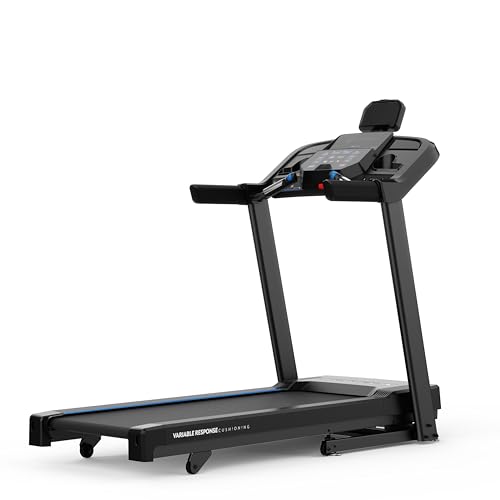
Rated at 2.5 continuous horsepower, this motor sustains running instead of fading on long sessions. Hydraulic assist raises the deck upright and lowers it slowly, which matters in a tight bedroom. Incline climbs to 10 percent, giving hill work that no walking pad can offer.
Pros
- Continuous horsepower rating built for running loads
- Hydraulic assist stops the deck dropping hard
- Bluetooth speakers and a tablet shelf included
Cons
- Folded upright it still occupies a corner
- Assembly takes two people and about an hour

WalkingPad C2
Hinged across the middle, this pad halves its length and slides into a closet or under a bed frame. Top speed near 3.72 mph keeps it in brisk walking territory. Nothing sticks up to hold, which suits confident walkers taking calls at a desk.
Pros
- Smallest stored footprint in this group
- Quiet at walking pace in upstairs apartments
- Deploys and stows in under a minute
Cons
- Tops out below jogging speed
- No handrail for unsteady users

UREVO 2 in 1 Folding Treadmill
Dropping the handrail flat turns this into a desk walker, while raising it unlocks speeds near 7.6 mph. One machine therefore covers a work day and an evening jog. Capacity sits around 265 pounds, and the slim chassis stays parked under a standing desk between sessions.
Pros
- Handles desk walking and light running in one frame
- Clears most standing desks with the rail folded
- Remote and LED console come in the box
Cons
- Belt is shorter than a full running deck
- Motor warms up on long fast sessions

NordicTrack EXP 7i
Incline reaches 12 percent, the steepest grade in this lineup. Guided iFIT workouts drive incline and speed from the touchscreen, so hill sessions run without manual input. SpaceSaver hinging tilts the 20 by 55 inch deck upright, though the frame stays heavy to shift.
Pros
- Steepest incline range here at 12 percent
- Guided sessions adjust incline and speed automatically
- Cushioned deck softens repeated foot strike
Cons
- Heavy to reposition even on transport wheels
- Best features assume an iFIT membership

Sole F63
At 20 by 60 inches, this belt adds five inches of stride room over the usual compact deck. A 3.0 CHP motor and a 325 pound capacity keep the frame settled at speed rather than flexing. Easy Assist folding raises it upright, yet nothing here is harder to move once assembled.
Pros
- Longest belt here for tall runners
- 325 pound capacity and a rigid frame
- Deck cushioning aimed at knee comfort
Cons
- Very heavy once assembled
- Folded upright it still needs floor area

XTERRA Fitness TR150
Pairing a 2.25 horsepower motor with a 16 by 50 inch belt suits walking and light jogging. Incline changes by hand across three fixed positions before a session starts. Soft drop hinging protects the deck, and the frame carries about 250 pounds.
Pros
- Cheapest entry into a folding treadmill
- Soft drop hinge lowers the deck safely
- Light enough to wheel between rooms
Cons
- Narrow 16 inch belt cramps longer strides
- Incline cannot change mid session
How to pick the right one
What to look for in a compact treadmill Folded height and weight settle this purchase more than motor claims do. Measure the gap under your bed and the corner you can spare, then shortlist from those two numbers. Slab folders such as Echelon Stride and WalkingPad C2 vanish under furniture, while upright folders like NordicTrack EXP 7i keep their width and lean into the room. Weight is the factor buyers underestimate, because anything past roughly 150 pounds stops getting moved after the second week.
Walking pad vs folding treadmill These two products share a shelf and solve different problems. Pads stop near 4 mph, skip the handrail and exist for desk work and phone calls. Folding treadmills add a continuous duty motor, a longer belt and powered incline. Pick a pad if the target is daily step count, and a treadmill if you want to train at pace. Anyone chasing both should look at the two mode UREVO before buying two machines.
Deck length for your height and stride Stride length sets the minimum belt you can live with. Runners near six feet or taller are better served by 60 inches, which is why Sole F63 earns a slot here. Most adults run comfortably on 55 inches, and 50 inches feels tight once pace climbs. Read continuous horsepower rather than peak figures, since peak describes a burst the motor cannot hold. Around 2.5 CHP is the sensible floor for regular running.
Best for apartments and shared floors Impact noise travels down through a floor far more readily than motor hum travels sideways. A rubber mat under the frame cuts vibration, damps belt whine and protects the flooring beneath. Walking pads stay quietest because low speed keeps the motor lightly loaded. Renters above a neighbor should assume a run before bed will be heard, whatever a listing claims about quiet operation. Shift hard sessions to daylight hours and the machine stops being a problem.
How they stack up
| # | Model | Folded height | Best for | Score | Price |
|---|---|---|---|---|---|
| 1 | Echelon Stride | About 10 inches | Best overall | 9.4 | Check price |
| 2 | Horizon Fitness T101 | 2.5 CHP | Best for regular runners | 9.2 | Check price |
| 3 | WalkingPad C2 | About 3.72 mph | Best for under bed storage | 9.0 | Check price |
| 4 | UREVO 2 in 1 Folding Treadmill | About 7.6 mph with handrail raised | Best under a standing desk | 8.8 | Check price |
| 5 | NordicTrack EXP 7i | Up to 12 percent | Best for incline training | 8.5 | Check price |
| 6 | Sole F63 | About 20 by 60 inches | Best for taller runners | 8.3 | Check price |
| 7 | XTERRA Fitness TR150 | 2.25 HP | Best budget | 8.0 | Check price |
Questions worth asking
Can you run on a compact treadmill?
Yes, as long as the belt is long enough and the motor carries a continuous horsepower rating. Echelon Stride, Horizon Fitness T101 and Sole F63 all support running. Walking pads such as WalkingPad C2 stop at brisk walking speed.
What is the difference between a walking pad and a treadmill?
Walking pads drop the handrail, cap speed near 4 mph and sit low for desk use. Treadmills add a rail, a stronger motor and usually powered incline. Two mode designs like the UREVO fold their rail flat to cover both roles.
How much space does a folding treadmill need?
Allow the full unfolded length during use plus clearance behind you for a safe dismount. Folded slab designs need only their length and roughly 10 inches of height. Upright folders keep their width and lean against a wall.
Which compact treadmill is quietest for apartments?
Walking pads run quietest because the motor works at low load. A rubber mat under any frame reduces the impact noise that carries to the floor below. Running at speed stays audible downstairs regardless of model.
Do compact treadmills have incline?
Many do. NordicTrack EXP 7i reaches 12 percent and Horizon Fitness T101 reaches 10 percent, both motorized. Budget machines like the XTERRA TR150 use fixed positions you set by hand before stepping on.
What deck length do I need for my height?
Around 60 inches suits runners near six feet or taller. Most adults are fine at 55 inches. Walking only users can live with 50 inches or less, which is why pads get away with short belts.
Is a compact treadmill good for tall runners?
Only the longer decks are. Sole F63 offers 20 by 60 inches, giving room for a full stride at pace. Belts at 50 inches force tall runners to shorten their step, which changes gait and invites heel strikes off the back.
Which is better, Echelon Stride or Horizon Fitness T101?
Stride folds flat to about 10 inches and disappears under furniture. T101 folds upright but brings a 2.5 CHP motor and 10 percent incline. Storage space decides it: choose Stride for tight rooms, T101 for training variety.
Are under desk treadmills worth it for working from home?
They add thousands of steps across a work day without blocking typing or calls. Roughly 2 mph is the practical ceiling for keyboard work. Keep a chair within reach, since standing all day brings its own fatigue.
How do I move a folding treadmill on my own?
Fold it first, tip it onto the transport wheels, then pull rather than push. Clear the route beforehand, because doorways and thresholds are where these machines jam. Anything past about 150 pounds realistically needs a second pair of hands.
The verdict
Echelon Stride takes this on one combination: a folded slab near 10 inches and a deck long enough to run on. Tall runners should step up to Sole F63, whose 20 by 60 inch belt no other folder here matches. Anyone whose goal is step count during a work day belongs on the WalkingPad C2, which never pretends to handle a jog.
Derek Holt
Derek has a background coaching recreational and amateur athletes and has worked the sales floor at specialty fitness retailers. He focuses on equipment durability, ergonomics and realistic use cases rather than marketing claims.