Pocket Marking Tools That Hold a Line on Any Surface
Milwaukee INKZALL fine point markers suit most pouches, writing on damp, dusty and oily material that stops graphite. Pica-Dry 3030 reaches inside drilled holes and shows white on black conduit. Swanson S0101 squares a framing line faster than a combination square can be set.
Milwaukee INKZALL fine point markers fit nearly every trade pouch. Ink grips damp lumber, dusty drywall and galvanised duct, where a carpenter pencil skates. Tips resist mushrooming when dragged across rough OSB. One limitation matters: the ink is permanent, so a wrong line on a show face has to be planed off.
Marking looks trivial until a 2mm line drifts across six repeated cuts and the last piece binds. Surfaces fight back in different ways. Graphite skids on galvanised steel, ink bleeds into open cedar grain, chalk washes off in rain. We compared tip geometry, line width, surface compatibility, refill availability and pouch footprint from manufacturer specifications. Owner feedback filled in what fails first, usually lead tips and chalk case seals.
What we recommend

Milwaukee 48-22-3100 INKZALL Fine Point Jobsite Markers
Fine point ink bonds to wet, dusty and oily material instead of beading off it. Chisel resistant tip geometry holds line width steady after hundreds of marks on sheathing and duct. A barrel clip rides in a pouch or on a hard hat brim, and the cap seals well enough to survive months in a bag.
Pros
- Writes on damp lumber, dusty drywall and galvanised duct
- Tip keeps its shape instead of mushrooming on OSB
- Multi packs let you stock several pouches at once
Cons
- Permanent ink cannot be erased from a show face
- Line runs wider than a scribed mark for joinery

Pica-Dry 3030 Longlife Automatic Pencil
A long slim nose pushes lead into drilled holes and recessed channels that no pencil reaches. Leads swap in seconds, and graphite, white and yellow options cover black conduit and galvanised pipe. Twisting the cap runs the point through a built in sharpener, so no knife is needed.
Pros
- Marks inside holes and behind obstructions
- White and yellow leads read clearly on dark metal
- Cap sharpener restores a fine point in seconds
Cons
- Leads snap when the tool lands nose first
- Bulkier in a pocket than a flat carpenter pencil
Kreg KMA2900 Multi-Mark Multi-Purpose Marking and Measuring Tool
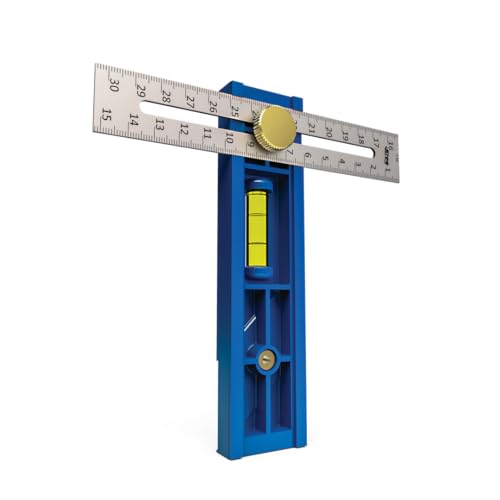
One body covers depth gauge, marking gauge, square, level and offset ruler duty. A thumbscrew locks the sliding arm, so repeated marks land on the same setting without re-measuring. Imperial graduations run along one face and metric along the other.
Pros
- Replaces four or five separate layout tools in a pouch
- Locked arm repeats an offset across a run of parts
- Bubble vial handles quick level checks
Cons
- Composite body flexes under hard hand pressure
- Short rule limits it to small layout work

Swanson Tool Co S0101 Speed Square 7 Inch
Cast aluminium and a fixed fence put a 90 or 45 degree line on a board edge in one motion. Degree graduations along the hypotenuse cover common and hip rafter angles. Many owners run a circular saw shoe against the thick edge for short crosscuts.
Pros
- Fence registers a square line without measuring
- Thick edge doubles as a short saw fence
- Degree scale handles rafter and stair layout
Cons
- Cast edges dent when dropped on concrete
- Too large for a shirt pocket
DEWALT DWHT47373L Chalk Reel
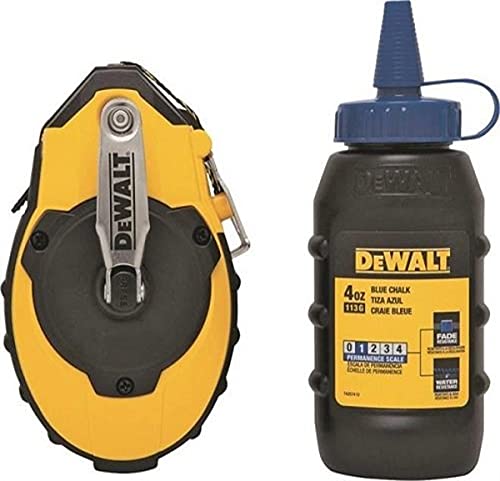
High speed gearing rewinds 100 feet of line quickly, which matters when snapping rafter after rafter across a roof deck. Sealed case keeps chalk dry, and a wide refill mouth cuts spillage. Folding handle and belt clip let it sit flat against a hip all day.
Pros
- Rewinds fast enough to keep pace with repeat snaps
- Sealed case keeps chalk usable in damp air
- Sits flat on a belt instead of catching on studs
Cons
- Chalk blurs on wet or heavily textured surfaces
- Lines beyond about 20 feet need a second pair of hands

General Tools 88 Automatic Center Punch
Push the body down and an internal spring fires a hardened point, leaving a dimple that stops a drill bit walking. A knurled cap adjusts impact force for thin sheet or thick plate. Nothing here needs a hammer, so it works one handed on an awkwardly clamped part.
Pros
- Stops bits skating on smooth or curved steel
- Adjustable force suits both sheet and plate
- Smallest and simplest tool listed here
Cons
- Dimple is permanent, so keep it off finish surfaces
- Spring softens after heavy production use

Starrett 70AZ Pocket Scriber
A hardened point cuts the line into metal or dense hardwood rather than laying ink on top. Marks survive cutting fluid, sawdust and handling that would smear a marker. Reversing the point into the knurled body makes the tool safe to pocket between cuts.
Pros
- Finest line of any tool listed here
- Scribed mark survives coolant, dust and handling
- Point stores inside the body for safe carry
Cons
- Scratches cannot be sanded out of visible faces
- Point follows grain on soft framing lumber
Side by side
| # | Model | Tip | Best for | Score | Price |
|---|---|---|---|---|---|
| 1 | Milwaukee 48-22-3100 INKZALL Fine Point Jobsite Markers | Fine point, chisel resistant | Best overall | 9.4 | Check price |
| 2 | Pica-Dry 3030 Longlife Automatic Pencil | 2.8mm graphite, white and yellow | Best for deep holes and dark surfaces | 9.2 | Check price |
| 3 | Kreg KMA2900 Multi-Mark Multi-Purpose Marking and Measuring Tool | Depth gauge, marking gauge, square, level | Best value | 9.0 | Check price |
| 4 | Swanson Tool Co S0101 Speed Square 7 Inch | 7 inch | Best for angle layout | 8.8 | Check price |
| 5 | DEWALT DWHT47373L Chalk Reel | 100 feet | Best for long straight lines | 8.6 | Check price |
| 6 | General Tools 88 Automatic Center Punch | Hardened steel, replaceable | Best budget | 8.3 | Check price |
| 7 | Starrett 70AZ Pocket Scriber | Hardened steel, reversible | Best for fine scribed lines | 8.0 | Check price |
How to choose
What to look for in a marking tool Match the mark to the surface before anything else. Ink covers wet and dirty material, graphite suits clean lumber, a scribed line wins on steel. Line width comes next, since a 2mm marker stroke doubles the error of a sharp pencil line. Refills decide how often you restock, because leads and chalk run out while a scriber never does. Pouch footprint settles whether the tool actually gets carried.
Best marking tools for framing and rough carpentry Speed beats hairline accuracy on framing lumber. Swanson’s S0101 registers a square line against a joist faster than a combination square can be set. Pair it with an INKZALL marker for stud layout and a chalk reel for plate lines. Leave the scriber in the truck here, because its point follows soft grain instead of your straightedge. Chalk also reads across a sheathed deck from ten feet away, which pencil never does.
How to mark metal, conduit and electrical runs Graphite barely registers on galvanised steel, and marker ink wipes off oily stock. White or yellow Pica-Dry leads fix visibility on black pipe and EMT conduit. Punch a dimple with the General Tools 88 before drilling, or the bit wanders and the hole ends up oval. Layout that must survive cutting fluid calls for the Starrett scriber. Knock the burr off scribed sheet metal before handling it, since a raised edge cuts through gloves.
Fine joinery and finish work: when to scribe instead Visible surfaces change the rules completely. Permanent marker bleeds into open grain and ghosts through stain, so keep INKZALL off show faces. A scribed line severs the top fibres and gives a chisel a definite wall to drop into. Where the mark has to vanish later, a 0.5mm mechanical pencil beats both. Kreg’s Multi-Mark repeats an offset across a run of parts without measuring each one again.
Good to know
What marking tools belong in a basic tool pouch?
A jobsite marker, a speed square and a chalk reel handle most framing and remodel work. Add a center punch once you start drilling steel. Trim carpenters usually swap the marker for a mechanical pencil or a scriber.
How do you mark accurately on wet or dirty lumber?
Reach for ink rather than graphite. INKZALL markers are formulated for damp and dusty surfaces, and the fine tip keeps the line narrow. Wipe standing water off first, because pooled water still repels ink.
Which marking tool works on dark metal and conduit?
White or yellow leads stand out against galvanised and black surfaces. Pica-Dry 3030 accepts both colours in the same body. Its long nose also reaches inside drilled holes, which no flat pencil manages.
Is a scriber better than a pencil for woodworking?
For joinery shoulders, yes. A scribed line cuts the top fibres and gives a chisel an edge to register against. On softwood framing a pencil wins, since a scriber point drifts along the grain rather than your rule.
Can a speed square replace a combination square?
Only partly. Speed squares are faster for 90 and 45 degree marks and for rafter angles. Combination squares still win on setting depths, gauging parallel lines and checking an assembled corner.
Do you need a center punch before drilling steel?
Yes on anything smooth or curved. Without a dimple the bit skates and the hole ends up elongated. An automatic punch such as the General Tools 88 does it one handed, which helps when the part is clamped awkwardly.
How long does a chalk line stay visible outdoors?
Standard blue chalk lasts a few dry days and rinses off in rain. Permanent red chalk holds far longer but stains masonry. Snap your lines shortly before cutting rather than the day before.
Chalk line vs laser line: which is more practical?
Chalk leaves a physical mark you can cut to, and it stays readable in bright sun. Lasers suit repeated reference lines indoors, especially tile and cabinet installs. Most crews carry chalk and borrow a laser for the odd job.
Are carpenter pencils still worth carrying?
For rough layout on dry lumber they remain hard to beat, and the flat body will not roll off a rafter. Sharpening is the nuisance, which is why Pica-Dry and mechanical pencils have taken over on finish work. Most pouches end up holding one of each.
The bottom line
Buy the Milwaukee INKZALL fine point markers if you only add one tool, because they mark the damp and dusty material that defeats graphite. Electricians and metalworkers should start with the Pica-Dry 3030 instead, since white and yellow leads read on conduit and the nose reaches inside drilled holes. Anyone cutting visible joinery is better off scribing with the Starrett 70AZ, which leaves a wall a chisel can land against.
Jake Monroe
Jake worked as a residential contractor for over a decade before shifting to full-time writing. He evaluates power tools, hand tools and workshop gear through the lens of someone who has actually used them on job sites, not just read the box.