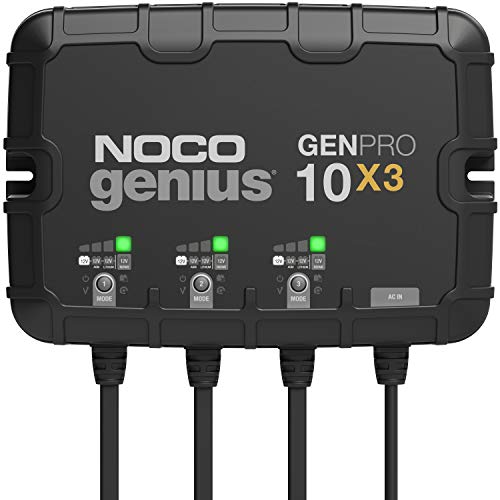
Compact Marine Battery Chargers That Keep You Afloat
The NOCO Genius GENPRO10X1 takes the top spot for compact marine charging, offering a 10-amp output in a rugged, waterproof case that suits most boat owners. Its main advantage is the boost mode that revives deeply discharged batteries, while its limitation is a single bank output.
A dead battery can ruin a day on the water. Compact marine battery chargers solve this by being small enough to store onboard and powerful enough to keep your batteries topped up.
We compared seven of the most popular compact chargers based on specs, owner feedback, and portability. Whether you need a single bank for a small boat or a multi-bank for a fishing rig, this list has a fit.
The shortlist, ranked

NOCO Genius GENPRO10X1
This charger delivers 10 amps of power in a compact, waterproof case. It automatically detects 12V or 24V systems and has a boost mode to revive dead batteries. Owners report it handles saltwater environments well.
Pros
- High charge current for fast top-ups
- Spark-proof and reverse polarity protection
- Compact and easy to mount
Cons
- Single bank only
- Price is higher than some competitors

Battery Tender Plus 021-0128
A classic 1.25 amp charger that is lightweight and simple. It is not waterproof, but it is ideal for keeping small boat batteries charged between trips. Owners appreciate its reliability and long cable.
Pros
- Very affordable
- Maintains battery without overcharging
- Lightweight and portable
Cons
- Slow charge time for larger batteries
- Not sealed against moisture

Minn Kota MK-2 Precision
This charger offers two 5 amp banks, letting you charge two batteries at once. It is designed for 12V trolling motors and has a rugged, water-resistant case. Users report it is reliable and easy to install.
Pros
- Charges two batteries simultaneously
- LED indicators for each bank
- Sturdy mounting brackets
Cons
- Not fully waterproof
- Amps per bank are moderate

ProMariner ProSport 8
The ProSport 8 provides three banks of 2.5 amps each, perfect for boats with a starting, house, and trolling battery. It is lightweight and has a splash-proof design. Owners like its smart charging profile.
Pros
- Charges three batteries independently
- Automatic temperature compensation
- Compact for its capacity
Cons
- Lower per-bank amperage
- No lithium support

Guest 2611A
A straightforward 10 amp charger that is small and easy to use. It is not waterproof but is durable enough for many boaters. Owners report it charges quickly and has a clear status light.
Pros
- High amperage for fast charging
- Simple plug and charge operation
- Compact footprint
Cons
- No multi-bank capability
- Less rugged than waterproof models

Schumacher SC1281
This 8 amp charger is compact and handles lead-acid, AGM, gel, and lithium batteries. It has a digital display and a float mode for maintenance. Owners find it versatile for both boat and car batteries.
Pros
- Works with lithium batteries
- Digital display for charging status
- Affordable price point
Cons
- Not waterproof
- Heavier than some competitors

CTEK 40-206
The CTEK 56-898 is a compact 4.3 amp charger that automatically adjusts to the battery’s needs. It is fully waterproof and designed for marine environments. Owners praise its ability to desulfate and extend battery life.
Pros
- Waterproof and rugged
- Multi-stage charging for battery health
- Desulfation mode
Cons
- Lower amperage for large batteries
- Premium price
Compared at a glance
| # | Model | Output | Best for | Score | Price |
|---|---|---|---|---|---|
| 1 | NOCO Genius GENPRO10X1 | 10 amps | Best overall for its power and durability | 9.4 | Check price |
| 2 | Battery Tender Plus 021-0128 | 1.25 amps | Best for small batteries and maintenance charging | 8.8 | Check price |
| 3 | Minn Kota MK-2 Precision | 5 amps per bank (2 banks) | Best for trolling motor batteries and two-bank setups | 9.0 | Check price |
| 4 | ProMariner ProSport 8 | 2.5 amps per bank (3 banks) | Best for three-bank setups | 8.9 | Check price |
| 5 | Guest 2611A | 10 amps | Best for basic single-bank charging with simplicity | 8.4 | Check price |
| 6 | Schumacher SC1281 | 8 amps | Best for value with multiple battery types | 8.7 | Check price |
| 7 | CTEK 40-206 | 4.3 amps | Best for automatic maintenance and multi-stage charging | 9.2 | Check price |
How to choose
Questions worth asking
Can I use a regular car battery charger on my marine battery?
Yes, but it is not recommended for long term. Marine batteries are often AGM or gel, which require a specific charging profile. A regular car charger may overcharge or damage them. A dedicated marine charger is safer.
What is the difference between a 2-bank and a 3-bank charger?
A 2-bank charger has two independent outputs, allowing you to charge two batteries at once. A 3-bank charger can handle three batteries, which is useful for boats with a start, house, and trolling battery.
How many amps do I need in a compact marine charger?
For small batteries under 50 amp hours, a 5 amp charger works. For larger batteries, choose a 10 amp charger. Higher amps reduce charge time but generate more heat. Always match the charger to your battery capacity.
Are all marine battery chargers waterproof?
No, not all are waterproof. Some are water resistant or splash proof. For marine use, look for an IP rating of at least IP65. Fully waterproof chargers can be submerged temporarily, but they are more expensive.
Can I leave my marine battery charger connected all the time?
Yes, many modern chargers have a float mode that maintains the battery without overcharging. Leaving a smart charger connected is safe and keeps the battery ready. Older chargers without this feature should be disconnected when charged.
Will a compact charger work on lithium marine batteries?
Only if the charger specifically supports lithium. Lithium batteries have a different charging profile and can be damaged by a lead acid charger. Check the specifications for lithium compatibility before use.
What is the typical lifespan of a marine battery charger?
With proper use, a quality marine charger can last 5 to 10 years. Waterproof models tend to last longer because they resist corrosion. Avoid exposing the charger to salt spray and store it in a dry place when not in use.
Do I need a charger with a desulfation mode?
Desulfation is helpful if you have lead acid batteries that sit unused for long periods. It can reverse sulfation and extend battery life. If you have AGM or lithium, this feature is not necessary.
Can I mount my compact charger inside the boat?
Yes, most compact chargers can be mounted in a dry location. Ensure the mounting surface is secure and the charger has proper ventilation. Avoid mounting where it can get wet or where vibration is high.
What safety features should I look for?
Look for reverse polarity protection, spark proof connections, and overcurrent protection. These features prevent damage if you connect the clamps incorrectly or if there is a short circuit.
Final word
For most boaters, the NOCO Genius GENPRO10X1 is the top choice because it offers the best balance of power, durability, and compact size. If you need to charge two batteries, the Minn Kota MK-2 is a solid alternative. For a budget option, the Battery Tender Plus is dependable for small batteries. Pick the NOCO for a hassle free experience.
Derek Holt
Derek has a background coaching recreational and amateur athletes and has worked the sales floor at specialty fitness retailers. He focuses on equipment durability, ergonomics and realistic use cases rather than marketing claims.