Which Compact Electrical Box Fits Your Wall Depth?
Carlon B618R fits most retrofit jobs. Its 18 cubic inches clears a device plus two 12 gauge cables, and swing arm ears grip finished drywall. Open studs suit the Carlon B120A, which nails flush and holds 20 cubic inches. RACO 8192 takes EMT and MC connectors directly.
Carlon B618R suits anyone adding a switch or outlet to a wall that is already closed. Eighteen cubic inches leaves room for a device and two 12 gauge cables under NEC fill rules. Swing arm ears set the limit here, since they need sound drywall to bite. Crumbling plaster or open studs call for a different box.
Sizing confuses buyers because the printed number is volume, not outside dimensions. NEC 314.16 counts conductors, devices, clamps and grounds as separate units. Overfill a box and the device pinches insulation as you seat it. We compared cubic inch ratings, wall depth needed, mounting hardware, knockout sizes and clamp design, then read owner reports on whether the ears and nails hold.
Before you buy
How to size a box by cubic inches Volume decides what fits, not the width of the opening. NEC 314.16 counts each 14 gauge conductor as 2 cubic inches and each 12 gauge conductor as 2.25. A switch or receptacle counts double the largest conductor present. All grounds together add one count, and internal clamps add one more. Total those numbers before choosing between a 14 and an 18 cubic inch box.
Old work or new work: matching the box to your wall Open framing wants a nail on box such as the B120A, which registers depth against the stud face. Finished walls need swing arm ears, and both Carlon retrofit boxes use them. Plaster and lath complicates matters, because crumbling keys give the ears nothing solid to grab. Cut a test hole first. Intact material should surround the opening for at least an inch.
Plastic or metal, and where each belongs Non metallic boxes pair with NM cable in residential walls and need no bond of their own. Metal earns its place where EMT, MC or armoured cable lands, since the raceway carries the equipment ground and connectors thread into knockouts. Ceilings make another case for steel, which shrugs off repeated fixture swaps that crack PVC tabs. Every metal box gets a pigtail to the green box screw.
Boxes for ceilings, outdoors and low voltage runs Ceiling fans demand a listed fan rated box with a brace, so treat the RACO 690 as a light fixture box only. Wet locations need a weatherproof housing plus a matching gasketed cover, and an in use cover becomes mandatory where cords stay connected. Data and AV cable belongs in an open bracket like the LV1RR. Mixing low voltage with line voltage inside one enclosure is not permitted.
What we recommend

Carlon B618R Old Work Box
Two captive screws rotate the swing arm ears behind the drywall and pull the box tight. Eighteen cubic inches covers a receptacle or a deep smart switch plus the cables a remodel usually brings in. PVC construction skips the box bond, though the device ground still terminates inside.
Pros
- One saw cut opening is all the install needs
- Integral clamps hold NM cable without extra connectors
- Volume leaves room to fold conductors behind a bulky device
Cons
- Sound drywall required, not crumbling plaster
- Over driven screws let the ears spin free
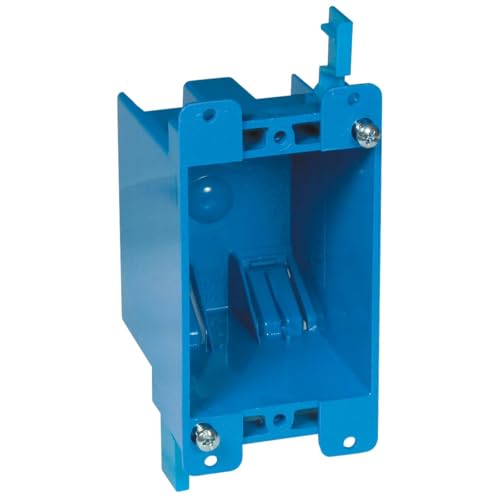
Carlon B114R Old Work Box
Shorter body, same ear mechanism as the B618R. Fourteen cubic inches handles one device with two cables in most cases, and the reduced depth clears insulation, ductwork or a stud face sitting just behind the opening. Run the fill count first if three cables land here.
Pros
- Clears cavities too shallow for a deep box
- Light enough to hold one handed while making up wires
- Standard single gang face fits any plate or device
Cons
- Three cables push the fill count to its limit
- Deep smart devices crowd the folded conductors

Carlon B120A New Work Box
Captive nails drive into the stud face while a depth gauge sets the box flush for half inch drywall. Twenty cubic inches makes this the roomiest single gang box listed here. Install it during a remodel with framing open, because those nails become unreachable once the wall closes.
Pros
- Largest single gang volume in this group
- Depth gauge removes guesswork on drywall thickness
- Fastest box to mount on exposed studs
Cons
- No use once the wall is closed up
- Nails bend in old, hardened framing lumber

RACO 8192 Steel Square Box
Drawn steel with welded corners accepts EMT connectors and MC cable clamps straight into its knockouts. Twenty one cubic inches leaves room for splices, and a mud ring converts the opening to one or two devices. Bonding is mandatory, so plan a pigtail to the green box screw.
Pros
- Half inch and three quarter inch knockouts suit mixed raceway
- A blank cover turns it into a junction box
- Welded corners resist twisting during rough in
Cons
- Separate bonding conductor required
- Mud ring needed before any device can mount

RACO 690 Steel Octagon Box
Fixture screws on 2.75 inch centres line up with most light canopies and smoke detector bases. Fifteen and a half cubic inches holds a fixture whip plus one incoming cable. Paddle fans fall outside its rating and need a listed fan rated box with a brace.
Pros
- Canopy screw pattern matches standard fixtures
- Steel survives repeated fixture swaps without cracking
- Mounts in ceilings and walls alike
Cons
- Not rated to carry a ceiling fan
- Bonding pigtail required like any metal box

Arlington Industries LV1RR Low Voltage Bracket
An open bracket rather than an enclosed box, which is what HDMI, coax and Ethernet actually need. Cable passes straight through with no clamp to crush the jacket, and flexible ears grip drywall from a quarter inch to one inch thick. Line voltage must never run through it.
Pros
- Open back lets a moulded HDMI head pass through
- Single cut install with no stud contact
- Takes standard keystone wall plates
Cons
- Not permitted for line voltage wiring
- Cable behind the wall gets no physical protection

Bell Outdoor 5320-0 Weatherproof Box
Die cast aluminium with three threaded half inch hubs lets conduit enter from whichever side the run favours. Supplied plugs seal whichever hubs stay unused. An in use cover belongs on top wherever a cord remains plugged in, since the housing alone does not weatherproof the opening.
Pros
- Conduit enters from three directions
- Threaded hubs seal tighter than punched knockouts
- Powder coat holds up to sun and rain
Cons
- Cover sold separately
- Heaviest box in this group
How they stack up
| # | Model | Capacity | Best for | Score | Price |
|---|---|---|---|---|---|
| 1 | Carlon B618R Old Work Box | 18 cubic inches | Best overall | 9.4 | Check price |
| 2 | Carlon B114R Old Work Box | 14 cubic inches | Best for shallow cavities | 9.1 | Check price |
| 3 | Carlon B120A New Work Box | 20 cubic inches | Best for new framing | 9.0 | Check price |
| 4 | RACO 8192 Steel Square Box | 21 cubic inches | Best for conduit runs | 8.8 | Check price |
| 5 | RACO 690 Steel Octagon Box | 15.5 cubic inches | Best for ceiling fixtures | 8.6 | Check price |
| 6 | Arlington Industries LV1RR Low Voltage Bracket | Open low voltage mounting bracket | Best for data and AV cable | 8.3 | Check price |
| 7 | Bell Outdoor 5320-0 Weatherproof Box | Die cast aluminium | Best for outdoor use | 8.0 | Check price |
Questions worth asking
How many wires fit in an 18 cubic inch box?
With 12 gauge cable, an 18 cubic inch box supports about eight counts. One device takes two, all grounds together take one, and internal clamps take one. That leaves room for two cables plus a switch.
What is the difference between old work and new work electrical boxes?
New work boxes nail or screw to a stud before drywall goes up. Old work boxes clamp onto finished drywall with swing arm ears through a single cut opening.
Can I hang a ceiling fan from a standard octagon box?
No. Paddle fans require a box listed for fan support plus a brace or direct structural attachment. A RACO 690 carries a light fixture only.
Do plastic electrical boxes need to be grounded?
The box itself does not, since PVC carries no current. Circuit grounds still land on the device, joined by a pigtail inside the box where more than one cable enters.
Which electrical box works in a shallow wall cavity?
Check the listed wall range instead of the volume. Arlington LV1RR covers drywall from 0.25 to 1 inch for low voltage, while the Carlon B114R is the shallow answer for line voltage.
Is a low voltage bracket the same as an electrical box?
No. Brackets have no back and no clamps, which suits Ethernet, coax, speaker and HDMI cable. Line voltage always requires an enclosed, listed box.
Can an indoor box be used outside under an eave?
Not safely. Damp and wet locations call for a weatherproof housing such as the Bell 5320-0 with a gasketed cover made for it.
How deep should a box be for a smart switch?
Aim for 18 to 20 cubic inches. Smart switches carry deep bodies and a neutral pigtail, so a 14 cubic inch box rarely leaves room to fold the conductors.
What size box do I need for two switches?
Either a two gang box or a 4 inch square box fitted with a two device mud ring. Each device counts double the largest conductor, so required volume climbs quickly.
Are metal boxes better than plastic for residential wiring?
Neither wins outright. Plastic installs faster and needs no bond with NM cable, while steel is required wherever conduit or armoured cable terminates.
The bottom line
Keep a Carlon B618R on the shelf. Eighteen cubic inches and swing arm ears cover the vast majority of retrofit switches and receptacles in drywall. Switch to the RACO 8192 wherever EMT or MC cable terminates and a bonded steel enclosure is required. Anyone pulling HDMI or Ethernet to a wall mounted display should skip boxes entirely and fit the Arlington LV1RR bracket.
Jake Monroe
Jake worked as a residential contractor for over a decade before shifting to full-time writing. He evaluates power tools, hand tools and workshop gear through the lens of someone who has actually used them on job sites, not just read the box.