Commercial Water Heaters That Keep Up With Peak Demand
Rheem Performance Platinum Commercial leads for fast recovery and a durable glass-lined tank. A.O. Smith ProLine XE suits buildings without gas service at a lower price. Restaurants running multiple stations at once get steadier output from the Rinnai RUC98iN Ultra Series tankless system.
Rheem Performance Platinum Commercial suits property managers who need fast recovery without a full tankless retrofit, though its footprint demands real mechanical room space.
Building type drives most of this decision, so recovery rate, fuel type, and tank versus tankless design were compared against typical demand patterns for offices, restaurants, and hotels.
What matters most
What to look for in a commercial water heater Recovery rate matters more than tank size alone in commercial settings, since it determines how fast hot water returns after a draw. Fuel type often gets decided by what’s already run to the building, because switching from electric to gas adds real installation cost. Duty rating labels, like light commercial versus continuous-use, show whether a unit actually fits your demand pattern.
Tank or tankless for your building Tank systems store a fixed volume of hot water, which works well for buildings with predictable, moderate demand. Tankless units like the Rinnai RUC98iN skip that limit entirely, so restaurants and gyms with unpredictable peak usage don’t run out. Upfront cost runs higher on tankless, and gas line sizing has to support the rated flow.
Matching capacity to building type Restaurants and commercial kitchens need either a high flow rate tankless unit or a large tank to handle dishwashing and handwashing at the same time. Offices and salons with lighter demand can run well on a mid-size tank, like the Bradford White or A.O. Smith ProLine XE. Hotels and larger multi-unit buildings need the highest capacity options, such as the State Water Heaters Sandblaster HD.
Efficiency and long-term operating cost Condensing tankless units, like the Navien NPE-240A2, cost more to install but recover heat that non-condensing models vent away unused. Buildings running hot water continuously through the day see the biggest payoff from that efficiency gain. Properties with lighter, intermittent demand may take longer to recoup the extra upfront cost.
Our top picks
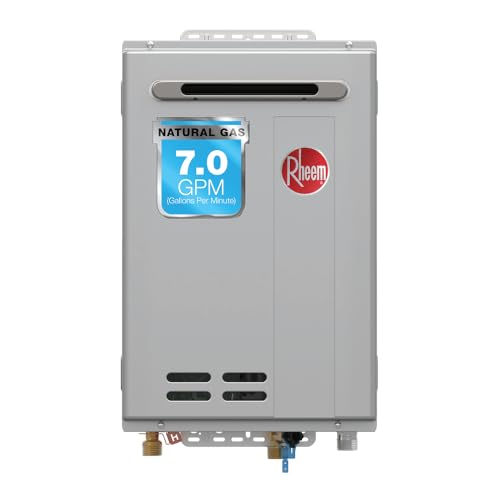
Rheem Performance Platinum Commercial Gas Water Heater
A high-input gas burner recovers hot water faster than typical residential units, which suits salons, laundromats, and small restaurants. Glass lining resists the corrosion that uncoated steel develops after years of daily draws. Built-in self-diagnostics flag problems early, before they cause a full shutdown.
Pros
- High-output burner recovers water faster than residential-grade tanks
- Glass-lined tank resists corrosion through years of daily use
- Self-diagnostic controls catch issues before a full outage
Cons
- Needs a properly sized gas line to reach full burner output
- Tank footprint requires dedicated mechanical room space
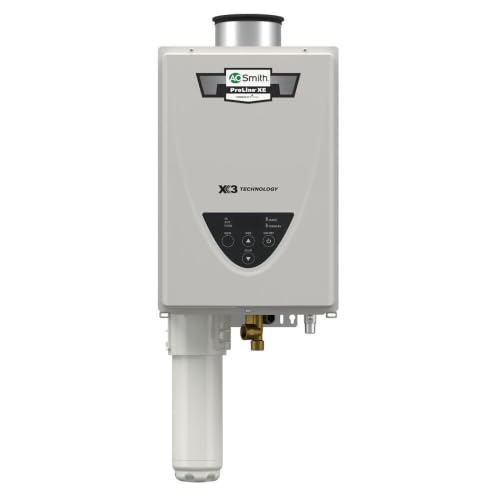
A.O. Smith ProLine XE Commercial Electric Water Heater
Dual heating elements keep recovery reasonably quick despite running on electricity alone, which fits buildings without gas service. A.O. Smith rates the tank for light commercial use in offices and small multi-unit properties. Foam insulation limits standby heat loss between draws better than older tank designs.
Pros
- Runs in buildings with no gas line access
- Dual elements keep recovery speed reasonable for an electric tank
- Foam insulation reduces standby heat loss between draws
Cons
- Recovery still trails a comparable gas-fired tank
- Electricity costs more per gallon heated than gas in most regions

Bradford White Commercial Electric Water Heater
Bradford White trims cost while still meeting a light commercial duty rating, fitting small offices and retail spaces. A brass drain valve resists the corrosion that plastic valves develop over years of service. The standard warranty runs shorter than premium commercial lines, reflecting the lower price.
Pros
- Lower price fits tighter commercial equipment budgets
- Brass drain valve outlasts plastic against corrosion
- Offered in several tank sizes for different building needs
Cons
- Warranty period runs shorter than higher-tier commercial models
- Not rated for high-demand or continuous-use buildings

Rinnai RUC98iN Ultra Series Tankless Water Heater
Continuous flow replaces tank storage entirely, which suits restaurants and gyms running several fixtures at once. A high flow rate keeps water pressure stable through simultaneous draws. Condensing technology recovers heat that standard tankless units vent away unused.
Pros
- Continuous output avoids running out during peak demand
- High flow rate supports multiple fixtures running together
- Condensing design improves fuel efficiency over standard tankless units
Cons
- Installation costs more than a comparable tank system
- Needs professional gas line sizing and venting work

Noritz NRC1111-DV Commercial Tankless Water Heater
Noritz built this line for commercial kitchens that need sustained hot water through long service hours. A high maximum flow rate covers dishwashing and handwashing stations running at the same time. Direct venting simplifies installation in buildings without an existing chimney.
Pros
- High flow rate keeps up with busy kitchen service
- Direct venting skips the need for existing chimney infrastructure
- Output holds steady through peak service hours
Cons
- Maximum flow rate requires larger gas line sizing
- Costs more upfront than a standard tank-style heater

Navien NPE-240A2 Condensing Tankless Water Heater
Condensing technology pulls extra heat from exhaust gas rather than venting it away, pushing efficiency higher than standard tankless models. A built-in buffer tank reduces the cold-water sandwich effect during quick on-off use. Buildings focused on lowering utility bills see the largest payoff from this design.
Pros
- Condensing design delivers strong efficiency and lower utility costs
- Built-in buffer tank smooths temperature swings during quick draws
- Fits buildings prioritizing long-term energy savings
Cons
- Upfront cost runs higher than non-condensing tankless models
- Condensate drain line adds an extra installation step

State Water Heaters Sandblaster HD Commercial Gas Water Heater
Larger tank capacity than most units here suits hotels and bigger multi-unit properties with sustained hot water demand. Commercial-grade anodes extend service life under continuous daily draw. Higher BTU input keeps recovery reasonable despite the bigger tank.
Pros
- Larger tank capacity suits high-volume properties like hotels
- Commercial-grade anodes extend service life under daily draw
- High BTU input keeps recovery reasonable at this tank size
Cons
- Large footprint needs significant mechanical room space
- More capacity than smaller offices or light-use buildings need
The lineup, side by side
| # | Model | Fuel type | Best for | Score | Price |
|---|---|---|---|---|---|
| 1 | Rheem Performance Platinum Commercial Gas Water Heater | Natural gas | Best overall | 9.4 | Check price |
| 2 | A.O. Smith ProLine XE Commercial Electric Water Heater | Electric | Best value | 8.6 | Check price |
| 3 | Bradford White Commercial Electric Water Heater | Electric | Best budget | 8.0 | Check price |
| 4 | Rinnai RUC98iN Ultra Series Tankless Water Heater | Natural gas or propane | Best for high-demand tankless use | 9.2 | Check price |
| 5 | Noritz NRC1111-DV Commercial Tankless Water Heater | Natural gas | Best for restaurants and continuous use | 8.8 | Check price |
| 6 | Navien NPE-240A2 Condensing Tankless Water Heater | Natural gas or propane | Best for energy efficiency | 9.0 | Check price |
| 7 | State Water Heaters Sandblaster HD Commercial Gas Water Heater | Natural gas | Best for high-volume heavy-duty use | 8.3 | Check price |
Questions worth asking
What is the difference between a commercial and residential water heater?
Commercial units use higher recovery rates, sturdier tanks, and heavier components rated for continuous or high-volume daily use.
Is tankless better than tank-style for a commercial building?
Tankless suits buildings with unpredictable peak demand since it won’t run out, while tank-style fits properties with steadier, more predictable use.
How do you size a commercial water heater for a restaurant?
Restaurants generally need a high flow rate tankless unit or a large tank sized around simultaneous dishwashing and handwashing demand.
Which fuel type is most efficient for commercial water heaters?
Condensing gas tankless units typically deliver the highest efficiency by recovering heat from exhaust that standard units vent away.
How long do commercial water heaters usually last?
Units with glass-lined tanks and commercial-grade anodes tend to outlast residential-grade equivalents under daily continuous use.
Can a commercial water heater be installed without a professional?
Gas line sizing, venting requirements, and local commercial code compliance make professional installation the standard for these units.
Do commercial tankless water heaters need special venting?
Most commercial tankless units need direct venting or condensing-rated venting, which differs from standard residential chimney setups.
What size tank does a small office building need?
Offices with light, predictable use are typically well served by a 50 to 80 gallon tank rated for light commercial duty.
Commercial tankless vs tank water heater: which costs less to run?
Tank systems usually cost less upfront, while condensing tankless units cost less to operate over years of continuous use.
The bottom line
Rheem Performance Platinum Commercial is the strongest overall pick for buildings that need fast recovery without a full tankless retrofit. Restaurants and gyms with unpredictable peak demand should choose the Rinnai RUC98iN Ultra Series instead. Buildings without gas service get more practical value from the A.O. Smith ProLine XE.
Dana Whitfield
Dana spent eight years buying and merchandising for a regional kitchenware retailer before moving into editorial work. She has handled thousands of SKUs across cookware, small appliances and kitchen organization, and focuses on the practical differences that matter once a product is actually in daily use.
You might also need

Glass Weights That Keep Vegetables Under Brine
Cooking Aprons That Actually Keep Grease Off Your Clothes

Tea Tins That Actually Keep Loose Leaf Fresh Longer
