Espresso Distribution Tools for Clump-Free Pucks
IKAPE’s WDT Tool leads this list for its adjustable needle depth and magnetic base that stores it upright by the grinder. Normcore’s WDT Tool suits buyers who want a simpler single-depth design, while the OCD Original Coffee Distributor fits anyone who wants a dedicated leveling tool instead of a needle tool.
IKAPE’s WDT Tool tops this list because its adjustable depth and auto-rotation feature stir grounds evenly across portafilter baskets of different depths. Its main tradeoff is a bulkier base than a simple handheld needle tool, which some home setups have less counter space for.
We compared published needle counts, depth adjustability and material across each tool, along with owner feedback on clump breakup and channeling reduction, rather than extracting shots with each one ourselves.
How to choose
What to look for in a coffee distribution tool Distribution tools fall into two jobs, breaking up clumps with fine needles or leveling the grounds surface with a flat disc. Needle count and depth adjustment affect how evenly a WDT tool reaches every part of the basket. Leveling tools depend more on calibration accuracy and portafilter fit than needle design.
Needle tools for breaking up clumps A WDT tool like IKAPE’s adjustable design or Normcore’s simpler handheld version stirs grounds to prevent channeling during extraction. Auto-rotation features save manual effort but add a mechanism that basic handheld tools skip entirely. Buyers on a tighter budget get similar clump-breaking results from Jeymei’s simpler stand-included design.
Leveling tools for an even surface before tamping A flat distributor like the OCD or Espro’s calibrated leveler spreads grounds evenly across the basket surface, a different function from clump breaking. Many home baristas use a leveling tool alongside a WDT needle tool rather than choosing one over the other. Espro’s calibrated depth adjustment suits buyers who weigh doses precisely and want the leveler to match.
Fitting a distribution tool to your setup Portafilter size narrows the choice fastest, since tools like Normcore’s 2-in-1 dosing cup and distributor only fit 54mm baskets. Counter space matters for anyone comparing a compact handheld needle tool against a wider motorized base. Travel or secondary setups benefit from a slim, lightweight option like Aieve’s tool over a bulkier stand-based design.
What we recommend

IKAPE WDT Tool, 58mm
Fourteen fine needles break up clumps in the grounds bed before tamping, reducing channeling during extraction. A one-press auto-rotation feature stirs the needles without manual swirling. The magnetic base holds the tool upright near the grinder between uses.
Pros
- Auto-rotation stirs grounds without manual effort
- Magnetic base keeps the tool stored upright
- Adjustable depth suits different basket sizes
Cons
- Bulkier footprint than a simple handheld needle tool
- Auto-rotation mechanism adds a part that can wear over years

Normcore WDT Tool
A bundle of fine stainless needles mounted in a wood handle stirs grounds with a simple manual swirl, without the bulk of a motorized base. The compact size fits in a drawer or a small tool stand. Stainless needles resist bending better than cheaper thin-wire alternatives.
Pros
- Simple manual design has no motor to fail over time
- Compact size stores easily without a bulky base
- Stainless needles hold up well to repeated use
Cons
- Manual swirling takes more hand coordination than auto-rotation tools
- No adjustable depth setting
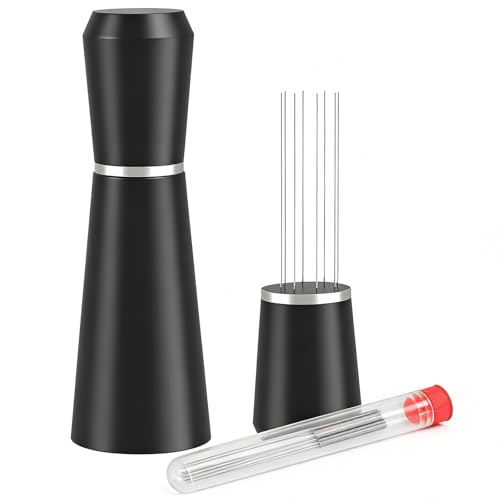
Jeymei WDT Tool
This tool pairs a fine-needle head with an included stand at a lower price than premium motorized options. The needle bundle still breaks up clumps effectively despite the lower cost. A wood handle keeps grip comfortable during the stirring motion.
Pros
- Lower price than motorized distribution tools
- Included stand keeps it upright by the grinder
- Needle bundle performs close to pricier handheld designs
Cons
- Needles are slightly thicker than premium ultra-fine designs
- No depth adjustment for different basket sizes

Aieve WDT Distribution Tool
A slim, low-profile design takes up less counter space than tools with a wide stand or motorized base. The lightweight build makes it easy to pack for travel or a second brewing setup. Fine needles still break up clumps despite the smaller overall footprint.
Pros
- Compact size suits small counters or travel kits
- Lightweight build is easy to pack and carry
- Still breaks up clumps effectively at this size
Cons
- Smaller stand is less stable than wider motorized bases
- Fewer accessory features than premium all-in-one tools

Normcore 54mm 2-in-1 Magnetic Dosing Cup and Distributor
This tool combines a dosing cup and a flat leveling distributor in one magnetic unit, reducing the number of separate accessories on a cramped counter. The magnetic base attaches directly to a 54mm portafilter during use. A matte black aluminum finish resists fingerprint marks better than bare metal.
Pros
- Combines two tools into one compact unit
- Magnetic attachment keeps it steady on the portafilter
- Matte finish resists visible fingerprints
Cons
- Only fits 54mm portafilters, not other common sizes
- Does not break up clumps the way a needle tool does

OCD Original Coffee Distributor
A flat rotating disc levels the grounds surface after dosing, a different job from a needle tool’s clump-breaking stir. Adjustable depth settings match different dose weights without swapping tools. The rotating action spreads grounds evenly before tamping.
Pros
- Levels the grounds surface more evenly than tamping alone
- Adjustable depth matches different dose weights
- Works alongside a WDT tool rather than replacing it
Cons
- Does not break up clumps the way a needle tool does
- Bulkier to store than a simple needle tool

Espro Calibrated Leveling Tool
A calibrated depth adjustment lets this leveler match a precise dose weight more consistently than an uncalibrated disc. The flat base spreads grounds evenly across the basket before tamping. A durable metal build holds up to daily espresso-bar use.
Pros
- Calibrated depth gives more consistent dosing results
- Durable metal build suits daily use
- Levels grounds evenly before tamping
Cons
- Costs more than a basic uncalibrated leveling disc
- Still works best paired with a separate WDT needle tool
Side by side
| # | Model | Needle Count | Best for | Score | Price |
|---|---|---|---|---|---|
| 1 | IKAPE WDT Tool, 58mm | 14 | Best Overall | 9.1 | Check price |
| 2 | Normcore WDT Tool | Multiple fine needles | Best Simple Handheld Design | 8.8 | Check price |
| 3 | Jeymei WDT Tool | Multiple fine needles | Best Value | 8.5 | Check price |
| 4 | Aieve WDT Distribution Tool | Multiple fine needles | Best Compact and Travel-Friendly | 8.3 | Check price |
| 5 | Normcore 54mm 2-in-1 Magnetic Dosing Cup and Distributor | Dosing cup plus leveling distributor | Best Multi-Function Tool | 8.7 | Check price |
| 6 | OCD Original Coffee Distributor | Flat-surface leveling | Best for Puck Leveling | 8.6 | Check price |
| 7 | Espro Calibrated Leveling Tool | Calibrated flat-surface leveling | Best Adjustable Depth Leveler | 8.5 | Check price |
Common questions
What is a WDT tool used for in espresso?
A WDT tool uses fine needles to stir and break up clumps in the coffee grounds bed, reducing channeling during extraction.
Do you need both a distribution tool and a leveler?
Many home baristas use a needle tool to break up clumps first, then a flat leveler like the OCD to even the surface before tamping.
What does WDT stand for in coffee?
WDT stands for Weiss Distribution Technique, named after the method of stirring grounds with fine needles before tamping.
Does a distribution tool improve espresso taste?
Breaking up clumps and leveling grounds reduces channeling, which generally leads to a more even extraction and fewer sour or bitter spots.
What portafilter sizes do distribution tools fit?
Sizes vary by brand, with common options built for 51mm, 54mm and 58mm baskets, so checking fit before buying matters.
Is an auto-rotating WDT tool better than a manual one?
Auto-rotation saves manual swirling effort, but a manual tool like Normcore’s handheld design works just as well for clump breaking with practice.
Can a coffee distribution tool replace a tamper?
No, a distribution or leveling tool prepares the grounds surface, while a separate tamper compresses the grounds afterward.
How many needles does a WDT tool typically have?
Needle counts vary, with some handheld tools using a small bundle and motorized designs like IKAPE’s using as many as 14 fine needles.
What is the difference between a WDT tool and the OCD?
A WDT tool breaks up clumps with needles before tamping, while the OCD levels the grounds surface with a flat rotating disc.
Are budget WDT tools as effective as premium ones?
Budget options like Jeymei’s tool use similar needle bundles to pricier designs, though they may lack depth adjustment or auto-rotation.
Our take
IKAPE’s WDT Tool is the strongest all-around pick for home baristas who want adjustable depth and auto-rotation without extra manual effort. Anyone on a tighter budget should choose Jeymei’s WDT Tool instead, since it breaks up clumps nearly as well at a lower price. Buyers who already own a needle tool and want to add surface leveling get more value from the OCD Original Coffee Distributor or Espro’s calibrated leveler than from a second needle-style tool.
Dana Whitfield
Dana spent eight years buying and merchandising for a regional kitchenware retailer before moving into editorial work. She has handled thousands of SKUs across cookware, small appliances and kitchen organization, and focuses on the practical differences that matter once a product is actually in daily use.