Close Up Filters Ranked by Optics, Not Diopter Number
Raynox DCR-250 leads on optics, since three cemented elements hold detail at plus eight diopters. Canon 500D fits 70mm to 300mm telephotos and keeps about half a metre of working room. Marumi DHG Achromat Macro 200 lands between them at plus five with multicoated glass.
Raynox DCR-250 suits anyone who wants real macro magnification from a lens already in the bag. Three cemented elements keep purple fringing off beetle shells and water drops. Working distance sits near 5cm, which makes lighting live subjects fiddly.
Diopter numbers hide most of what matters. A single element plus ten magnifies hard and smears the corners, while a well built plus five achromat stays clean across the frame. We compared optical construction, coating type and thread sizes, then read owner feedback on fringing, flare and vignetting. Pairing strength to focal length turned out to matter as much as raw diopters.
What matters most
What a close up filter actually does Screw one onto a lens and its minimum focus distance shrinks. Aperture, autofocus and metering all keep working, so exposure barely shifts. Extension tubes do a similar job but cost you light as they push the lens forward. Strength appears in diopters, where a higher number buys more magnification and less room between glass and subject. Quality of your host lens still sets the ceiling, because a close up lens magnifies its flaws along with the subject.
Achromatic doublets versus single element glass Single element glass bends red and blue light to slightly different points. Purple edges on twigs and green halos on chrome are what that looks like in a file. Cementing two or three elements together pulls those wavelengths back into line. DCR-250, Canon 500D, Marumi DHG Achromat Macro 200 and the NiSi kit all use that construction. Budget sets such as the Neewer four pack run one element per lens, which passes at plus one and shows badly at plus ten.
Matching diopter strength to your lens Focal length drives magnification as much as the diopter number does. Plus two on a 300mm zoom delivers far more reach than plus two on a 35mm prime. Pair gentle strengths near plus two with telephotos, and mid strengths near plus five with 50mm to 100mm glass. Reserve plus twenty five for long lenses locked on a tripod. Owners consistently report that stopping down to around f8 recovers most corner softness, whichever strength is fitted.
Which filter suits insects, flowers or small products Insects reward magnification but punish short working distance, so a DCR-250 on a 100mm or longer lens is the practical compromise. Flowers and food sit best near plus five, where a Marumi or a stacked Hoya pair fills the frame with room left to light it. Coins, stamps and jewellery favour a tripod and the MSN-202, since those subjects hold still. Below 10cm of working distance your own lens shades the subject, and a small diffused flash fixes that faster than raising ISO. Focus by rocking the camera slowly and shoot bursts, because turning the ring at high magnification overshoots every time.
The best picks, ranked
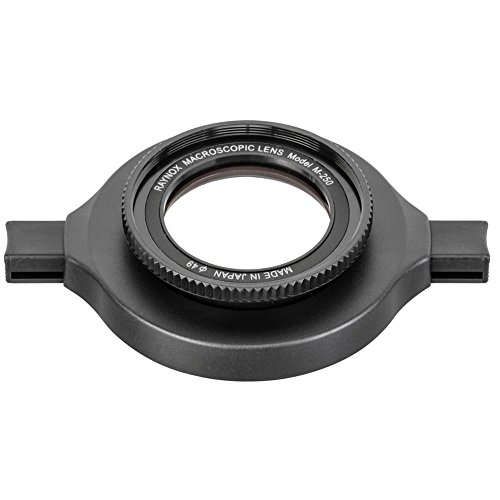
Raynox DCR-250 Super Macro Snap-On Lens
Three elements in two groups give the DCR-250 achromatic correction, so high contrast edges stay free of purple and green fringing. A sprung snap-on adapter grips threads from 52mm to 67mm, letting one unit serve several lenses. Plus eight diopters places the subject roughly 5cm from the front element.
Pros
- Achromatic triplet controls fringing at high magnification
- One clip mount spans 52mm to 67mm lens threads
- Turns a 70-300mm zoom into a genuine macro setup
Cons
- Five centimetre working distance spooks live insects
- Corners soften on lenses shorter than 100mm

Canon 500D Close-Up Lens 77mm
Canon built the 500D as a cemented doublet rather than a simple magnifier. Mild plus two strength is precisely why it holds sharpness on 70mm to 300mm lenses. Half a metre of working room leaves space for a reflector, a speedlight or a nervous subject.
Pros
- Roughly half a metre of working distance to the subject
- Doublet holds corner detail better than single element glass
- Fits any brand of lens with a 77mm front thread
Cons
- Plus two strength never reaches 1:1 magnification
- One thread size, so step rings follow for other lenses

Marumi DHG Achromat Macro 200 (+5)
Marumi splits the difference at plus five, using an achromatic doublet under Digital High Grade multicoating. Backlit petals are where that coating earns its place, because uncoated close up glass veils fast. Thread options run from 49mm through 77mm, covering most standard zooms.
Pros
- Multicoating holds contrast in backlit shots
- Plus five pairs naturally with 50mm to 100mm lenses
- Slim ring avoids vignetting on wider zooms
Cons
- Every thread size is a separate purchase
- Magnifies less than either Raynox lens

Hoya Close-Up Lens Set II (+1, +2, +4)
Three single element lenses ship in one wallet at plus one, plus two and plus four. Stack the plus two and plus four for an effective plus six when a subject needs more reach. HMC multicoating is unusual on close up kits at this level and shows in flare control.
Pros
- Three strengths cover flowers, food and product detail
- Coated glass resists flare better than bare budget sets
- Lenses stack when one strength is not enough
Cons
- Single element design shows fringing wide open
- Corners go soft once two lenses stack
Raynox MSN-202 Super Macro Conversion Lens
At plus twenty five diopters, MSN-202 reaches past what most dedicated macro lenses manage. Insect eyes and fabric weave become the whole subject rather than a detail inside it. Working distance collapses to about 3cm, so a diffuser and a focusing rail stop being optional extras.
Pros
- Magnification beyond 1:1 without tubes or bellows
- Shares the universal clip used by other Raynox lenses
- Light enough to carry loose in a jacket pocket
Cons
- Depth of field measures under a millimetre
- Handheld frames rarely land in focus

NiSi Close Up Lens Kit NC 77mm
NiSi pairs a plus 2.3 achromat with 67mm and 72mm step down rings in the box. Photographers whose kit spans several thread sizes get all three covered with no extra parts. Nano coating on both faces helps when a wide lens points near the sky and focuses on close foreground.
Pros
- Included rings cover 67mm, 72mm and 77mm threads
- Gentle strength keeps wide angle corners usable
- Metal ring and hard case survive a packed bag
Cons
- Too weak for insect level magnification
- 77mm body overwhelms small mirrorless lenses

Neewer Close-Up Macro Filter Set (+1 +2 +4 +10)
Four single element lenses give a beginner a low commitment way to find out whether macro sticks. Plus ten is the useful outlier, reaching magnification the Hoya set never touches. Optics trail the achromats, with softening visible before you even reach the corners.
Pros
- Four strengths, including a strong plus ten
- Thread sizes run all the way up to 82mm
- Zip pouch keeps four lenses sorted and dust free
Cons
- Uncoated edges flare against bright skies
- Corner sharpness collapses on the plus ten
The lineup, side by side
| # | Model | Optical design | Best for | Score | Price |
|---|---|---|---|---|---|
| 1 | Raynox DCR-250 Super Macro Snap-On Lens | 3 elements in 2 groups, achromatic | Best overall | 9.4 | Check price |
| 2 | Canon 500D Close-Up Lens 77mm | 2 element achromatic | Best for telephoto lenses | 9.2 | Check price |
| 3 | Marumi DHG Achromat Macro 200 (+5) | 2 element achromatic | Best for flowers and still life | 9.0 | Check price |
| 4 | Hoya Close-Up Lens Set II (+1, +2, +4) | +1, +2 and +4 lenses | Best value | 8.7 | Check price |
| 5 | Raynox MSN-202 Super Macro Conversion Lens | 3 elements in 2 groups | Best for extreme magnification | 8.5 | Check price |
| 6 | NiSi Close Up Lens Kit NC 77mm | 2 element achromatic | Best for wide and standard zooms | 8.2 | Check price |
| 7 | Neewer Close-Up Macro Filter Set (+1 +2 +4 +10) | +1, +2, +4 and +10 lenses | Best budget | 8.0 | Check price |
Frequently asked questions
What is a close up filter used for?
It shortens how close your lens can focus, so insects, jewellery, stamps and plant detail fill the frame without a dedicated macro lens on the body.
Is a close up filter as good as a macro lens?
No. A true macro lens is corrected for close focus across the whole frame. Good achromats like the Canon 500D match it near the centre, but edges stay softer and contrast drops.
Which diopter strength should I buy first?
Around plus four suits flowers and food shot on a 50mm or a kit zoom. Choose plus two for telephoto lenses. Leave plus ten and higher for tripod work with a long lens.
Can you stack close up filters together?
Yes, and the strengths add. A plus two over a plus four behaves like a plus six. Each extra piece of glass costs corner quality and flare resistance, so stop at two.
Raynox DCR-250 vs Canon 500D: which should you choose?
DCR-250 magnifies far more at plus eight and clips onto several thread sizes. Canon 500D is milder at plus two but keeps roughly half a metre of working distance, which is easier for lighting and skittish subjects.
Does a close up filter reduce image quality?
Some loss is unavoidable, though construction decides how much. Achromats keep colour fringing minimal; single element glass adds purple edges and corner softness that stopping down only partly clears.
Will a close up filter cause vignetting?
It can on wide lenses, or when the filter ring sits thicker than the lens thread. Pick a filter equal to or larger than your thread size and fit a step ring to avoid most of it.
Do you lose autofocus with a close up lens?
Autofocus keeps working, but the focus range narrows sharply and hunting increases. Many owners switch to manual and move the whole camera instead, which lands more frames at high magnification.
Do close up filters work on phone cameras?
Only with a clip adapter that centres the glass over the lens. Phone lenses are very wide, so magnification stays modest next to what the same filter gives a telephoto.
What is the best close up filter for beginners?
Hoya Close-Up Lens Set II covers plus one through plus four in one wallet, with coating that budget kits skip. Start there, then move to an achromat once you know which subjects you keep shooting.
Our take
Buy the Raynox DCR-250 if you already own a lens above 100mm and want the most magnification per piece of glass. Photographers who need room to light a subject, or who chase skittish insects, should take the Canon 500D and accept its milder plus two strength. Still unsure whether macro will stick? Start with the Hoya Close-Up Lens Set II and move up once the subjects choose themselves.
Marcus Chen
Marcus covered consumer electronics for enthusiast tech publications for six years before joining ChoiceCrest. He specializes in translating manufacturer spec sheets into plain-language buying advice, with a focus on audio, computing accessories and smart-home gear.
You might also need
Nintendo Game & Watch: Super Mario Bros Review: Still Worth It as a Collectible?

Ray-Ban Meta (Gen 2) Wayfarer Smart Glasses: Worth $379 for Clear Lenses?
AlyKets Nikon UC-E6 Replacement USB Cable: Does a $7.95 Cord Work as Well as the Original?
