Charcoal Grills That Hold Heat Longer Than a Kettle
The Weber Original Kettle Premium 22-inch is the strongest overall charcoal grill, pairing one-touch ash cleaning with a built-in lid thermometer. Buyers who also want serious low-and-slow smoking should consider the Kamado Joe Classic III instead, while kamado-style cooking on a budget fits better with the Char-Griller Akorn.
The Weber Original Kettle Premium 22-inch stands out because its one-touch cleaning system and built-in thermometer simplify both cooking and cleanup. Its main limitation is cooking area, since large kamado grills offer more total surface.
We compared published material, cooking area, heat retention features and cleanup design across each listing based on manufacturer specifications.
The top picks, ranked

Weber Original Kettle Premium 22-inch
A one-touch cleaning lever sweeps ash into a removable catch pan, a detail that separates this kettle from cheaper grills needing manual ash removal. A built-in lid thermometer tracks temperature without lifting the lid to guess. Porcelain enamel on the bowl and lid resists rust better than bare steel over years of outdoor storage.
Pros
- One-touch cleaning system simplifies ash removal
- Built-in thermometer avoids guessing temperature
- Porcelain enamel resists rust long-term
Cons
- No side table for prep space
- Cooking area is smaller than large kamado-style grills

Kamado Joe Classic III
Thick ceramic walls hold heat and moisture more consistently than steel kettles, useful for both high-heat searing and low, slow smoking in the same grill. A divide and conquer rack system lets different zones cook at different heights and heat levels at once. An air lift hinge makes the heavy ceramic lid easier to open than it looks.
Pros
- Ceramic walls hold heat steady for both searing and smoking
- Flexible rack system allows multiple cooking zones at once
- Precise top and bottom vents control airflow closely
Cons
- Significantly heavier and pricier than steel kettle grills
- Ceramic body can crack if struck or dropped
Weber Master-Touch 22-inch
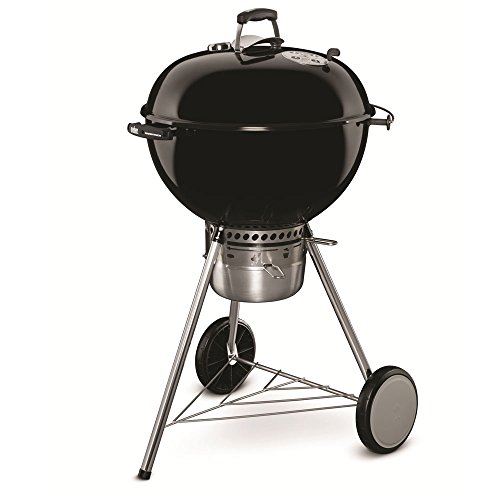
A hinged gourmet grate lifts in sections, so charcoal can be added mid-cook without removing the entire cooking grate. An ash catcher below the one-touch cleaning system makes disposal cleaner than a loose catch pan. It shares its base dimensions with the standard Kettle Premium but adds these convenience details at a higher price.
Pros
- Hinged grate allows adding charcoal without full grate removal
- Ash catcher simplifies disposal versus a basic pan
- Same reliable 22 inch kettle size as the standard model
Cons
- Costs more than the standard Kettle Premium for incremental convenience features
- Same cooking area as the base kettle despite the higher price
Dyna-Glo Signature Series Heavy-Duty Charcoal Grill
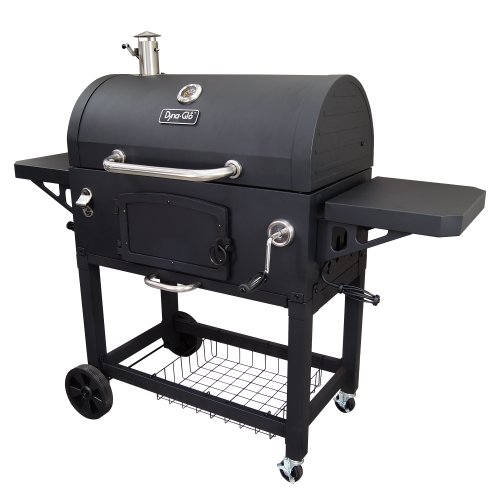
Combined cooking area across main and warming racks reaches roughly 784 square inches, among the largest charcoal grills at this price tier. An adjustable charcoal tray raises and lowers independently from the cooking grate, giving more heat control than fixed-height designs. Large wheels help move the heavier steel body across a patio or yard.
Pros
- Among the largest cooking areas available in a charcoal grill
- Adjustable charcoal tray separate from the grate improves heat control
- Large wheels ease mobility despite the heavier frame
Cons
- Larger footprint needs more storage space when not in use
- Heavier gauge steel takes longer to reach initial searing temperature

PK Grills PK300-AF
Cast aluminum construction gives this grill kamado-style heat control at a weight far lower than ceramic models, making it easier to move around a patio. A hinged lid design, distinct from a dome shape, opens to the side rather than straight up. Adjustable vents at both ends manage airflow for searing or slow cooking.
Pros
- Cast aluminum is lighter than ceramic while retaining good heat control
- Side-hinged lid design differs from dome-style kamados
- Portable cart simplifies repositioning
Cons
- Smaller cooking area than larger kamado or kettle grills
- Premium pricing relative to its size compared to steel kettles

Char-Griller Akorn Kamado Kooker
A double-walled steel body approximates the heat retention of ceramic kamados at a fraction of the price, though it runs lighter than true ceramic models. Combined cooking area across main and warming racks reaches about 447 square inches. Side shelves add prep space that most kettle grills skip entirely.
Pros
- Kamado-style heat retention at a steel-body price
- Larger combined cooking area than a standard kettle
- Side shelves add prep space
Cons
- Steel body retains heat less consistently than true ceramic
- Rubber gasket around the lid needs periodic replacement

Royal Gourmet CC1830F
A larger 30 inch kettle body gives more cooking area than standard 22 inch kettles at a lower price than premium brands. An adjustable charcoal pan raises or lowers to control heat intensity, a feature not every budget kettle includes. A single side shelf adds some prep space lacking on basic kettle designs.
Pros
- Larger cooking area than standard 22 inch kettles
- Adjustable charcoal pan helps control heat intensity
- Lower price than premium kettle brands
Cons
- Steel body lacks the porcelain enamel protection of pricier kettles
- Build feels less sturdy than Weber’s kettle line
What matters most
What to look for in a charcoal grill Material decides heat retention and long-term durability, whether that is a steel kettle, a ceramic kamado, or cast aluminum. Cooking area should match how often and for how many people a household grills. Vent control and extras like ash catchers or side shelves affect how much daily hassle comes with ownership.
Kettle grills versus kamado-style grills Kettle grills like the Weber Kettle Premium and Royal Gourmet CC1830F cost less and heat up faster for everyday grilling. Kamado-style grills like the Kamado Joe Classic III, Char-Griller Akorn and PK Grills PK300-AF hold heat longer, suiting both high-heat searing and low, slow smoking in the same body.
Cooking area and group size A standard 22 inch kettle suits smaller households grilling a few times a month. Larger combined cooking areas, like the Dyna-Glo Signature Series at roughly 784 square inches or the Royal Gourmet CC1830F, suit bigger groups or more frequent entertaining.
Convenience features worth the upgrade One-touch ash cleaning, found on both Weber kettle models, turns a messy chore into a quick step. A hinged grate on the Weber Master-Touch allows adding charcoal mid-cook without lifting the entire grate. An adjustable charcoal tray, like the one on the Dyna-Glo Signature Series, separates heat control from the cooking surface itself.
How they compare
| # | Model | Cooking area | Best for | Score | Price |
|---|---|---|---|---|---|
| 1 | Weber Original Kettle Premium 22-inch | Approx 363 sq in | Best Overall Classic Kettle | 9.2 | Check price |
| 2 | Kamado Joe Classic III | Thick-walled ceramic | Best Ceramic Kamado for Heat Retention | 9.0 | Check price |
| 3 | Weber Master-Touch 22-inch | Approx 363 sq in | Best With Added Grilling Features | 8.8 | Check price |
| 4 | Dyna-Glo Signature Series Heavy-Duty Charcoal Grill | Approx 784 sq in combined | Best for Large Cooking Area | 8.6 | Check price |
| 5 | PK Grills PK300-AF | Cast aluminum body | Best Cast Aluminum Portable Kamado-Style | 8.5 | Check price |
| 6 | Char-Griller Akorn Kamado Kooker | Double-walled steel body | Best Budget Kamado | 8.4 | Check price |
| 7 | Royal Gourmet CC1830F | Approx 505 sq in with warming rack | Best Budget Basic Kettle | 8.2 | Check price |
Frequently asked questions
What is the difference between a kettle grill and a kamado grill?
A kettle grill, like the Weber Original Kettle Premium, uses a thin steel bowl, while a kamado, like the Kamado Joe Classic III, uses thick ceramic walls that hold heat and moisture more consistently.
Is a ceramic kamado worth the extra cost over a steel kettle?
For grillers who also want to smoke food low and slow regularly, the heat retention of a ceramic kamado like the Kamado Joe Classic III can justify the higher price.
How much cooking area does a family need on a charcoal grill?
A standard 22 inch kettle, around 363 square inches, covers most families, while larger combined areas like the Dyna-Glo Signature Series suit bigger groups.
Does a charcoal grill need a side shelf?
A side shelf, found on the Char-Griller Akorn and Royal Gourmet CC1830F, adds prep space that basic kettles without one lack.
How long does a charcoal grill take to heat up?
Lighter steel kettles generally heat up faster than thick-walled ceramic kamados, though kamados hold heat longer once they reach temperature.
Can a kamado-style grill also be used for smoking?
Yes. The thick walls on models like the Kamado Joe Classic III and Char-Griller Akorn make them well suited to both direct grilling and low, slow smoking.
Do charcoal grills need a cover?
A cover helps protect the finish between uses, though porcelain-enameled or ceramic bodies already resist weather better than bare steel.
What is an ash catcher used for?
An ash catcher, found on the Weber Master-Touch, collects swept ash in a removable container for easier, cleaner disposal.
Is cast aluminum as durable as ceramic for a kamado-style grill?
Cast aluminum, used on the PK Grills PK300-AF, is lighter and less prone to cracking from impact than ceramic, though ceramic generally holds heat more consistently.
The verdict
The Weber Original Kettle Premium 22-inch is the strongest pick for most households wanting reliable grilling with easy cleanup. Anyone wanting serious low-and-slow smoking in the same grill should choose the Kamado Joe Classic III instead. Buyers wanting kamado-style heat retention without the ceramic price fit better with the Char-Griller Akorn.
Sierra Daniels
Sierra's background is in landscape design and nursery retail. She focuses on lawn and garden equipment, outdoor furniture and gear durability, weighing published specs against how materials actually hold up outside.

