Which Cervical Pillow Fits Your Sleeping Position?
Tempur-Pedic TEMPUR-Neck Pillow leads on contour support. Its dense foam still holds the neck lobe by morning. EPABO Contour Memory Foam Pillow copies the butterfly shape and adds a height insert. Coop Home Goods Original suits sleepers who want to pull fill out by hand.
TEMPUR-Neck Pillow is the pick for most side and back sleepers who want a fixed contour. Dense TEMPUR foam keeps the neck lobe raised all night instead of flattening under head weight. Loft cannot be changed afterwards, so the size you order is the size you keep.
Loft is what usually goes wrong. Your shoulder width and sleeping position set the gap between ear and mattress, and a pillow either fills it or does not. Side sleepers need the most height, back sleepers less, stomach sleepers almost none. We compared contour geometry, fill material, stated loft options, firmness grades and whether the cover unzips. Owner feedback then settled the break in period, heat buildup and how each shape handles rolling over.
Our top picks

Tempur-Pedic TEMPUR-Neck Pillow
A raised lobe sits under the neck while a shallow hollow takes the head. Dense TEMPUR viscoelastic resists bottoming out, which is where budget contour foam loses support before morning. Three loft sizes exist, so shoulder width decides which one you order.
Pros
- Contour stays raised from bedtime to morning
- Small, medium and large lofts match shoulder width
- Knit cover unzips and goes in the machine
Cons
- Firm feel takes several nights to adapt to
- Loft is fixed, with no fill to add or remove
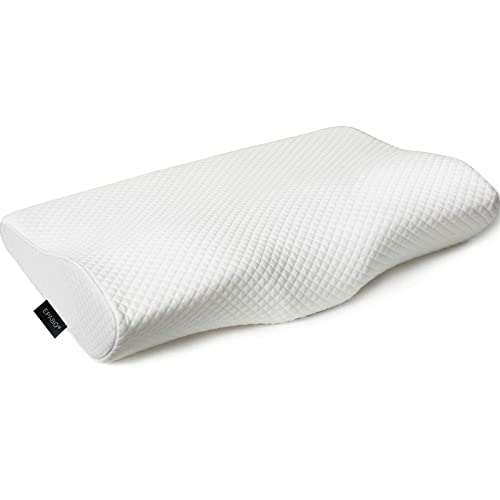
EPABO Contour Memory Foam Pillow
Wings on each side rise above a lower centre, giving side sleepers height and back sleepers a dip. Ventilation holes run through the memory foam to move warm air out. A removable insert raises the centre slightly, which few contour pillows allow at this level.
Pros
- Insert adds a small amount of centre height
- Side wings hold the neck when you roll over
- Punched vents cut trapped heat
Cons
- New foam gives off an odour for a few days
- Softer than TEMPUR, so it compresses further overnight

Elviros Cervical Memory Foam Pillow
Recesses along both edges let the shoulder tuck under rather than lift upward. Broader shoulders therefore keep the cervical spine straighter on the side. Two height zones split the surface, so rolling onto your back lands on the lower section.
Pros
- Shoulder recess stops the shoulder being pushed up
- Lower back zone catches overnight position changes
- Wide surface keeps the head from rolling off
Cons
- Large footprint crowds a narrow single bed
- Too tall for stomach sleeping
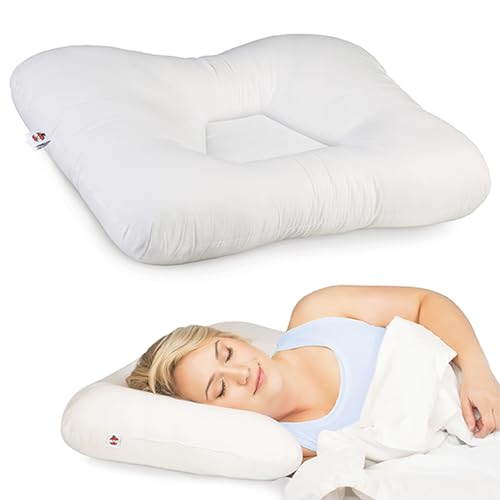
Core Products Tri-Core Cervical Support Pillow
Polyester fibre packs around a trapezoid core that fills the neck curve face up. Fibre springs back rather than slowly sinking, and it carries heat away better than foam. Side lobes stand taller than the centre, giving extra height if you turn over.
Pros
- Fibre sleeps cooler than memory foam
- Trapezoid core matches the natural neck curve
- Sold in several firmness grades
Cons
- Fibre packs down and needs replacing sooner
- Bulky traditional shape feels odd at first

Mediflow Original Waterbase Pillow
A sealed water pouch sits under a polyester fibre layer, and water volume sets the firmness. Support shifts with you, since water redistributes instead of holding one impression. Filling and burping the pouch takes a few minutes at setup, and a thermal layer stops it feeling cold.
Pros
- Firmness tunes in small steps by water volume
- Water answers position changes straight away
- Fibre top layer avoids the sunken foam feel
Cons
- Filled weight makes it awkward to lift or move
- Setup needs filling and air removal before first use

Coop Home Goods Original Adjustable Pillow
Shredded memory foam mixed with microfibre comes out handful by handful until the loft matches your shoulders. That fixes the usual problem with contour pillows, which arrive either too high or too low. Cover and fill both survive a domestic washing machine.
Pros
- Loft dials in to any shoulder width
- Whole pillow washes at home, fill included
- Spare fill bag ships in the box for raising height
Cons
- Loose fill gives no defined neck contour
- Fill clumps and needs fluffing to stay level

Purple Harmony Pillow
Hyper elastic polymer forms a hex grid around a Talalay latex core, leaving open air channels. Heat escapes sideways rather than pooling under the head. Latex answers with a springy push back, not the slow sink of memory foam.
Pros
- Open grid channels vent heat away from the head
- Latex rebounds instead of sinking slowly
- Low, medium and tall lofts fit most positions
Cons
- Bouncy feel splits opinion among foam sleepers
- Heavier than a standard foam pillow
How to choose
What to look for in a cervical pillow Loft decides almost everything. Measure the gap between your ear and the mattress while lying in your usual position, then match a contour to it. Fill material sets the feel next: dense foam holds an impression, polyester fibre stays cooler, latex pushes back. Check that the cover unzips, since scalp oils build up in fabric that cannot be washed. Return windows matter too, because no pillow proves itself on night one.
Matching loft to your sleeping position Side sleepers need the most height. Shoulder width opens a wide gap, and Elviros answers it with a recess that lets the shoulder drop in. Back sleepers want the opposite: a low centre with a lip under the neck, which is what the Tri-Core trapezoid builds in. Stomach sleeping needs almost no loft, and a raised lobe tips the head backward there. Switch positions overnight? Pick a two zone surface like the Elviros, or pull fill from the Coop until both positions work.
Memory foam vs fibre vs latex vs water Memory foam moulds and keeps that shape, so TEMPUR and EPABO support firmly but store heat. Polyester fibre in the Tri-Core breathes better and rebounds, though it packs down within a couple of years. Latex and the Purple polymer grid stay springy and vent through open channels. Water is the outlier: Mediflow redistributes as you turn, which suits anyone who changes position several times a night. Wake up warm and dense foam is the wrong branch entirely, so start with Purple Harmony or the fibre filled Tri-Core.
Break in time, care and when to replace Give a new contour at least seven nights. Your neck has adapted to whatever it slept on before, so the right pillow can still feel wrong at first. Adjustment exists on only some models: Coop lets fill out, EPABO adds an insert, Mediflow changes water volume, while TEMPUR and Elviros are fixed once opened. Foam typically holds its shape for two to three years and fibre less. Fold a pillow in half and let go, because anything that stays folded has lost its support. Neck pain that persists on a well matched pillow is a question for a clinician, not another purchase.
The lineup, side by side
| # | Model | Fill | Best for | Score | Price |
|---|---|---|---|---|---|
| 1 | Tempur-Pedic TEMPUR-Neck Pillow | TEMPUR viscoelastic foam | Best overall | 9.4 | Check price |
| 2 | EPABO Contour Memory Foam Pillow | Ventilated memory foam | Best value | 9.2 | Check price |
| 3 | Elviros Cervical Memory Foam Pillow | Memory foam | Best for side sleepers | 9.0 | Check price |
| 4 | Core Products Tri-Core Cervical Support Pillow | Resilient polyester fibre | Best for back sleepers | 8.8 | Check price |
| 5 | Mediflow Original Waterbase Pillow | Water pouch under polyester fibre | Best for restless sleepers | 8.6 | Check price |
| 6 | Coop Home Goods Original Adjustable Pillow | Shredded memory foam and microfibre | Best for custom loft | 8.3 | Check price |
| 7 | Purple Harmony Pillow | Talalay latex core with polymer grid | Best for hot sleepers | 8.0 | Check price |
Common questions
What is the best cervical pillow for side sleepers?
Elviros Cervical Memory Foam Pillow. Its shoulder recess lets a broad shoulder drop in, which keeps the neck level with the spine.
Do cervical pillows really help neck pain?
Owners report easier mornings once loft matches their position. Alignment is what a pillow can fix, so pain that lingers needs a clinician.
How long does it take to get used to a contour pillow?
About a week for most people. Necks adapt to the old pillow’s shape, so early nights feel strange even on the right pick.
Which cervical pillow is best for back sleepers?
Core Products Tri-Core. Its trapezoid core fills the neck curve while the head sits lower than the raised side lobes.
Are memory foam pillows too hot to sleep on?
Dense foam does store heat. Purple Harmony vents through its hex grid, and the fibre filled Tri-Core runs cooler than any foam here.
Can you adjust the height of a cervical pillow?
Some models only. Coop Home Goods removes fill by hand, EPABO ships a centre insert, and Mediflow firms up with more water.
Is a cervical pillow good for stomach sleepers?
Rarely. Stomach sleeping wants minimal loft, and a raised neck lobe pushes the head into extension.
How often should you replace a cervical pillow?
Foam lasts roughly two to three years, fibre less. Replace any pillow that stays folded instead of springing open.
Cervical pillow vs regular pillow: what is the difference?
A cervical shape has a fixed lobe and hollow, so neck and head sit at different heights. Standard pillows compress to one flat level.
The verdict
TEMPUR-Neck Pillow earns the recommendation, because its contour is still doing the job at 6am rather than lying flat. Broad shouldered side sleepers gain more from the Elviros shoulder recess. If your ideal loft is still a guess, start with the Coop Home Goods Original and remove fill until mornings improve. Hot sleepers should leave dense foam alone and take Purple Harmony.
Dana Whitfield
Dana spent eight years buying and merchandising for a regional kitchenware retailer before moving into editorial work. She has handled thousands of SKUs across cookware, small appliances and kitchen organization, and focuses on the practical differences that matter once a product is actually in daily use.


