Ceramic Space Heaters Compared for Every Room Size
Lasko’s 5538 tower heater leads this comparison for its oscillation, remote, and 8-hour timer in medium rooms. Dreo’s Solaris Max app-controlled unit suits larger spaces up to 400 square feet. Honeywell’s compact HCE200B works best at a desk, since it skips oscillation for direct personal warmth instead.
Lasko’s 5538 Ceramic Tower Heater earns the top spot for anyone heating a living room or bedroom up to 300 square feet. Oscillation, a remote, and an 8-hour timer come standard at this price, features some rival towers charge more for. Households needing whole-floor coverage will find its single-zone output falls short.
Selection came down to comparing published wattage against real room-size claims, since manufacturer coverage figures often assume a home already has some background heat. We weighed oscillation range, thermostat precision, and safety shutoffs against patterns in owner feedback about noise and build quality across all seven models.
What we recommend

Lasko 5538 Ceramic Tower Heater with Remote Control
Twenty-three inches tall, this 1500-watt ceramic tower oscillates to spread warm air instead of aiming it at one wall. An electronic thermostat holds a set temperature while the 8-hour timer allows scheduled shutoff overnight. Lasko rates it for rooms up to 300 square feet, sized for a typical bedroom or living room.
Pros
- Remote adjusts thermostat and timer without leaving the couch
- Oscillation spreads heat across the room rather than one corner
- 8-hour timer supports scheduled overnight shutoff
Cons
- No low-wattage eco setting for mild shoulder-season days
- Digital display stays bright with no dimming option for bedrooms

Dreo Solaris Max Space Heater
Wi-Fi connectivity lets owners start or schedule this 1500-watt PTC heater through the Dreo app, Alexa, or Google Assistant. An ECO mode cycles output to hold a target temperature instead of running at full power constantly. Dreo rates coverage up to 400 square feet, more than most towers in this comparison, with a 12-hour timer for extended scheduling.
Pros
- App and voice control schedule heat without touching the unit
- ECO mode maintains temperature instead of cycling at full power
- 400 square foot rating covers larger rooms than most towers here
Cons
- Setup depends on a home Wi-Fi network and account
- Smart features add cost over basic tower models
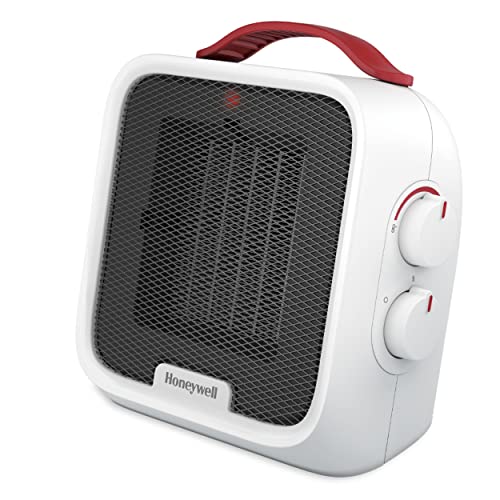
Honeywell HCE200B UberHeat Ceramic Heater
Six inches wide, the UberHeat targets a desk, under-table space, or small office rather than an entire room. A manual dial switches between a 250-watt low setting and a 1500-watt high setting, skipping any digital display or remote. Honeywell markets it for personal space heating up to about 150 square feet.
Pros
- Compact footprint fits under a desk or on a nightstand
- Cool-touch exterior stays safe near feet and pets
- 250-watt low setting suits gentle year-round warmth
Cons
- Fixed direction warms only whoever sits in front of it
- No timer or digital thermostat for scheduled heating
Pelonis PSH15A2ABB Digital Ceramic Tower Heater
An ECO mode cycles this 1500-watt ceramic tower’s output to hold a set temperature rather than running continuously. Oscillation spreads air across the room, and a remote plus 8-hour timer handle adjustments from a chair. Owners commonly note quieter fan noise than comparable towers on the low setting; Pelonis rates it for rooms up to 250 square feet.
Pros
- ECO mode cuts cycling noise versus running on high constantly
- Remote adjusts thermostat without leaving a seat
- Digital display shows both set and current room temperature
Cons
- No Wi-Fi or app control despite the digital interface
- Narrow base can tip on thick carpet if bumped

Honeywell HZ-789 EnergySmart Cool Touch Ceramic Heater
Three heat settings, 750, 1250, and 1500 watts, plus an Energy Smart eco mode, let owners match output to outdoor temperature. Cool-touch housing stays safe to touch during operation, and an adjustable dial fine-tunes warmth without a digital display. Honeywell positions this tower for living rooms and bedrooms up to roughly 300 square feet.
Pros
- Three wattage settings suit both mild and cold days
- Cool-touch housing is safer around kids and pets
- Eco setting cycles power to reduce running cost
Cons
- No remote control; every adjustment happens at the unit
- No digital timer for scheduled shutoff

GiveBest Portable Electric Space Heater
A simple knob switches this compact heater between 750 watts on low and 1500 watts on high, with no digital panel. It skips oscillation entirely, aiming heat at one area such as a desk or bedroom corner. Tip-over and overheat protection come standard despite its low price relative to tower models.
Pros
- Simple dial needs no manual to operate
- Compact size stores easily in a closet off-season
- Tip-over and overheat protection included at a budget price
Cons
- No thermostat display makes precise temperature harder to set
- Fixed direction requires repositioning to change where heat goes

Trustech Oscillating Ceramic Space Heater
Roughly 80 degrees of oscillation spreads heat from this 1500-watt PTC heater across more of a room than fixed units manage. A digital thermostat pairs with a 12-hour timer and remote control for hands-off adjustments. Trustech rates it for rooms up to 200 square feet, between compact personal heaters and larger towers.
Pros
- 12-hour timer covers a full overnight cycle without resetting
- Remote includes thermostat adjustment from a couch or bed
- 80-degree oscillation covers more floor area than fixed heaters
Cons
- Plastic housing warms noticeably near the vents during extended use
- No app or voice control compared to Wi-Fi-enabled models
What matters most
What to look for in a ceramic heater PTC, or positive temperature coefficient, ceramic plates self-regulate resistance as they warm, which limits overheating risk. Check packaging for ETL or UL certification, since that mark means independent testing against US electrical safety standards. A thermostat with numbered settings holds a steadier temperature than a simple low/high switch. Fan-driven ceramic elements heat up faster than oil-filled radiators, though radiators hold warmth longer after shutoff.
How many watts do you need for your room size? A common rule allows about 10 watts per square foot in a well-insulated room, so a 1500-watt heater reasonably covers around 150 square feet as the sole heat source. Manufacturers often list higher figures, such as 300 or 400 square feet, assuming a central system already supplies background heat. Older windows, high ceilings, and poor insulation all raise the wattage a room actually needs. Personal heaters like the Honeywell HCE200B are sized for a few feet of desk space, not a whole room.
Tower heaters vs compact desktop heaters Standing roughly two feet tall, tower heaters such as the Lasko 5538 and Pelonis PSH15A2ABB oscillate to cover a wider floor area. Compact units like the GiveBest heater and Honeywell HCE200B sit low and aim in one fixed direction, better suited to a desk or nightstand. Towers cost more and claim floor or corner space, while compact heaters move easily between rooms or pack away seasonally. Oscillation angle among these seven models ranges from roughly 70 to 90 degrees, which changes how much of a room receives airflow.
Is a ceramic heater safe to leave running near kids and pets? Tip-over protection, standard across every model compared here, cuts power automatically if a pet or child knocks the heater onto its side. Overheat protection shuts the unit down once internal temperatures cross a safe threshold, which matters most for heaters left running unattended. Cool-touch housing on the Honeywell HCE200B and HZ-789 stays safe to brush against, unlike metal-bodied heaters that can burn skin. Cord placement matters too, since a heater near a walkway invites tripping in households with young kids.
Side by side
| # | Model | Wattage | Best for | Score | Price |
|---|---|---|---|---|---|
| 1 | Lasko 5538 Ceramic Tower Heater with Remote Control | 1500W | Best overall | 9.4 | Check price |
| 2 | Dreo Solaris Max Space Heater | 1500W | Best with app/smart control | 9.1 | Check price |
| 3 | Honeywell HCE200B UberHeat Ceramic Heater | 250W / 1500W | Best for desks/small spaces | 8.8 | Check price |
| 4 | Pelonis PSH15A2ABB Digital Ceramic Tower Heater | 1500W | Best quiet operation | 8.6 | Check price |
| 5 | Honeywell HZ-789 EnergySmart Cool Touch Ceramic Heater | 750W / 1250W / 1500W | Best value | 8.4 | Check price |
| 6 | GiveBest Portable Electric Space Heater | 750W / 1500W | Best budget | 8.2 | Check price |
| 7 | Trustech Oscillating Ceramic Space Heater | 1500W | Best for large rooms | 8.0 | Check price |
Good to know
How much does it cost to run a ceramic heater?
Running cost depends on wattage and local electricity rates. A 1500-watt heater running eight hours draws about 12 kilowatt-hours, a figure owners can multiply by their utility’s per-kWh rate. Eco or cycling modes lower that draw since the element isn’t running at full output the whole time.
What is the difference between a ceramic heater and a PTC heater?
PTC, positive temperature coefficient, describes the ceramic plate technology inside most modern space heaters rather than a separate category. These plates self-limit resistance as they warm, which is why most heaters sold today, including several compared here, get labeled both ceramic and PTC.
Are ceramic heaters safe to leave on overnight?
Models with tip-over and overheat protection, present on all seven compared here, shut off automatically if knocked over or if internal temperatures spike. Manufacturers still recommend against leaving any space heater unattended in an empty room, and placing it on a flat, hard floor away from bedding or curtains.
Which ceramic heater works best for a large living room?
Dreo’s Solaris Max is rated for up to 400 square feet, and its oscillation paired with app-based scheduling suits a living room better than compact personal heaters. Lasko’s 5538 and Honeywell’s HZ-789 towers also handle medium to large rooms up to roughly 300 square feet.
Can a ceramic heater heat an entire house?
No single ceramic space heater heats a whole house; these units supplement central heating in one room or zone at a time. Running several heaters to cover multiple rooms usually costs more in electricity than running a central furnace or heat pump.
Is a tower heater better than a compact heater for a bedroom?
A tower heater like the Pelonis PSH15A2ABB oscillates and covers more of a bedroom’s floor area, useful for anyone who moves around before bed. A compact heater near a reading chair or the foot of the bed, such as the Honeywell HCE200B, uses less energy when only one person needs direct warmth.
Lasko vs Dreo, which oscillating heater heats faster?
Both the Lasko 5538 and Dreo Solaris Max run a 1500-watt ceramic element, so initial heat output is similar. The practical difference comes down to room coverage and control, since Dreo is rated for larger spaces and adds app-based scheduling that Lasko skips.
What size room does a 1500 watt ceramic heater cover?
Following the roughly 10-watt-per-square-foot rule, a 1500-watt heater adequately warms around 150 square feet as the sole heat source. Manufacturers often list higher figures assuming existing background heat, though compact 1500-watt units without oscillation, like the GiveBest heater, still perform best in smaller spaces.
Do ceramic heaters use a lot of electricity?
A 1500-watt ceramic heater draws as much power as a hair dryer or toaster oven running continuously, which adds up on a monthly bill if used for hours daily. Models with eco modes, such as the Dreo Solaris Max and Pelonis PSH15A2ABB, cycle output to reduce that draw once the room reaches temperature.
What’s the quietest ceramic heater for a bedroom?
The Pelonis PSH15A2ABB’s ECO mode reduces cycling noise compared to running continuously on high, and owners cite it as quieter than similar towers on low. Compact units like the Honeywell HCE200B also run quietly since they use a smaller 250-watt low setting rather than a full-power fan.
Our take
Lasko’s 5538 Ceramic Tower Heater remains the strongest all-around choice, pairing 1500-watt output with oscillation and remote-controlled scheduling for rooms up to 300 square feet. Anyone heating a larger open floor plan or wanting app-based scheduling should choose the Dreo Solaris Max instead, since its higher coverage rating and Wi-Fi control handle spaces the Lasko wasn’t built for. Buyers who just need warmth at a desk or nightstand get more value from the compact Honeywell HCE200B, which costs less to run and takes up almost no floor space.
Dana Whitfield
Dana spent eight years buying and merchandising for a regional kitchenware retailer before moving into editorial work. She has handled thousands of SKUs across cookware, small appliances and kitchen organization, and focuses on the practical differences that matter once a product is actually in daily use.


