Cardstock Weights Explained, Plus 7 Sheets Worth Buying
Neenah Bright White Cardstock handles the widest range of jobs, since 176 gsm feeds most home printers and still stands as a card. Accent Opaque White Cardstock stops backside ink showing through on invitations. For folded cards that must not crack, Hamilco White Cardstock at 216 gsm is the pick.
Neenah Bright White Cardstock suits crafters who print at home and fold by hand. At 176 gsm it clears most paper paths without curling, yet holds a card shape once creased. Deep embossing and thick die cuts ask for a heavier sheet.
Weight labels on cardstock contradict each other, because a 110 lb index sheet measures thinner than an 80 lb cover sheet. We compared gsm figures, brightness ratings, finish and sheet size across seven lines, then read what repeat buyers report about jams, curling and cracked folds.
What to look for
How cardstock weight and gsm actually work Two scales sit behind most of the confusion. Cover weight and index weight are measured against different parent sheet sizes, so 110 lb index lands thinner than 80 lb cover. Read gsm instead, since grams per square metre uses one universal scale. Around 176 gsm is everyday craft stock, 216 gsm folds into a sturdy greeting card, and 271 gsm behaves like thin board. When a listing omits gsm entirely, treat the weight claim as unverified.
Finish and texture: what each does to ink Smooth uncoated stock is the default for good reason, because stamps, pigment ink and toner all behave predictably on it. Linen and felt textures hide small surface flaws, though they break up 8 pt text and hairline rules. Coated and glossy sheets resist absorption, letting alcohol markers blend on the surface while water-based ink pools and dries slowly. Match the finish to the tool you reach for most often. Product photos rarely show texture accurately, so trust the stated finish over the image.
Best cardstock for greeting cards and invitations Folded cards live or die on the score line. Hamilco White Cardstock at 216 gsm is the safe default, since its fibres bend without splitting along a crease. Double-sided invitations are a different problem, and that is where Accent Opaque at 271 gsm earns its place by blocking show-through. Folding with the grain rather than across it cuts cracking further at any weight. Check envelope fit before buying, because A7 blanks suit 5 by 7 inch invitations and A2 blanks suit note cards.
Printing and die cutting cardstock at home Feed path matters more than printer brand. A rear or straight-through tray takes heavy stock, while a front cassette that forces a U-turn curls and jams anything past roughly 220 gsm. Load ten sheets at a time, set media type to cardstock or heavy paper, and let each sheet dry before stacking. Cutting machines want consistency rather than prestige, since one blade depth has to work across a whole sheet. Cricut Cardstock Sampler cuts intricate designs more predictably than bulk packs, while Colorbok covers simple shapes where a slightly ragged edge goes unnoticed. Glitter and foil stock needs a deep-point blade, because the coating dulls a fine-point tip quickly.
The shortlist, ranked

Neenah Bright White Cardstock
Feed reliability explains why this sheet turns up in so many craft rooms. At 176 gsm it clears a front-loading tray yet still stands as a folded card, and brightness of 94 keeps photo prints from going muddy. Alcohol markers bleed on the uncoated face, so Copic users tend to keep a coated sheet alongside.
Pros
- Runs through inkjet and laser paths alike
- Smooth face holds 8 pt text and hairline rules
- Packs of 250 sheets cover long print runs
Cons
- Too thin for deep embossing folders
- Uncoated surface lets alcohol ink bleed
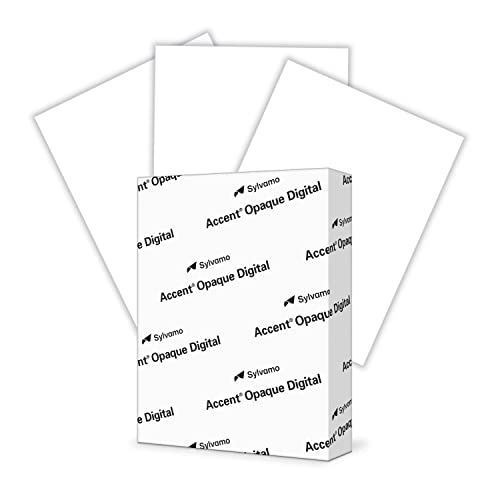
Accent Opaque White Cardstock
Opacity is the selling point, so printed backs stay invisible from the front on menus, programmes and invitations. Density of 271 gsm also means a tent card stands with no easel behind it. Feeding slows at that weight, and older inkjets often need the rear tray.
Pros
- Hides reverse-side ink on double-sided jobs
- Brightness of 97 lifts solid colour blocks
- Stands unaided once folded into a table card
Cons
- 271 gsm exceeds many front-feed cassettes
- Cracks along folds unless scored first

Hamilco White Cardstock
Fibres here take a score line without splitting, which is why handmade card sellers keep reordering it. Hamilco packs this 216 gsm stock as flat sheets and as pre-scored blanks cut for A2 and A7 envelopes. Colour choice stops at white and ivory, so a mixed-palette project needs a second brand.
Pros
- Scores and folds with no surface cracking
- Blank sizes match standard A2 and A7 envelopes
- Matte face takes stamping ink evenly
Cons
- Colour range covers white and ivory only
- Pre-scored packs hold fewer sheets than flat stock

Astrobrights Color Cardstock
Dye runs through the fibre rather than sitting on a coating, so a cut edge matches the face instead of flashing white. Assortment packs reach neon and jewel tones that no printer can lay down on white stock. Darker shades swallow printed ink, which makes them better suited to die cuts than to text.
Pros
- Cut edges show no white core
- Acid free and lignin free for scrapbook pages
- Handles like white 176 gsm stock in a printer
Cons
- Printed text disappears on the dark shades
- Saturated dyes can transfer when damp

Springhill Digital Index White Cardstock
Index stock was built around toner, so laser output fuses crisp and survives a fold without flaking. Its 110 lb index rating converts to roughly 199 gsm, lighter than the cover sheets above it despite the larger number. Cards folded from it flop rather than stand.
Pros
- Toner bonds without flaking at the crease
- Runs at full speed through office laser trays
- Sold in 250 sheet packs for long runs
Cons
- Thinner than the 110 lb label implies
- Tent-fold cards sag instead of standing
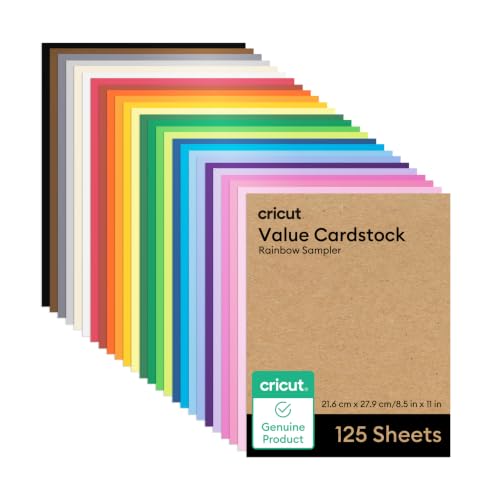
Cricut Cardstock Sampler
Sheets arrive at 12 by 12 inches, matching a standard cutting mat so nothing needs trimming first. Cricut publishes blade and pressure settings for this stock, which removes the guesswork on intricate designs. Paper sized around one machine has limited use anywhere else.
Pros
- Mat-sized sheets skip the trimming step
- Published blade settings cut trial and error
- Even thickness keeps blade depth predictable
Cons
- 12 inch sheets will not fit a letter tray
- Fewer sheets per pack than bulk letter stock

Colorbok Smooth Cardstock
Bulk 12 by 12 inch packs make this the stock for classrooms, scout troops and anyone cutting shapes by the hundred. Craft glue and adhesive vinyl sit flat on the smooth face without bubbling. Thickness wanders from sheet to sheet more than mill-branded paper, and that shows up on fine die cuts.
Pros
- High sheet counts suit group projects
- Glue and adhesive vinyl bond without bubbling
- Wide colour assortments in a single pack
Cons
- Sheet thickness varies within a pack
- Not rated for home printer feeding
Compared at a glance
| # | Model | Basis weight | Best for | Score | Price |
|---|---|---|---|---|---|
| 1 | Neenah Bright White Cardstock | 65 lb cover | Best overall | 9.4 | Check price |
| 2 | Accent Opaque White Cardstock | 100 lb cover | Best for double-sided printing | 9.2 | Check price |
| 3 | Hamilco White Cardstock | 80 lb cover | Best for card making | 9.0 | Check price |
| 4 | Astrobrights Color Cardstock | 65 lb cover | Best for colour variety | 8.8 | Check price |
| 5 | Springhill Digital Index White Cardstock | 110 lb index | Best for laser printers | 8.6 | Check price |
| 6 | Cricut Cardstock Sampler | 65 lb cover | Best for die cutting machines | 8.3 | Check price |
| 7 | Colorbok Smooth Cardstock | 73 lb | Best budget | 8.0 | Check price |
Frequently asked questions
What weight cardstock is best for greeting cards?
Aim for 80 lb cover, roughly 216 gsm. Hamilco White Cardstock sits exactly there and folds without splitting. A 65 lb sheet feels flimsy once creased, while 100 lb stock needs a score line first.
Is 110 lb cardstock thicker than 80 lb cardstock?
Usually the opposite. Index and cover weights measure against different parent sheets, so 110 lb index works out near 199 gsm against roughly 216 gsm for 80 lb cover. Compare gsm and ignore the pound figure.
Can you print cardstock on a home inkjet printer?
Most models cope up to about 220 gsm through the rear or manual feed, with media type set to cardstock. Front cassettes jam above that. Accent Opaque at 271 gsm wants a straight paper path.
Which cardstock works best with a Cricut?
Cricut Cardstock Sampler cuts most predictably, arriving mat-sized at 12 by 12 inches with published blade settings. Any smooth 65 lb to 80 lb sheet works, provided thickness stays even across the pack.
What does brightness mean on a cardstock listing?
Brightness scores how much blue light a sheet reflects, with 100 at the bright white end. Neenah rates 94 and Accent Opaque rates 97. Higher numbers make printed colour look more saturated.
How do you stop cardstock from cracking when you fold it?
Score the line first with a bone folder or scoring board, then fold along the score. Folding with the grain helps as well. Heavy 100 lb cover cracks almost every time without a score.
Can you print on coloured cardstock?
Light and medium shades print acceptably, though ink shifts toward the paper tone. Dark Astrobrights colours absorb ink until text turns unreadable. Save those shades for die cuts and backing layers.
Does acid free cardstock matter for scrapbooking?
Yes. Acid free and lignin free sheets resist yellowing and will not damage photos they touch. Astrobrights and Neenah both meet that standard, which is why archival crafters stay with them.
What is the difference between cardstock and construction paper?
Construction paper is soft and fibrous at around 80 gsm, built for tearing and gluing in classrooms. Cardstock starts near 176 gsm, holds a clean cut edge and accepts printer ink. Colour in construction paper also fades within months in daylight.
Final word
Neenah Bright White Cardstock takes the top spot because one sheet prints, folds and cuts with no special handling. Card makers who score every piece should step up to Hamilco at 216 gsm, which survives the crease intact. Double-sided invitations are the exception, and Accent Opaque 100 lb Cover is the sheet to buy there, or the back of the card will read through the front.
Jake Monroe
Jake worked as a residential contractor for over a decade before shifting to full-time writing. He evaluates power tools, hand tools and workshop gear through the lens of someone who has actually used them on job sites, not just read the box.

