Smart Chargers vs Trickle Maintainers for Car Batteries
The NOCO Genius10 ranks first for its 10 amp output and compatibility with lithium, AGM, and standard lead-acid batteries. The CTEK MXS 5.0 suits owners who need precise charging across multiple battery chemistries. Black and Decker’s BM3B fits budget buyers maintaining a single seasonal vehicle.
The NOCO Genius10 is the strongest pick here for most owners because its 10 amp output charges a dead battery faster than lower-amperage maintainers while still supporting automatic maintenance mode after. It works with lithium, AGM, gel, and standard lead-acid batteries without switching chargers. The tradeoff is a higher price than basic trickle chargers built for one battery type.
Battery charger shopping gets confusing because amperage, chemistry compatibility, and charging mode do not always scale together, a higher amp charger is not automatically better for long-term storage. We compared amperage output, supported battery types listed by each manufacturer, and owner reports on charging speed and clamp durability.
How to choose
Matching amperage to how dead the battery is A severely drained battery charges faster with a higher amp charger like the Schumacher SC1281’s 15 amp rate or boost mode. A battery that just needs topping off works fine on a lower amp trickle charger like the Battery Tender Plus without the risk of overcharging.
Battery chemistry compatibility matters more than amperage Lithium and AGM batteries need specific charging profiles that differ from standard lead-acid batteries, and using the wrong mode can shorten battery life. The NOCO Genius10 and Genius5 cover multiple chemistries, while budget chargers like the Black and Decker BM3B are built for standard lead-acid only.
Daily use versus long-term seasonal storage Owners maintaining a motorcycle, boat, or RV through winter benefit from a low-amp automatic maintainer like the Battery Tender Plus that will not overcharge during months of inactivity. Daily drivers needing an occasional quick charge benefit more from higher amperage units.
When a combo jump starter charger makes sense Owners who want one tool for both routine maintenance and roadside emergencies should consider a combo unit like the Stanley BC25BS. Those who already carry a separate jump starter can stick with a dedicated charger and save on bulk.
The shortlist, ranked

NOCO Genius10
NOCO built this charger to handle lithium, AGM, gel, and standard flooded lead-acid batteries through selectable charging modes. The 10 amp output charges a depleted battery faster than 2 or 5 amp maintainers while still switching to a trickle maintenance mode once full. A cold-weather mode adjusts voltage for low temperatures.
Pros
- Works across four different battery chemistries
- 10 amp output charges faster than basic maintainers
- Cold weather mode adjusts for low temperature charging
Cons
- Higher price than single-purpose trickle chargers
- Overkill for owners with only one standard battery

CTEK MXS 5.0
CTEK designed this charger around precise voltage control for AGM, gel, and standard batteries, aimed at owners who rotate between different vehicles and battery chemistries. An eight-step charging program adjusts automatically based on battery condition rather than applying one fixed charge curve.
Pros
- Eight-step program adjusts precisely to battery condition
- Weatherproof housing suits garage or outdoor storage
- Reliable across multiple battery chemistries
Cons
- Lower amperage than the NOCO Genius10, charges slower from dead
- No lithium battery mode included

Battery Tender Plus
Deltran’s Battery Tender Plus focuses on keeping an already-charged battery topped off over months of storage rather than reviving a dead one quickly. Its low 1.25 amp output trickle-charges gently, which suits seasonal vehicles like boats, motorcycles, and RVs left unused for long stretches.
Pros
- Gentle trickle charge suits long-term storage without overcharging
- Automatic switch to maintenance mode once full
- Widely used for motorcycles, boats, and seasonal vehicles
Cons
- Low amperage means slow charging from a fully dead battery
- No lithium battery compatibility

Schumacher SC1281
Schumacher built this unit with a higher 15 amp charging rate plus a 30 amp boost mode for quickly reviving a severely drained battery. A built-in digital display shows voltage and charge percentage, which helps track progress compared to a basic indicator light.
Pros
- Boost mode revives severely drained batteries quickly
- Digital display tracks charge percentage in real time
- Works with deep-cycle batteries, not just standard starting batteries
Cons
- Larger and heavier than compact maintainers
- Higher amperage needs more careful monitoring on small batteries

NOCO Genius5
This smaller sibling to the Genius10 drops output to 5 amps in a more compact housing, which suits owners who want portability for occasional use across multiple vehicles. It retains compatibility with lithium, AGM, gel, and standard batteries despite the smaller size.
Pros
- Compact size is easier to store and transport
- Same battery chemistry versatility as the larger Genius10
- Repair mode helps recover sulfated batteries
Cons
- 5 amp output charges a dead battery slower than the Genius10
- Smaller cable length than some competitors
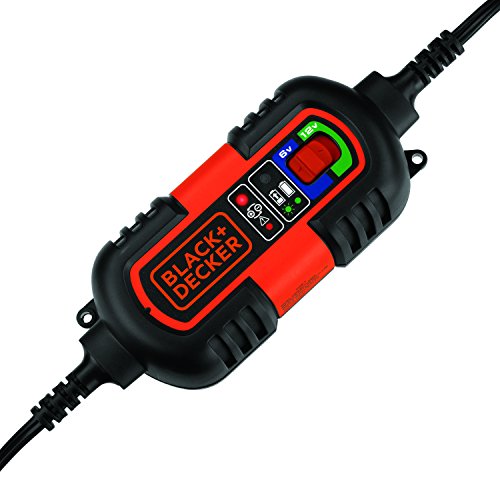
Black and Decker BM3B Battery Charger and Maintainer
Black and Decker keeps this charger simple with a single 1.5 amp output and automatic maintenance mode, aimed at owners who just need a basic, affordable way to keep one battery topped off. It skips the extra charging modes found on pricier units but handles routine maintenance reliably.
Pros
- Lowest cost option among chargers compared here
- Simple one-button operation with no settings to adjust
- Reliable automatic maintenance mode for seasonal vehicles
Cons
- No AGM or lithium compatibility
- Slow charging rate from a fully dead battery
Stanley BC25BS
Stanley combines a battery charger with a built-in jump starter function on wheels, aimed at owners who want both maintenance charging and emergency jump starting in one unit. The rolling design makes it easier to move around a garage than handheld chargers.
Pros
- Combines charging and jump starting in one unit
- Wheeled design makes it easy to move around a garage
- Higher amp output handles larger batteries
Cons
- Bulkier footprint than handheld chargers or maintainers
- No lithium battery support
How they compare
| # | Model | Output | Best for | Score | Price |
|---|---|---|---|---|---|
| 1 | NOCO Genius10 | 10 amp, 6 and 12 volt selectable | Best Overall | 9.4 | Check price |
| 2 | CTEK MXS 5.0 | 5 amp, 12 volt | Best for Multiple Battery Types | 9.1 | Check price |
| 3 | Battery Tender Plus | 1.25 amp, 12 volt | Best for Long-Term Storage Maintenance | 8.9 | Check price |
| 4 | Schumacher SC1281 | 15 amp charge, 30 amp boost mode | Best for Fast Charging | 8.7 | Check price |
| 5 | NOCO Genius5 | 5 amp, 6 and 12 volt selectable | Best Compact Option | 8.5 | Check price |
| 6 | Black and Decker BM3B Battery Charger and Maintainer | 1.5 amp, 12 volt | Best Budget | 8.0 | Check price |
| 7 | Stanley BC25BS | 25 amp charge, higher amp jump start | Best for Jump Starting Combo | 8.3 | Check price |
Questions worth asking
What amperage charger do I need for a car battery?
A 5 to 10 amp charger works well for most car batteries, balancing reasonable charging speed with safety. Lower amperage units around 1 to 2 amps suit long-term maintenance rather than charging from dead.
Can a car battery charger overcharge a battery?
Smart chargers with automatic maintenance mode detect a full charge and reduce output to prevent overcharging. Basic non-automatic chargers can overcharge if left connected too long without monitoring.
Is a trickle charger the same as a battery maintainer?
A trickle charger delivers a slow, steady charge, while a maintainer specifically monitors the battery and adjusts output automatically. Many modern units, like the Battery Tender Plus, combine both functions.
Does an AGM battery need a different charger than a standard battery?
Yes, AGM batteries need a charging profile with different voltage limits than standard flooded lead-acid batteries. Chargers like the NOCO Genius10 and CTEK MXS 5.0 include a selectable AGM mode.
How long does it take to charge a dead car battery?
Charging time depends on amperage and battery size, ranging from a few hours on a 10 amp charger to over a day on a 1 to 2 amp maintainer. Boost modes on units like the Schumacher SC1281 cut that time further.
Can I leave a battery charger connected long term?
Only chargers with automatic maintenance mode are designed for long-term connection without risk. Non-automatic chargers should be disconnected once the battery reaches full charge.
Does cold weather affect car battery charging?
Yes, cold temperatures change a battery’s internal resistance, which some chargers like the NOCO Genius10 account for with a dedicated cold weather charging mode. Standard chargers without that mode may charge less efficiently in freezing conditions.
Can a battery charger also jump start a dead car?
Standard maintainers cannot jump start a vehicle, but combo units like the Stanley BC25BS include a separate jump start function built into the same unit.
The bottom line
The NOCO Genius10 is the best overall pick for most owners because its multiple battery chemistry support and 10 amp output cover daily charging and long-term maintenance in one unit. Owners focused purely on seasonal storage for a motorcycle or boat should pick the Battery Tender Plus instead for its gentle trickle charge. Anyone who wants charging and emergency jump starting combined should choose the Stanley BC25BS.
Tony Russo
Tony trained as an automotive technician and spent years in service and parts retail before moving into writing. He focuses on garage tools, car care products and accessories from a hands-on maintenance perspective.


