How to Pick a Camping Stove for Outdoor Cooking
The Camp Chef Everest 2X leads group cooking with two high output burners and real three sided wind shielding. Solo travelers get the fastest boil from the Jetboil Flash, while the Coleman Cascade Classic 2-Burner Propane Stove remains the dependable choice for straightforward car camping.
Group cooks get the most from the Camp Chef Everest 2X, solo travelers boiling water fast should look at the Jetboil Flash, and car campers wanting no fuss get there with the Coleman Cascade Classic 2-Burner Propane Stove.
Published burner ratings are measured in still air at room temperature, so a stove with an impressive number on the box can still struggle in a breeze or below freezing depending on its fuel and burner design. We compared burner output, wind shielding, canister behaviour in cold conditions, simmer control and what owners report about stability with a full pot.
Before you buy
Fuel type sets your cold weather ceiling Butane stops vaporising near freezing, which is why cheap cartridge stoves die on cold mornings. Isobutane propane blends do better and remain the standard for canister backpacking stoves. Straight propane, used by most car camping stoves, keeps working well below freezing. Liquid fuel stoves handle the deepest cold but need priming first.
Wind shielding matters more than the headline output number A published burner rating is measured in still air. In a steady breeze, an unshielded burner loses much of its useful heat as the flame gets pushed off the pot base. Folding wind panels help, integrated heat exchanger systems help more, and a bare backpacking burner needs a separate windscreen or a sheltered spot. Never fully enclose a canister stove with a windscreen, since trapped heat can overheat the canister.
Simmering is a different skill from boiling Integrated systems built to boil water fast are usually poor at holding a low flame, so sauces scorch easily. Stoves with progressive valves and a wider burner ring spread heat and hold a genuine simmer. Prioritise valve quality over headline output whenever camp cooking goes beyond dehydrated meals and coffee.
Stability is a safety feature, not an afterthought A tipped pot full of boiling water is the most common camp stove accident. Tall narrow canister systems are the worst offenders, which is why canister stabiliser feet exist at all. Wide two burner stoves stay stable only on a level surface, so a warped picnic table defeats the purpose. Check that pot supports hold your largest pan without the handle overhanging into the wind.
What we recommend

Camp Chef Everest 2X
Two independently controlled burners push high output even with a three sided wind shield in place. Matchless push button ignition lights each side without matches or a lighter. One burner can hold a rolling boil while the other simmers a sauce. Owners report full size pans stay stable without flame fanning out sideways.
Pros
- High output holds up in wind
- Independent controls allow a real simmer
- Stable platform for large pans
Cons
- Heavy and bulky for anything but car camping
- Burns through fuel quickly at full output

Jetboil Flash Cooking System
A heat exchanger built into the cup base captures far more energy than an open flame, cutting boil times to a couple of minutes. A colour changing indicator on the sleeve shows when water is ready without lifting the lid. Everything nests inside the cup itself for storage. Owners report the trade off is a flame too aggressive for anything beyond boiling.
Pros
- Fastest boil times in the lineup
- Very fuel efficient per boil
- Packs entirely inside its own cup
Cons
- Poor simmer control for real cooking
- Tall shape tips easily without the stabiliser

MSR PocketRocket 2
This screw on canister burner weighs about 2.6 ounces and folds flat enough to fit inside a mug. Three serrated pot supports grip better than most compact stoves manage. Based on specifications it still holds a usable simmer, unlike most integrated boil only systems. Nothing shields the flame, so wind cuts output fast outdoors.
Pros
- Almost weightless in a pack
- Better simmer than integrated systems
- Works with most pot diameters
Cons
- No wind protection built in
- Small supports limit maximum pan size
Coleman Cascade Classic 2-Burner Propane Stove
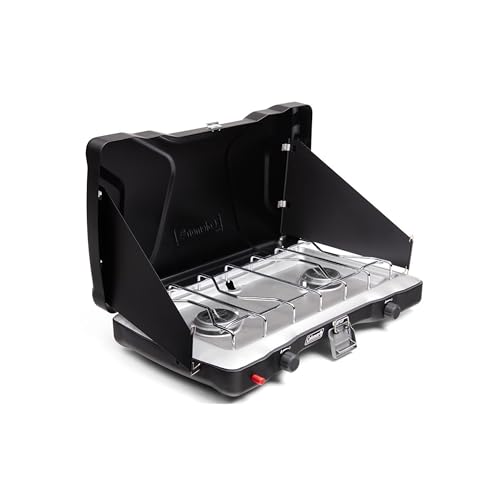
Two burners and folding wind panels cover most camp meals at output lower than premium stoves. A latching lid doubles as an extra windbreak when closed halfway. Its design has barely changed in years, which keeps spare parts easy to find. Owners report years of service with only occasional burner port cleaning.
Pros
- Proven long term reliability
- Folds flat for easy transport
- Spare parts stay widely available
Cons
- Lower output than premium two burner stoves
- Thin side panels flex in strong wind
Eureka Ignite Plus 2-Burner Camp Stove
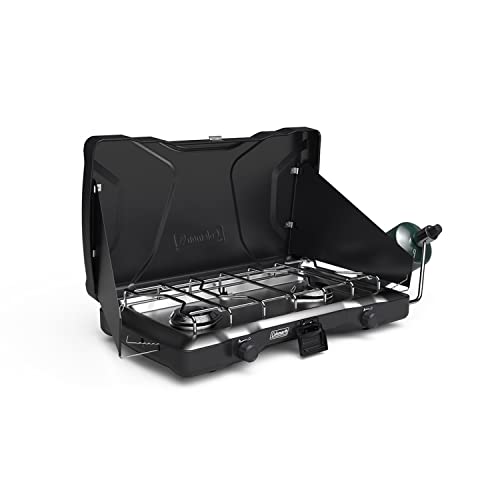
A wider burner ring spreads heat more evenly than narrower designs, and progressive valves hold a genuine low flame without cutting out. Hinged wind panels stay sturdy rather than flexing in a breeze. Owners report it as the stove to reach for when cooking real meals rather than reheating pouches.
Pros
- Holds a genuine low simmer
- Wide burner spreads heat evenly
- Sturdy hinged wind panels
Cons
- Heavier than the Coleman Cascade Classic
- Peak output trails the Camp Chef Everest 2X
Gas One GS-3400P Portable Butane Stove
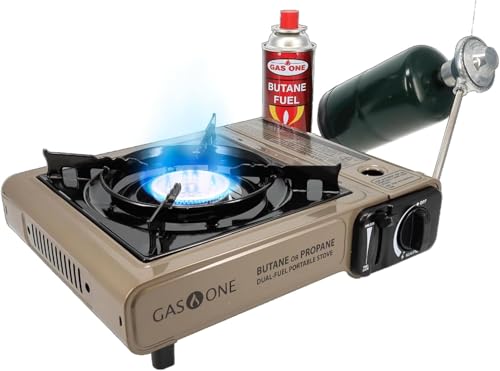
This single burner runs on butane cartridges or, with the included adapter, propane, which hedges against either fuel being out of stock. A hard carry case protects the unit and sets up within seconds at a tailgate. Piezo ignition skips the need for matches. Based on specifications, keep it out of hard wind and deep cold.
Pros
- Runs on either butane or propane
- Sets up within seconds
- Compact hard case for storage
Cons
- Butane performs poorly near freezing
- Single burner limits group cooking

Solo Stove Lite
Twigs and pine cones fuel this double wall stainless stove, so there is no canister to carry or run dry. Secondary combustion burns fuel cleaner than an open fire would. Owners report it shines in dry forest but struggles after rain, when dry fuel is hard to find. It also needs feeding constantly while cooking.
Pros
- No fuel to buy or carry
- Cleaner secondary combustion burn
- Nothing to break or leak
Cons
- Useless where fires are banned or fuel is wet
- Needs constant feeding while cooking
Side by side
| # | Model | Burners | Best for | Score | Price |
|---|---|---|---|---|---|
| 1 | Camp Chef Everest 2X | Two, independently controlled | Best overall | 9.4 | Check price |
| 2 | Jetboil Flash Cooking System | Integrated canister system | Best for fast boiling | 9.2 | Check price |
| 3 | MSR PocketRocket 2 | Around 2.6 ounces | Best for backpacking | 9.0 | Check price |
| 4 | Coleman Cascade Classic 2-Burner Propane Stove | Two | Best value | 8.8 | Check price |
| 5 | Eureka Ignite Plus 2-Burner Camp Stove | Two | Best simmer control | 8.6 | Check price |
| 6 | Gas One GS-3400P Portable Butane Stove | One | Best for tailgating | 8.3 | Check price |
| 7 | Solo Stove Lite | Twigs and biomass | Best fuel free option | 8.0 | Check price |
Questions worth asking
Which fuel works best for camping stoves?
Propane suits car camping best, since it is cheap, widely stocked and reliable in cold. Isobutane propane canisters suit backpacking because of the weight saving. Plain butane struggles below about forty degrees Fahrenheit, so avoid it for cold trips.
Can a camp stove be used inside a tent?
No. Every fuel burning stove produces carbon monoxide, and tent fabric ignites easily near an open flame. Cook in the open air or under a well ventilated shelter with the stove clear of any fabric.
How long does a propane cylinder last while camping?
It depends on burner output and how much simmering happens. A standard portable cylinder typically covers a weekend of moderate two burner cooking. Cold weather and full output both shorten that considerably.
Do I need a two burner camp stove?
Cooking for more than two people usually means yes, since a single burner turns every meal into a queue. Solo and pair campers are often better served by one efficient burner and a second small pot.
Why does a canister stove lose power as it empties?
Pressure drops as the canister empties and cools from its own evaporation. Keeping the canister slightly warm, for example in a jacket pocket before use, restores much of the lost output.
Are wood burning camp stoves worth buying?
They work well where dry twigs are plentiful and fires are permitted. They make a poor primary choice for wet regions, alpine areas above the treeline and anywhere under fire restrictions.
How do you clean a blocked camp stove burner?
Let it cool fully, brush the burner ports with a stiff brush, then clear any blocked holes with a thin wire. Uneven or yellow flames usually signal a partly blocked burner rather than a fuel problem.
Can camp stove fuel be taken on a flight?
No. Fuel canisters and cylinders are banned in both checked and carry on baggage. Stoves themselves are generally allowed once completely free of fuel residue, so plan to buy fuel after arriving.
Our pick
The Camp Chef Everest 2X suits anyone cooking for a group in exposed places, since its output and wind shielding hold up when conditions turn. Solo hikers boiling water mostly get more from the Jetboil Flash and its fuel efficiency. For straightforward car camping without spending heavily, the Coleman Cascade Classic 2-Burner Propane Stove remains the safe pick.
Derek Holt
Derek has a background coaching recreational and amateur athletes and has worked the sales floor at specialty fitness retailers. He focuses on equipment durability, ergonomics and realistic use cases rather than marketing claims.