Camera Flashes That Improve Low-Light Shots
The Godox V1 Pro is the strongest all-around pick, pairing a round flash head with built-in wireless TTL control that works across multiple camera brands. The Profoto A2 suits buyers who want a more compact on-camera unit, while the Neewer TT560 fits anyone on a tight budget who only needs manual power control.
The Godox V1 Pro stands out because its round flash head produces softer, more even light falloff than traditional rectangular flash heads, while built-in wireless control removes the need for a separate trigger. Its main limitation is a higher price than simpler manual flashes aimed at occasional use.
We compared guide number, recycle time, wireless triggering range and head design across each listing rather than running our own studio lighting tests.
What we recommend

Godox V1 Pro
A round flash head mimics the softer light falloff of a studio strobe more closely than the flat rectangular heads on most speedlights. Built-in 2.4GHz wireless control lets it work as a master or remote flash without a separate trigger, and a lithium battery recharges the full flash in about 1.5 seconds. TTL and manual modes cover both automated and precise manual exposure control.
Pros
- Round head gives softer light falloff than rectangular speedlight heads
- Built-in wireless control skips the need for a separate trigger
- Fast lithium battery recycle time supports rapid shooting
Cons
- Costs more than rectangular-head speedlights with similar guide numbers
- Larger and heavier than compact on-camera flash units

Godox V860III
This rectangular-head flash reaches full power recycle in roughly 1.2 seconds, among the fastest in its price range, which matters for continuous burst shooting. A lithium battery rated for around 480 full-power flashes outlasts the AA batteries used in many budget units. Built-in wireless TTL control pairs with Godox’s broader trigger and light system.
Pros
- Among the fastest recycle times in its price class
- Lithium battery lasts far longer per charge than AA-powered flashes
- Compatible with Godox’s wider wireless lighting ecosystem
Cons
- Lower guide number than the round-head V1 Pro
- Rectangular head produces harder light falloff than round-head designs

Canon Speedlite 600EX II-RT
Built specifically for Canon’s E-TTL II system, this flash integrates menu control directly through compatible Canon camera bodies rather than relying on third-party firmware. A weather-resistant build matches Canon’s own weather-sealed lens and body lineup. Radio wireless transmission reaches further than the optical wireless systems used on older Canon speedlites.
Pros
- Direct camera menu control simplifies settings on compatible Canon bodies
- Weather-resistant build matches Canon’s sealed camera lineup
- Radio wireless range exceeds older optical-only systems
Cons
- Only works at full capability with Canon camera bodies
- Costs more than third-party flashes with similar output
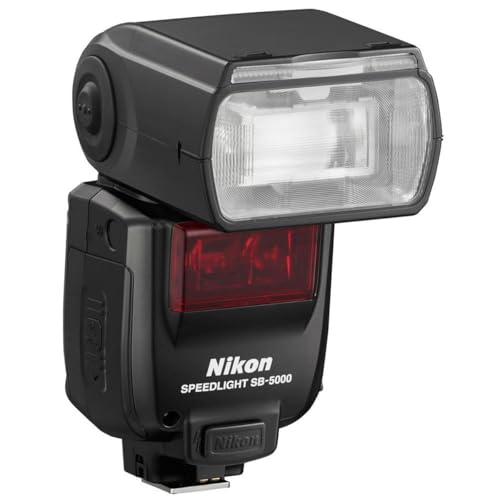
Nikon SB-5000 Speedlight
Radio-controlled wireless flash communicates directly with compatible Nikon camera bodies through Nikon’s Advanced Wireless Lighting system. A cooling system inside the flash head allows more consecutive full-power flashes before overheating protection kicks in. Nikon tunes the color output specifically to match its own camera sensors for consistent results.
Pros
- Internal cooling allows more consecutive full-power flashes
- Deep integration with Nikon’s wireless lighting system
- Color output tuned specifically for Nikon camera sensors
Cons
- Lower guide number than the Godox V1 Pro or V860III
- Limited to Nikon cameras for full wireless functionality

Sony HVL-F60RM2
A high guide number gives this flash more reach than most on-camera units, useful for bouncing light off distant ceilings or walls. Sony’s own radio wireless system lets it control other compatible Sony flashes as a group. Weather sealing throughout the body matches Sony’s higher-end mirrorless camera lineup.
Pros
- High guide number extends reach for bounce flash techniques
- Deep integration with Sony’s radio wireless flash system
- Weather sealing matches Sony’s higher-end camera bodies
Cons
- Full functionality limited to Sony camera bodies
- Premium price compared to third-party flashes with similar output

Profoto A2
A round flash head on a notably compact body gives softer light falloff without the bulk of larger speedlights. Profoto’s AirTTL wireless system connects to the company’s larger studio lights, letting one small flash control a bigger lighting setup. A built-in LED guide light helps with focusing in low light before the flash fires.
Pros
- Compact body with a round head is rare at this size
- AirTTL wireless connects directly to Profoto studio lights
- Built-in LED light assists focusing in low light
Cons
- Lower guide number than full-size speedlights on this list
- Premium price relative to its physical output capacity

Neewer TT560
This manual-only flash skips TTL automation entirely, giving full control over power output through a simple dial for buyers who prefer manual exposure. A universal hot shoe mount works across multiple camera brands without brand-specific firmware. Optical slave triggering lets it fire alongside other flashes without a dedicated wireless transmitter.
Pros
- Lowest price point among flashes on this list
- Universal mount works across multiple camera brands
- Optical slave mode allows basic multi-flash setups
Cons
- No TTL automation, so every shot needs manual power adjustment
- Lower guide number limits reach compared to pricier flashes
What matters most
What guide number, recycle time and TTL actually mean Guide number measures how far a flash’s light reaches at a given ISO and zoom setting, with a higher number meaning more usable range or power in a dim room. Recycle time is how long a flash takes to recharge between full-power shots, which matters most for fast-paced events like weddings or sports. TTL, or through-the-lens metering, lets the camera calculate flash power automatically, while manual mode hands that control entirely to the photographer. Wireless control lets one flash trigger others off-camera without a cable running between them.
Round head versus rectangular head flashes A round flash head, used on the Godox V1 Pro and Profoto A2, spreads light more evenly across a subject, closer to the falloff pattern of a studio strobe. A rectangular head, found on the Godox V860III and most brand-specific speedlites, concentrates light more directly, which some photographers prefer for harder-edged portrait lighting. Neither shape is strictly better, since the choice depends on whether softer bounce lighting or more directional output fits the shot being planned.
Matching a flash to your camera brand Canon, Nikon and Sony each sell a flagship speedlight built around their own camera’s wireless and metering system, seen in the Canon Speedlite 600EX II-RT, Nikon SB-5000 and Sony HVL-F60RM2. These brand-specific flashes integrate menu settings directly into the camera body, which third-party flashes cannot always match. Photographers using multiple camera brands, or who want to avoid being locked into one ecosystem, often choose a third-party flash like the Godox V1 Pro instead, since many support several camera mounts.
Wireless flash control and building a multi-light setup Building a multi-light setup starts with one flash acting as a master or trigger, which the Godox V1 Pro and Profoto A2 both support through their own built-in wireless systems. Brand-specific flashes extend that same idea within their own ecosystem, letting a Sony HVL-F60RM2 control a group of matching Sony flashes. Budget manual flashes like the Neewer TT560 can still join a multi-flash setup using optical slave triggering, though without the automatic power coordination that TTL wireless systems provide.
The lineup, side by side
| # | Model | Flash Head | Best for | Score | Price |
|---|---|---|---|---|---|
| 1 | Godox V1 Pro | Round head design | Best Overall | 9.2 | Check price |
| 2 | Godox V860III | Rectangular head design | Best for Fast Recycle Time | 8.8 | Check price |
| 3 | Canon Speedlite 600EX II-RT | Canon E-TTL II cameras | Best for Canon Camera Integration | 8.7 | Check price |
| 4 | Nikon SB-5000 Speedlight | Nikon Advanced Wireless Lighting | Best for Nikon Camera Integration | 8.6 | Check price |
| 5 | Sony HVL-F60RM2 | Sony Multi Interface, radio wireless | Best for Sony Camera Integration | 8.5 | Check price |
| 6 | Profoto A2 | Compact round head design | Best Compact On-Camera Flash | 8.4 | Check price |
| 7 | Neewer TT560 | Manual only, no TTL | Best Budget Manual Flash | 8.0 | Check price |
Frequently asked questions
What does guide number mean on a camera flash?
It measures the maximum usable range of a flash at a specific ISO and zoom setting. A higher guide number, like the 76 on the Godox V1 Pro, reaches further in a dim room.
Is TTL or manual flash mode better?
TTL automatically calculates flash power through the camera’s metering, which suits fast-moving situations. Manual mode, as used exclusively on the Neewer TT560, gives full control but takes more adjustment per shot.
Do third-party flashes work as well as brand-name speedlites?
Many do. The Godox V1 Pro supports multiple camera brands with full TTL compatibility, matching much of what brand-specific flashes like the Canon Speedlite 600EX II-RT offer.
What is a round head flash used for?
A round flash head, found on the Godox V1 Pro and Profoto A2, spreads light more evenly, closer to the look of a small studio strobe than a flat rectangular head.
How fast should a flash recycle between shots?
For continuous shooting, look for a recycle time under two seconds, like the roughly 1.2 second rating on the Godox V860III.
Can a camera flash trigger other flashes wirelessly?
Yes, flashes with built-in radio wireless, like the Godox V1 Pro, Canon Speedlite 600EX II-RT and Sony HVL-F60RM2, can act as a master to trigger compatible remote flashes.
Do I need a flash that matches my camera brand exactly?
Not always. Brand-matched flashes integrate more deeply with camera menus, but third-party flashes like the Godox V1 Pro cover most of the same core functions across brands.
What is optical slave mode on a budget flash?
It lets a flash fire automatically when it detects another flash firing nearby, a simple way for budget units like the Neewer TT560 to join a multi-flash setup.
Is a compact flash like the Profoto A2 powerful enough for events?
It works well for on-camera fill light at events, though its lower guide number means less reach than larger speedlights for bouncing light off distant ceilings.
Our pick
The Godox V1 Pro earns the top recommendation for most photographers, since its round head and built-in wireless control cover both softer lighting and multi-flash setups without extra accessories. Buyers fully invested in one camera brand’s ecosystem should instead choose that brand’s own flash, such as the Canon Speedlite 600EX II-RT or Sony HVL-F60RM2, for deeper menu integration. Anyone shooting occasionally on a tight budget should skip TTL automation entirely and pick the Neewer TT560.
Marcus Chen
Marcus covered consumer electronics for enthusiast tech publications for six years before joining ChoiceCrest. He specializes in translating manufacturer spec sheets into plain-language buying advice, with a focus on audio, computing accessories and smart-home gear.


