Camera Cages That Add Mounting Points Without Bulk
The SmallRig cage for the Sony a7 IV adds the most mounting points without excessive weight for hybrid shooters. Filmmakers running heavier rigs should look at a Tilta full cage, while anyone wanting a lighter footprint can rely on a minimal cage built for smaller mirrorless bodies.
The SmallRig cage for the Sony a7 IV earns the top spot for adding NATO rails, cold shoe mounts and thread points without adding excessive bulk to a camera already comfortable to hand-hold. Its main limitation is that it fits only Sony’s a7 IV and closely related bodies, so it will not transfer to a different camera system later. Buyers with a different camera body or heavier rigging needs have better-matched options below.
We compared published mounting point counts, added weight, camera compatibility and included accessories rather than running our own drop or durability testing.
The shortlist, ranked

SmallRig Camera Cage for Sony a7 IV
This cage wraps the Sony a7 IV’s body in aluminum alloy, adding multiple quarter-inch and three-eighths-inch thread points plus a cold shoe mount for a microphone or light. Cutouts keep every port, button and card slot accessible without removing the cage for daily use. NATO rail compatibility on the side allows quick-release handle attachments for handheld shooting.
Pros
- Full port and button access without removing the cage
- NATO rail allows quick-release handle attachments
- Multiple mounting points for microphones, lights and accessories
Cons
- Fits only the Sony a7 IV, not transferable to other camera bodies
- Adds noticeable bulk versus shooting with no cage at all

Tilta Full Camera Cage for Sony a7 IV
Tilta builds this cage as a more complete rigging solution than SmallRig’s, with side plates and top handle sold as part of a fuller kit aimed at filmmakers adding matte boxes, external monitors and follow focus systems. The baseplate includes standard 15mm rod mounting points for attaching further rig components. Weight runs higher than lighter cages, a reasonable tradeoff for the added rigidity under a heavier accessory load.
Pros
- 15mm rod support suits heavier rigging with monitors and follow focus
- More rigid build than lighter cages under heavy accessory load
- Full kit approach suits filmmakers building a complete rig
Cons
- Heavier than SmallRig’s cage for the same camera body
- Costs more than simpler cages for hybrid photo and video shooters

SmallRig Mini Cage for Sony ZV-E1
Built specifically for Sony’s compact ZV-E1, this mini cage adds just enough mounting points for a microphone and light without working against the camera’s small, lightweight design philosophy. A cold shoe mount sits directly above the hot shoe for simple accessory stacking. Unlike full cages built for larger bodies, this one keeps the camera’s original grip shape mostly intact.
Pros
- Keeps the camera’s compact, lightweight handling intact
- Cold shoe placement simplifies stacking a mic and light
- Adds far less bulk than full-size cages built for larger bodies
Cons
- Fewer mounting points than full cages for heavier rigs
- Not compatible with larger Sony bodies like the a7 IV
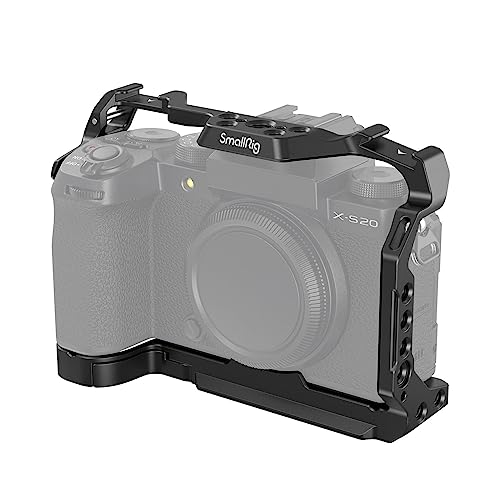
Ulanzi Camera Cage for Fujifilm X-S20
Ulanzi fits this cage to Fujifilm’s X-S20, a popular hybrid body among content creators, at a lower cost than premium cage brands. Cutouts preserve access to the flip-out screen and all ports, important for a camera marketed heavily toward vlogging. A built-in cold shoe and multiple thread points cover basic microphone and light mounting without the extra cost of a full rigging kit.
Pros
- Lower cost than premium cage brands for the same body
- Preserves flip-out screen access for vlogging use
- Covers basic microphone and light mounting needs
Cons
- Fewer advanced rigging points than Tilta’s full cage systems
- Fits only the X-S20, not other Fujifilm camera bodies

Neewer Camera Cage for Canon EOS R5
This cage fits Canon’s EOS R5 body closely, adding top and side mounting points while keeping the camera’s original battery door and card slots accessible. A built-in NATO rail on top accepts quick-release handles similar to pricier cage brands. Neewer prices this cage below SmallRig and Tilta equivalents, a useful option for Canon shooters not needing the most premium build quality.
Pros
- Lower cost than SmallRig or Tilta equivalents for the R5
- NATO rail supports quick-release handle attachments
- Preserves full access to battery door and card slots
Cons
- Build quality feels less refined than premium cage brands
- Fits only the Canon EOS R5, not other Canon bodies

8Sinn Cage for Canon EOS R5 C
8Sinn targets this cage at the video-focused R5 C variant, adding top handle mounting and side rod support aimed at cinema-style shooting rather than casual photography. A thicker baseplate than consumer cages adds stability when a heavier lens or matte box is attached. Its design favors filmmakers over photographers who just want occasional accessory mounting.
Pros
- Thicker baseplate adds stability under heavier lenses
- 15mm rod support suits cinema-style rigging
- Built specifically around the video-focused R5 C variant
Cons
- Costs more than simpler cages built for casual use
- Overbuilt for photographers who only need basic mounting

SmallRig Universal Video Cage
Rather than fitting one specific body, this cage uses an adjustable mounting plate designed to fit a range of smaller compact and mirrorless cameras within a size range. Cold shoe and thread mounting points cover basic microphone and light needs for creators who swap camera bodies occasionally. Fit is less precise than a body-specific cage, since cutouts cannot align perfectly with every supported camera’s ports.
Pros
- Fits a range of smaller cameras rather than one specific body
- Useful for creators who switch between multiple small cameras
- Lower cost than most body-specific cages in this list
Cons
- Port access is less precise than a body-specific cage design
- Less secure fit than cages built for one exact camera model
How to pick the right one
What a camera cage actually adds A cage wraps around a camera body to add mounting points, like cold shoes and thread holes, for microphones, lights, monitors and handles that the camera’s stock body cannot support. Most cages preserve access to ports, buttons and the battery door, so the camera still functions normally day to day. The main cost is added weight and bulk, which matters more for handheld shooting than tripod work.
Body-specific versus universal cage fit A body-specific cage, like the SmallRig cage for the Sony a7 IV or the Ulanzi cage for the Fujifilm X-S20, aligns cutouts precisely with that camera’s ports and buttons. A universal cage, like SmallRig’s adjustable model, fits a range of smaller cameras but with less precise port alignment. Buyers who own one camera long-term benefit most from a body-specific cage, while those switching bodies often may prefer universal flexibility.
Light mounting versus heavy rigging needs Hybrid shooters who occasionally mount a microphone or small light need only basic cold shoe and thread points, covered well by the SmallRig a7 IV cage or Neewer’s Canon EOS R5 cage. Filmmakers adding matte boxes, external monitors and follow focus systems need 15mm rod support, found on the Tilta full cage and the 8Sinn cage for the R5 C. Matching cage complexity to actual rigging plans avoids paying for rod support that never gets used.
Weight tradeoffs for handheld and vlogging work Smaller, lighter cages like the SmallRig Mini Cage for the Sony ZV-E1 preserve a camera’s original lightweight handling, important for all-day vlogging or travel. Full cages with rod support, like Tilta’s or 8Sinn’s, add noticeable weight that benefits stability on a gimbal or shoulder rig but tires out handheld shooters faster. Buyers should weigh how the camera will actually be held before choosing a heavier, more feature-complete cage.
How they compare
| # | Model | Camera Compatibility | Best for | Score | Price |
|---|---|---|---|---|---|
| 1 | SmallRig Camera Cage for Sony a7 IV | Sony a7 IV | Best Overall for Sony Mirrorless | 9.1 | Check price |
| 2 | Tilta Full Camera Cage for Sony a7 IV | Sony a7 IV | Best for Heavy Rigging | 8.9 | Check price |
| 3 | SmallRig Mini Cage for Sony ZV-E1 | Sony ZV-E1 | Best Lightweight Cage for Vlogging Bodies | 8.6 | Check price |
| 4 | Ulanzi Camera Cage for Fujifilm X-S20 | Fujifilm X-S20 | Best Value for Fujifilm Shooters | 8.4 | Check price |
| 5 | Neewer Camera Cage for Canon EOS R5 | Canon EOS R5 | Best for Canon Mirrorless Shooters | 8.3 | Check price |
| 6 | 8Sinn Cage for Canon EOS R5 C | Canon EOS R5 C | Best for Cinema-Style Shooting | 8.2 | Check price |
| 7 | SmallRig Universal Video Cage | Various compact and mirrorless cameras within size range | Best for Smaller Compact Cameras | 8.0 | Check price |
Questions worth asking
Do I need a camera cage for casual shooting?
Not necessarily. A cage mainly helps when mounting a microphone, light or monitor beyond what the camera’s hot shoe alone supports.
Will a camera cage fit any camera body?
Most cages, like the SmallRig cage for the Sony a7 IV, fit one specific body precisely. Universal cages fit a range of smaller cameras with less precise alignment.
Does a camera cage block access to ports and buttons?
Well-designed cages, including every body-specific option in this list, cut out space for ports, buttons and the battery door so normal use is not affected.
What is a NATO rail used for on a camera cage?
A NATO rail allows a quick-release handle to clamp on and off without tools, useful for switching between handheld and tripod shooting.
Do I need 15mm rod support on a camera cage?
Only if adding a matte box, external monitor bracket or follow focus system. Casual shooters mounting just a mic or light do not need rod support.
Can a camera cage protect my camera from drops?
Cages add some physical protection to the body’s edges and corners, though they are designed primarily for mounting accessories, not as dedicated drop protection.
Is a universal camera cage worth it over a body-specific one?
Only for creators who switch camera bodies often. A body-specific cage fits more precisely for anyone keeping the same camera long-term.
Does adding a camera cage affect battery or card access?
Most well-designed cages, like the ones from SmallRig, Tilta and Ulanzi in this list, leave the battery door and card slots fully accessible without removing the cage.
Are heavier camera cages better?
Not automatically. A heavier cage with rod support benefits serious rigging setups, but adds unnecessary weight for shooters who only need basic accessory mounting.
The verdict
The SmallRig cage for the Sony a7 IV is the strongest overall pick for hybrid shooters who want solid mounting points without excessive bulk. Filmmakers planning to add a matte box, monitor or follow focus system should choose the Tilta full cage instead, since its 15mm rod support handles heavier rigging better. Vloggers who prioritize a lightweight, compact setup should skip full cages entirely and pick the SmallRig Mini Cage built for the Sony ZV-E1.
Marcus Chen
Marcus covered consumer electronics for enthusiast tech publications for six years before joining ChoiceCrest. He specializes in translating manufacturer spec sheets into plain-language buying advice, with a focus on audio, computing accessories and smart-home gear.


