Digital, Dial or Vernier: Picking a DIY Caliper
Mitutoyo 500-196-30 suits anyone cutting metal, reading to 0.0005 inch on jaws that hold zero overnight. iGaging ABSOLUTE ORIGIN repeats that zero retention and adds IP54 sealing plus a fraction readout. For woodworking and 3D print checks, Neiko 01407A measures close enough.
Mitutoyo 500-196-30 is the caliper to buy if you fit bearings, size shafts or check tap drills. Absolute encoding wakes it already zeroed, and 0.0005 inch resolution holds across the full 6 inch beam. One limitation stands out: no fractional inch mode, so woodworkers convert 0.4844 in their head.
Nearly every listing quotes 0.0005 inch, yet plenty of budget units drift a thousandth by the next morning. We compared published resolution and accuracy figures against jaw material, battery type and ingress ratings. Owner reports about zero drift, screen flicker and dead cells broke the ties.
The shortlist, ranked

Mitutoyo 500-196-30 Absolute Digimatic Caliper
Absolute encoding stores the origin, so the display shows a true reading the moment it powers on. Resolution runs to 0.0005 inch or 0.01 mm, with stated accuracy of plus or minus 0.001 inch. Hardened stainless jaws keep their tip geometry after years of contact with steel stock.
Pros
- Wakes up already zeroed thanks to absolute encoding
- Hardened stainless jaws resist wear from steel and aluminium
- One SR44 cell is rated for roughly 3.5 years
Cons
- Decimal inch only, with no 64ths readout for layout
- Unsealed beam slot lets fine sawdust reach the encoder

iGaging ABSOLUTE ORIGIN Digital Caliper
Origin technology keeps the reference point stored between sessions, so re-zeroing stops being a habit. An IP54 rating covers workshop dust and the occasional splash, which few budget calipers claim. Three display modes rotate through inch decimals, 64ths and millimetres.
Pros
- Fraction mode prints 64ths, matching bit and lumber labels
- IP54 sealing shrugs off sawdust and damp hands
- Zero holds overnight, unlike most low cost digitals
Cons
- Jaw finish marks more easily than Mitutoyo hardened steel
- Fraction rounding hides error that matters on metal fits
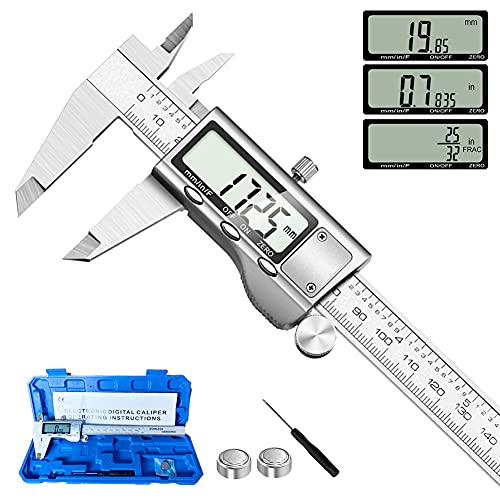
Neiko 01407A Electronic Digital Caliper
Stainless frame and an oversized LCD make this the default first caliper in many home shops. Display steps land at 0.0005 inch, though real accuracy sits nearer 0.001 inch across the beam. Leave the jaws open in a drawer and the LR44 cell drains within months.
Pros
- Tall digits stay readable under a dim shop light
- Switches between inch, fraction and millimetre modes
- Stainless frame shrugs off knocks that crack plastic bodies
Cons
- Battery drains fast whenever the jaws sit open
- Zero needs checking at the start of every session

Starrett 3202-6 Dial Caliper
Rack and pinion drive reads 0.001 inch per division, with no electronics to quit mid job. Needle movement gives feel, which helps when chasing a slip fit on a shaft. Grit in the rack makes the dial skip, so blow the beam clean before measuring.
Pros
- Never needs a battery or a power on sequence
- Moving needle shows change while you adjust the jaws
- Hardened stainless holds calibration across decades
Cons
- Rack collects grit and starts skipping readings
- Inch only scale, so metric means mental conversion

Mitutoyo 530-312 Vernier Caliper
Nothing here can fail electrically, since readings come off a vernier scale etched into hardened stainless. Both scales share one beam, marked to 0.001 inch and 0.02 mm. Reading takes practice, which is why most buyers start digital and keep this one for the long run.
Pros
- Immune to flat batteries, moisture and screen failure
- Inch and metric scales sit on a single beam
- Survives drops that would crack an LCD caliper
Cons
- Vernier scale needs practice and good light to read
- Slower than digital across a long run of measurements

VINCA DCLA-0605 Digital Caliper
Fraction mode steps in 1/64 inch, matching how lumber, router bits and drill indexes are labelled. A thumb roller handles fine adjustment, and the locking screw parks a dimension while you set a fence. Depth rod and step jaws reach mortise bottoms and rabbet shoulders.
Pros
- Reads 64ths, so numbers match tape measures and bit sets
- Locking screw holds a dimension during fence setup
- Step jaws measure rabbets and tenon shoulders
Cons
- Fraction rounding masks small errors on metal work
- Screen contrast washes out in direct sunlight
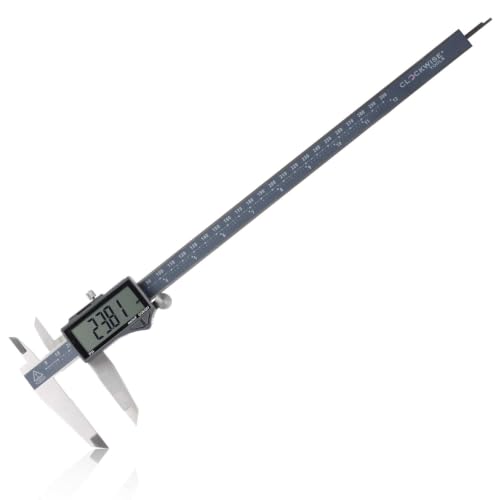
Clockwise Tools DCLR-1205 Digital Caliper
Twelve inches of beam reach across cabinet rails, brake rotors and wide pipe. Resolution stays at 0.0005 inch, though a longer beam flexes if you squeeze the jaws hard. Storage means a drawer or case, because it will not ride in an apron pocket.
Pros
- Doubles the span of a standard 6 inch caliper
- Keeps inch, fraction and millimetre switching
- Wide jaws sit flat on rotor faces and large pipe
Cons
- Beam flex skews readings when jaws are overtightened
- Too long for pocket carry around a workshop
The lineup, side by side
| # | Model | Range | Best for | Score | Price |
|---|---|---|---|---|---|
| 1 | Mitutoyo 500-196-30 Absolute Digimatic Caliper | 0 to 6 inches, 0 to 150 mm | Best overall | 9.4 | Check price |
| 2 | iGaging ABSOLUTE ORIGIN Digital Caliper | 0 to 6 inches, 0 to 150 mm | Best value | 9.2 | Check price |
| 3 | Neiko 01407A Electronic Digital Caliper | 0 to 6 inches, 0 to 150 mm | Best budget | 9.0 | Check price |
| 4 | Starrett 3202-6 Dial Caliper | 0 to 6 inches | Best dial caliper | 8.8 | Check price |
| 5 | Mitutoyo 530-312 Vernier Caliper | 0 to 6 inches, 0 to 150 mm | Best for durability | 8.6 | Check price |
| 6 | VINCA DCLA-0605 Digital Caliper | 0 to 6 inches, 0 to 150 mm | Best for woodworking | 8.3 | Check price |
| 7 | Clockwise Tools DCLR-1205 Digital Caliper | 0 to 12 inches, 0 to 300 mm | Best for long stock | 8.0 | Check price |
What matters most
What to look for in a DIY caliper Resolution and accuracy are two different numbers. A screen stepping in 0.0005 inch may still be accurate only to 0.001 inch, and cheap units drift past that. Jaw material decides how long any accuracy lasts. Hardened stainless keeps its tip shape, while chrome plated zinc rounds off within a year. Zero retention saves more time than buyers expect, because a caliper that forgets its origin costs a re-zero every session. Battery type is worth a glance too, since SR44 and LR44 cells behave very differently over months of storage.
Digital vs dial vs vernier: which type fits your shop Speed and instant unit switching push most home shops toward digital. Dial models such as the Starrett 3202-6 add feel, useful when hunting a slip fit, and they never die mid job. Vernier beams like the Mitutoyo 530-312 outlast everything, though reading one quickly takes practice. Measure only now and then? Digital pays off. Keep tools in a damp garage, and dial or vernier avoids the corroded contacts and drained cells that kill budget digitals.
Best caliper for woodworking Lumber, router bits and drill indexes carry fraction labels, so a readout of 0.4844 inch forces mental maths. Fraction mode on the VINCA DCLA-0605 and iGaging ABSOLUTE ORIGIN shows 31/64 directly instead. Dust causes the second woodworking problem. Fine particles pack into the beam slot and turn readings jumpy. IP54 sealing helps, and wiping the beam after each session helps more. Joinery work also rewards a locking screw, which holds a dimension while you move to the saw.
Calipers for metalwork and 3D printing Metal fits live inside a thousandth of an inch, which turns fraction mode into a liability. Stay on decimal inch or millimetre output from the Mitutoyo 500-196-30 for bearing bores, shaft diameters and tap drill checks. 3D printing sits between the two worlds. Filament diameter and first layer squish need only 0.001 inch resolution, so the Neiko 01407A covers that job. Let hot parts cool first, because aluminium and PLA both expand enough to move the reading.
Frequently asked questions
What caliper accuracy do I need for DIY projects?
Woodworking joints absorb 0.005 inch without a visible gap, so almost any caliper works. Metal fits, bearing bores and engine parts want 0.001 inch or better. For 3D printer calibration, 0.001 inch resolution is plenty, since filament itself varies more than that.
Are digital or dial calipers better for home use?
Digital is faster and switches units instantly, which suits mixed projects. Dial gives a moving needle that shows change as you close the jaws, and it never runs flat. Many shops keep a digital as the daily driver with a dial as backup.
Why does my digital caliper battery die so fast?
Budget calipers often keep the encoder powered whenever the jaws are open, even with the display off. Closing the jaws fully before storage cuts that drain sharply. Absolute encoder designs from Mitutoyo and iGaging use a different circuit and last far longer.
Can calipers measure inside diameters and depths?
Yes. Upper knife edge jaws handle internal dimensions such as pipe bores and mortise widths, and the depth rod reaches blind holes. Inside readings are less reliable than outside ones because contact area is small. Rock the caliper slightly and take the largest value.
How do I check whether my caliper is still accurate?
Close the jaws and confirm a clean zero, then measure a gauge block or a drill shank of known size. Deviation over 0.001 inch on a 6 inch tool points to worn jaws or grit in the beam slot. Clean the beam and retest before condemning the caliper.
Is a 12 inch caliper worth it instead of a 6 inch?
Only when cabinet parts, brake rotors or wide pipe come up regularly. Longer beams flex under jaw pressure, which costs precision on small parts. Most workshops do better with a 6 inch caliper plus a steel rule for long spans.
What does IP54 mean on a caliper?
IP54 covers dust ingress and water splashed from any direction. That rating matters in garages with airborne sawdust or wet cutting. Unrated calipers work fine on a clean bench, then read erratically once particles reach the encoder strip.
Mitutoyo vs iGaging: which caliper should I buy?
Mitutoyo holds tighter accuracy and uses harder jaw steel, so machinists lean that way. iGaging matches the zero retention behaviour, adds IP54 sealing and reads in 64ths. Woodworkers generally prefer the iGaging, while metalworkers gravitate to the Mitutoyo.
Which caliper is best for 3D printing?
Neiko 01407A covers the usual jobs: filament diameter, nozzle clearance, first layer height and printed part dimensions. Millimetre mode should be the default, since slicers work in metric. Skip fraction display entirely for this work, because rounding to 64ths destroys useful precision.
Our take
Buy the Mitutoyo 500-196-30 if metal fits, bearings or tap drills are part of your projects, because absolute encoding and hardened jaws keep a thousandth honest. Woodworkers get more out of the iGaging ABSOLUTE ORIGIN, where 64ths display and IP54 sealing match how a dusty garage actually runs. Anyone who wants one caliper that still reads true in twenty years should take the Starrett 3202-6 dial and forget batteries exist.
Jake Monroe
Jake worked as a residential contractor for over a decade before shifting to full-time writing. He evaluates power tools, hand tools and workshop gear through the lens of someone who has actually used them on job sites, not just read the box.


