Budget Exercise Wheels That Keep Hamsters Active
The Kaytee Silent Spinner is the best budget wheel overall, since its enclosed bearing stays quiet and it comes in several sizes. The Niteangel Super-Silent wheel spins the smoothest. The Ware Flying Saucer suits cages with limited height.
The Kaytee Silent Spinner covers the most cages on a small budget, thanks to its size range and enclosed bearing. Niteangel’s Super-Silent runs quieter still, and the Ware Flying Saucer solves the problem of a cage too short for an upright wheel.
Wheel shopping goes wrong in two predictable ways: buying one too small so the animal runs with a curved spine, or choosing a wire or mesh surface where feet and tails can catch. We compared running surface type, diameter options, bearing design, stand stability and mounting method across currently sold listings, then weighed those against what owners report about squeaking after a few weeks and how easily each one comes apart for cleaning.
What matters most
What size exercise wheel does your pet need? An animal running in a wheel that is too small arches its spine, which is uncomfortable and can cause long term problems. As a rough guide, dwarf hamsters need at least about twenty centimetres, Syrian hamsters closer to twenty eight or thirty, and rats and larger rodents more again. Watching the animal run is the simplest test, since a straight back means the wheel fits and a visible curve means it does not.
Why a solid running surface matters more than price Wire rung and mesh wheels are still sold, and vets report they cause the injuries small pets suffer most often, from trapped toes to bumblefoot to tail damage where a tail slips through a gap. A solid plastic or wooden track avoids all of that. Treat any wheel with a gap in the running surface as unsuitable regardless of its price.
Solving noise, wobble and stand stability Wheels squeak for two reasons: a dry axle or a wobbly stand. Enclosed ball bearings run far quieter than a plain axle, which is the real difference between the Silent Spinner and the Comfort Wheel. A wide stand base stops the low frequency rattle that carries through a shelf at three in the morning, and a drop of vegetable oil on a squeaking hub is the usual fix, never a petroleum lubricant.
Choosing between a saucer, a wooden wheel and a cage mounted wheel Saucers solve limited headroom and spine curvature at once, but some animals refuse the tilted surface, and they use a large share of floor space. Wooden wheels suit heavy chewers and natural style setups but absorb odour and need replacing sooner than plastic. Cage mounted wheels free up floor space in a wire enclosure but will not work on a glass or plastic tank.
What we recommend

Kaytee Silent Spinner Exercise Wheel
The Silent Spinner has stayed the default budget wheel for years by combining a solid plastic running surface with an enclosed ball bearing that keeps it genuinely quiet at night. Several diameters let you match the wheel to a dwarf hamster or a Syrian rather than compromising on size. Owners report the bearing eventually develops a squeak, and a drop of vegetable oil on the hub usually fixes it.
Pros
- Solid surface protects feet and tails
- Several sizes so you can fit the animal properly
- Quiet enough for a bedroom at night
Cons
- Bearing can squeak after months of use
- Stand base is small on the larger sizes
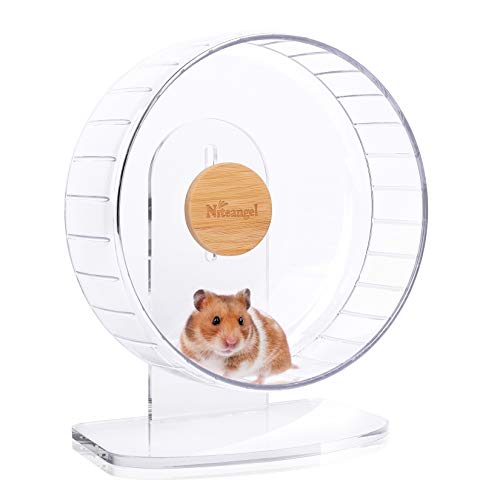
Niteangel Super-Silent Hamster Exercise Wheel
Niteangel invests more in the bearing than the price suggests, and the result spins for a long time with almost no noise. A wider stand than most budget wheels resists tipping when a heavier animal jumps aboard at speed. The solid textured surface adds grip without leaving gaps for toes to slip through.
Pros
- Among the quietest wheels at any price
- Wide base resists tipping
- Textured surface gives good grip
Cons
- Base takes up floor space in a small cage
- Larger sizes are harder to find in stock
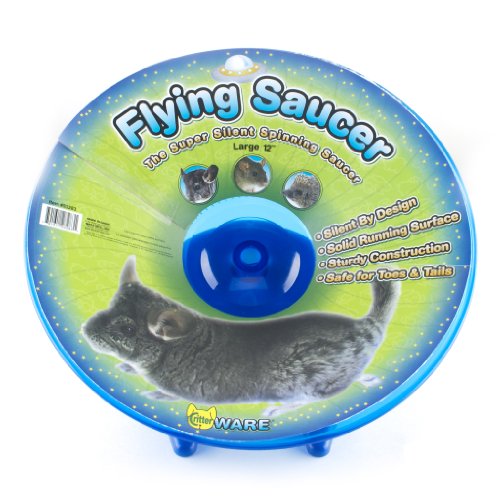
Ware Manufacturing Flying Saucer Exercise Wheel
Sitting at an angle rather than standing upright, a saucer fits cages where a conventional wheel would not clear the roof. Running on a shallow arc removes any spine curvature concern regardless of the animal’s size. Cleaning is simplest of any design here, since there is nothing to disassemble, though some animals never take to the tilted surface.
Pros
- Fits cages with limited headroom
- No spine curvature concern at any size
- Simplest cleaning of any design here
Cons
- Some animals refuse to use a saucer
- Takes a large share of the cage floor

Kaytee Comfort Exercise Wheel
Stripped back to a solid plastic wheel on a simple axle, the Comfort Wheel skips the ball bearing and any frills. That trade off makes it noisier than the Silent Spinner but costs noticeably less, while the running surface stays just as safe. Choose this one when the cage sits somewhere the extra noise will not keep anyone awake.
Pros
- Lowest cost solid surface wheel here
- Same safe running surface as pricier models
- Few parts so very little to break
Cons
- Noticeably noisier than bearing wheels
- Wobbles more at speed

Exotic Nutrition Silent Runner Exercise Wheel
Exotic Nutrition built this wheel for sugar gliders and larger rodents, so the construction is heavier than a typical hamster wheel and handles more weight without flexing. A dual bearing system and a tail and toe guard come standard. It costs more than the basic wheels here while still sitting at the top end of what most people would call budget.
Pros
- Handles heavier animals without flexing
- Tail and toe guard fitted as standard
- Dual bearings keep noise low under load
Cons
- More expensive than basic hamster wheels
- More parts to take apart for cleaning

Trixie Wooden Exercise Wheel
For animals that chew everything, a wooden wheel avoids the plastic shards a determined gnawer can produce. This version pairs a solid running surface with a simple wooden stand, fitting a natural style setup better than plastic ever could. Wood absorbs urine over time, so plan to replace it sooner than a plastic wheel.
Pros
- Safe for animals that chew plastic
- Suits natural style cage setups
- Solid surface with no gaps
Cons
- Absorbs odour and needs replacing sooner
- Cannot be washed as thoroughly as plastic

Prevue Pet Products Quiet Wheel Small Animal Exercise Wheel
Bolting firmly to wire cage bars, Prevue’s wheel keeps the floor clear and stops the wheel wandering across the bedding. Included mounting hardware pairs with a solid running surface for straightforward installation. This design solves the specific problem of a small cage where floor space runs scarce.
Pros
- Frees up cage floor space
- Stays put instead of sliding around
- Mounting hardware supplied
Cons
- Only works on wire cages, not tanks
- Fewer size options than Kaytee
Side by side
| # | Model | Surface | Best for | Score | Price |
|---|---|---|---|---|---|
| 1 | Kaytee Silent Spinner Exercise Wheel | Solid plastic, no gaps | Best overall | 9.4 | Check price |
| 2 | Niteangel Super-Silent Hamster Exercise Wheel | Solid textured plastic | Best value | 9.2 | Check price |
| 3 | Ware Manufacturing Flying Saucer Exercise Wheel | Angled saucer | Best for short cages | 9.0 | Check price |
| 4 | Kaytee Comfort Exercise Wheel | Solid plastic | Best budget | 8.8 | Check price |
| 5 | Exotic Nutrition Silent Runner Exercise Wheel | Heavy duty, larger animals | Best for larger animals | 8.6 | Check price |
| 6 | Trixie Wooden Exercise Wheel | Wood | Best natural material | 8.3 | Check price |
| 7 | Prevue Pet Products Quiet Wheel Small Animal Exercise Wheel | Bolts to wire cage bars | Best for wire cages | 8.0 | Check price |
Frequently asked questions
What size exercise wheel does my hamster need?
Dwarf hamsters generally need around twenty centimetres or more, and Syrians closer to twenty eight to thirty. Watching the animal run is the reliable check, since a back that curves upward means the wheel is too small no matter what the packaging claims.
Are wire exercise wheels safe for small pets?
Wheels with wire rungs or mesh surfaces are widely advised against because feet and tails can slip through the gaps. A solid plastic or wooden running surface avoids that risk entirely and costs no more, leaving little reason to choose wire.
Why is my exercise wheel squeaking?
A dry axle or bearing is the usual cause. A small amount of vegetable oil on the hub normally silences it, and petroleum based lubricants should be avoided since the animal will inevitably contact them. A wobbly stand can also produce noise, which repositioning often solves.
Do all small pets need an exercise wheel?
Hamsters, gerbils, mice and rats commonly use them. Guinea pigs and rabbits should not, since their spines are not suited to the shape. Check what is recommended for your specific species before buying.
Is a saucer wheel better than an upright wheel?
A saucer removes the spine curvature concern and fits low cages, real advantages for short enclosures. The trade off is floor space and the fact that some animals simply will not use one, so many owners offer a saucer alongside a wheel and let the animal choose.
How often should you clean a hamster wheel?
Most owners wipe it during the weekly cage clean and give it a full wash when it looks soiled. Wheels that come apart without tools tend to get cleaned more consistently, worth considering when choosing one.
Free standing or cage mounted exercise wheel: which is better?
Cage mounted wheels free up floor space and stay put, suiting small wire cages. Free standing wheels work in tanks and bin cages where there are no bars to bolt to, and they can move to wherever the animal prefers.
Are wooden exercise wheels better than plastic ones?
They suit animals that chew plastic aggressively and fit natural style setups well. Wood absorbs urine and cannot be disinfected as thoroughly as plastic, though, so it needs replacing more often.
What is the best budget exercise wheel for a bedroom cage?
The Niteangel Super-Silent runs quieter than almost any wheel at this price, making it the best pick for a cage sharing a bedroom. The Kaytee Silent Spinner is a close second and offers more size options for different species.
The verdict
The Kaytee Silent Spinner remains the sensible budget default, since it gets the two things right that matter most: a solid running surface and a bearing quiet enough to live with overnight, with a size range that fits the wheel to the animal. Spend a little more on the Niteangel Super-Silent if the cage shares a bedroom, and choose the Ware Flying Saucer when the cage lacks headroom for anything else.
Olivia Hartley
Olivia spent several years working at an animal shelter and a pet-supply retailer before joining the editorial team. She researches pet gear with an emphasis on safety, comfort and the fine print that owners often miss.