Replacement Brackets That Stop a Shelf From Sagging
Simpson Strong-Tie A34 framing angles suit structural repairs, since 18 gauge galvanised steel arrives with a published load table. For damp rooms and visible shelving, Alise stainless L brackets hold up without rust bleed. Bowing garage shelves call for Knape & Vogt 208 brackets in slotted standards.
Simpson Strong-Tie A34 handles most failed framing connections. Eighteen gauge steel, a G90 coating and a published fastener schedule tell you exactly what the angle carries. Looks are the tradeoff, since a structural connector reads industrial on open shelving. Visible shelves and stone overhangs need different shapes entirely.
Brackets fail in three ways, and each one points to a different replacement. Bent metal means the gauge was too thin for the span. Screws torn through drywall mean the anchor gave way, not the steel. Rust blooming at a fold means the coating never suited the room. We compared thickness, coating, arm length and hole spacing across seven options, then checked manufacturer load data against what owners report about sag after a year of use.
The shortlist, ranked

Simpson Strong-Tie A34 Framing Angle
A34 ties studs, joists and blocking back together at 90 degrees. Simpson forms it from 18 gauge steel, coats it G90 galvanised, then publishes allowable loads for each fastener schedule. Prepunched holes accept 8d common nails or number 9 by 1-1/2 inch structural screws.
Pros
- Published load tables replace guesswork on structural repairs
- G90 coating survives crawl spaces and damp basements
- Bulk boxes cover a whole repair in one order
Cons
- Bare industrial look suits framing, not open shelving
- Short 1-7/16 inch leg limits the span it can brace
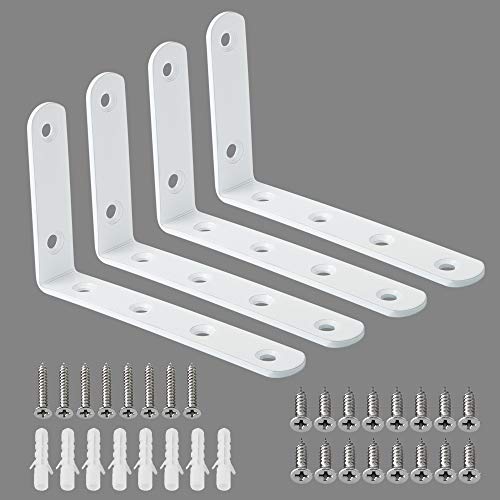
Alise Stainless Steel L Shelf Bracket
Alise folds 304 stainless into a right angle and brushes the face to a satin finish. Six inch arms match a standard shelf depth. Countersunk holes, four per bracket, let screw heads sit flush under the board. Unlike zinc plate, this steel will not streak a white wall after a shower.
Pros
- 304 stainless shrugs off bathroom steam and sink splash
- Flush countersunk heads leave no bump under the board
- Satin brushing hides the fingerprints polished steel shows
Cons
- Thinner stock than a framing angle, so keep spans short
- No published load rating to size the shelf against

Wallniture Iron Shelf Bracket
Stamped iron under a matte black powder coat gives reclaimed wood shelves the look most buyers are after. Arm lengths run 6 to 12 inches, sold in packs of 4 to 12. Treat these as support for books, plants and spice jars. Stock stays thinner than a framing angle, so a loaded garage shelf will outgrow them.
Pros
- Matte black matches common pipe and iron shelf hardware
- Packs of up to 12 cover a full wall in one order
- Two hole wall pattern lines up quickly with a level
Cons
- Powder coat chips at folded edges during install
- Indoor only, because chips let rust start underneath

Knape & Vogt 208 Series Heavy Duty Shelf Bracket
Hooks into Knape & Vogt 80 series slotted standards, so shelf height moves without drilling again. A hemmed edge and formed rib carry far more than flat stamped steel. Arms come in 8 to 16 inch lengths, painted or anochrome. Reach for this system once a pantry or garage shelf starts bowing mid span.
Pros
- Shelf height steps up or down in one inch increments
- Formed rib resists the bending that flattens plain angles
- Vertical standards spread load across several studs
Cons
- Needs matching KV standards, so it is no drop-in swap
- Exposed vertical tracks read industrial in a living room

Rubbermaid FastTrack Shelf Bracket
Brackets clip onto a horizontal rail lagged into studs, turning one row of anchors into a whole storage wall. Each bracket slides sideways with no tools. Rubbermaid rates the system for heavy garage loads once that rail reaches framing. Hooks, baskets and bike hangers share the same track.
Pros
- One lagged rail supports every bracket on the wall
- Shelves reposition sideways without fresh holes
- Same rail also takes hooks, bins and bike hangers
Cons
- Shelf widths and accessories stay locked to Rubbermaid
- Rail must land on studs to reach the rated capacity

Pinnacle Mercantile Floating Shelf Brackets
Solid steel rods around half an inch thick weld to a flat wall plate. Each rod slides into a hole bored in the back edge of a thick board, and nothing shows once the shelf seats. Board choice decides whether this works. Nominal two inch solid stock gives the rod enough material to resist tipping.
Pros
- Hardware disappears completely once the board is on
- Solid rod bends less than folded sheet of equal depth
- Wall plate splits the load across two anchor points
Cons
- Bored holes must align exactly, with no adjustment after
- Thin or hollow shelf boards cannot take the rod

Federal Brace Hidden Countertop Support Bracket
Flat powder coated plates sit inside the cabinet and cantilever out beneath a stone or quartz overhang. Thin stock lets the slab drop straight on with no visible gap. Installers screw them to the cabinet deck or set them into a routed pocket. Knee room stays open where a corbel would intrude.
Pros
- Nothing shows once the slab is set in place
- Bar seating keeps the leg room a corbel eats
- Plate spreads load along the overhang, not one point
Cons
- Fitting means lifting or removing the countertop
- More support than a short laminate overhang needs
How they stack up
| # | Model | Steel gauge | Best for | Score | Price |
|---|---|---|---|---|---|
| 1 | Simpson Strong-Tie A34 Framing Angle | 18 gauge | Best overall | 9.4 | Check price |
| 2 | Alise Stainless Steel L Shelf Bracket | 304 stainless steel | Best value | 9.2 | Check price |
| 3 | Wallniture Iron Shelf Bracket | Powder coated iron | Best budget | 9.0 | Check price |
| 4 | Knape & Vogt 208 Series Heavy Duty Shelf Bracket | 80 series slotted standard | Best for heavy shelving | 8.8 | Check price |
| 5 | Rubbermaid FastTrack Shelf Bracket | FastTrack horizontal rail | Best for garage and closet rails | 8.6 | Check price |
| 6 | Pinnacle Mercantile Floating Shelf Brackets | Concealed rod with wall plate | Best for floating shelves | 8.3 | Check price |
| 7 | Federal Brace Hidden Countertop Support Bracket | Flat concealed countertop support | Best for countertop overhangs | 8.0 | Check price |
How to choose
What to check before replacing a bracket Start with the failure itself. Bent metal points to undersized gauge or too long a span. Screws pulled through paper facing mean the anchor let go, not the bracket. Rust flaking at a fold says the coating never matched the room. Measure arm length and hole spacing before the old part goes in the bin, since reusing sound holes saves patching and keeps the shelf level. Then decide which job you have: a load rated structural connector, or a decorative support that only ever holds paperbacks.
How much weight a bracket can actually hold Gauge numbers run backwards, so 18 gauge steel is thicker than 22 gauge. Shape beats thickness anyway. A formed rib or hemmed edge stiffens a bracket more than extra flat material ever will, which is why the Knape & Vogt 208 outcarries a plain angle of similar weight. Simpson lists allowable loads per fastener schedule; most decorative brands publish no figure at all. Two working rules help. Keep the arm within roughly two thirds of the shelf depth, and space supports no wider than 32 inches under a loaded shelf.
Best brackets for bathrooms, garages and outdoor walls Moisture picks the material for you. 304 stainless, as on the Alise bracket, takes shower steam and sink splash without bleeding rust onto paint. Galvanised steel such as the A34 belongs in basements, crawl spaces and garages. Powder coated iron stays indoors, because one chipped fold starts corrosion under the coating. Garage walls do better on a Rubbermaid FastTrack rail, since shelves then move as your storage changes. Near pool chemicals or coastal salt air, skip zinc plated hardware entirely.
Hidden supports for floating shelves and stone overhangs Some repairs need the bracket out of sight. Pinnacle Mercantile rods only work with thick solid boards bored to match, so check the shelf stock before ordering. Stone overhangs are a separate problem: flat plates like the Federal Brace slide under the slab and leave knee room free, which corbels never do. Heavy adjustable shelving still belongs on KV 208 brackets in 80 series standards. Whatever the shape, framing carries the load. Drywall anchors set the real ceiling in most failed installs, not the steel.
Questions worth asking
How much weight can a replacement shelf bracket hold?
Rarely is the bracket the limit. A 10 inch stamped bracket screwed into a stud commonly carries a few dozen pounds; the same bracket in a plastic drywall plug may fail under a fraction of that. Structural connectors like the Simpson A34 publish allowable loads per fastener schedule, and that is the only figure worth trusting.
Which bracket fixes a sagging garage shelf?
Move to a ribbed bracket on a slotted standard, such as the Knape & Vogt 208 series. Flat angles have nothing to resist bending along their length. Adding one support at mid span helps more than upgrading the two end brackets.
Can you screw shelf brackets into drywall without studs?
Only for light decorative loads, and then with a rated toggle rather than a plastic plug. Books, tools and dishes need wood behind the screw. Find the framing first, then pick an arm length and spacing that puts every bracket on a stud.
What is the difference between a shelf bracket and a framing angle?
Shelf brackets carry a horizontal load out in front of the wall. Framing angles like the A34 join two structural members and are rated for uplift and lateral force. They look similar and are not interchangeable.
Are stainless steel brackets worth it over powder coated iron?
In bathrooms, kitchens and covered porches, yes. 304 stainless will not bleed rust down paint when condensation sits on it for hours. Dry living rooms are different, since powder coated iron gives the same matte black look with no corrosion risk.
How do floating shelf brackets attach to the wall?
A steel plate screws into studs, and rods welded to that plate cantilever outward. Matching holes get bored into the back edge of a thick board, which then slides onto the rods. Drilling accuracy and board thickness matter more than the hardware.
Do granite countertops need hidden support brackets?
Unsupported stone past roughly 10 inches usually does. Flat plates like the Federal Brace sit under the slab and leave knee space clear. Shorter overhangs sitting on a continuous cabinet run generally need nothing extra.
Should I reuse the old screw holes or drill new ones?
Reuse them when the wood behind is sound, because that saves patching and keeps the shelf at its original height. Stripped holes call for fresh ones offset by at least an inch, so the screws bite undamaged framing.
What are the best brackets for heavy garage storage?
Rail systems win here. Rubbermaid FastTrack puts every bracket on one lagged rail, and Knape & Vogt 80 series standards do the same job with adjustable ribbed arms. Both beat individual angles because load spreads across multiple studs instead of two.
Final word
Simpson Strong-Tie A34 angles take the recommendation for structural repairs, where a published capacity beats a guess every time. Pick the Alise stainless L bracket when the shelf is visible and the room gets damp. Anyone rebuilding garage storage should stop buying single brackets and lag up a Rubbermaid FastTrack rail, because one row of anchors then carries every shelf added later.
Jake Monroe
Jake worked as a residential contractor for over a decade before shifting to full-time writing. He evaluates power tools, hand tools and workshop gear through the lens of someone who has actually used them on job sites, not just read the box.