How bakers get a bow shaped cake without a bow pan
Nordic Ware Pretty Package Bundt bakes a wrapped gift and bow motif in one cast aluminium piece, the closest mainstream option to a bow pan. For a built present cake, the Fat Daddio’s 8 inch anodized square gives the crispest corners. An Ateco pastry wheel cuts even fondant ribbon.
Nordic Ware’s Pretty Package Bundt suits bakers who want the bow baked rather than sculpted. Cast aluminium picks up ribbon relief that stamped steel would blur. Ten cups of batter fill it, so a standard bundt recipe needs no scaling. Every groove has to be greased, or the ribbon detail tears on release.
Search for a bow shaped cake pan and you hit a supply problem. Manufacturers avoid the shape, so most bow cakes get assembled from square layers with a separate topper. We compared the shaped pans that do exist against the square and round pans decorators actually reach for, judging corner definition, gauge, coating and release. Owner reports about sticking and warping settled the order.
The top picks, ranked

Nordic Ware Pretty Package Bundt Pan
Relief detail survives the bake here because cast aluminium fills a mould more finely than stamped steel. Capacity lands near 10 cups, matching most bundt and pound cake recipes without any maths. Release is the whole skill: coat every groove with baking spray, then invert after roughly 10 minutes.
Pros
- Bakes the gift and bow motif in one piece
- Cast aluminium holds fine relief detail
- Standard bundt volume needs no recipe scaling
Cons
- Deep crevices demand meticulous greasing
- Hand wash only after every bake

Fat Daddio’s Anodized Aluminum Square Cake Pan, 8 inch
Seamless construction leaves no rivets or welds to round off an interior angle. Corners come out square enough to read as a wrapped box once fondant goes on. Anodized aluminium is bare metal rather than coated, so lining the base with parchment is not optional.
Pros
- Interior angles stay genuinely square
- Even heating limits domed centres
- No coating to scratch or flake off
Cons
- Parchment or greasing needed every bake
- Dishwasher detergent dulls the anodizing

Wilton Decorator Preferred Square Cake Pan
Vertical walls mean a stack rises straight instead of stepping inward at each layer. Wilton sizes this line to its own boards and ribbon widths, which saves measuring at the decorating stage. Lighter gauge aluminium heats fast, so check a shallow layer a few minutes before the recipe says.
Pros
- Straight walls stack without tapering
- Sizes line up with common cake boards
- Quick heat suits shallow layer recipes
Cons
- Thinner gauge flexes under a full load
- Edges brown ahead of heavier pans
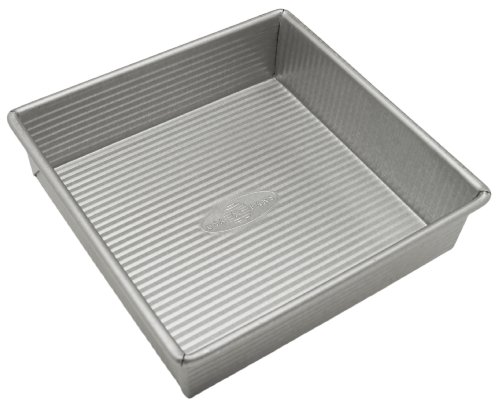
USA Pan Bakeware Square Cake Pan
Aluminised steel with a silicone based coating turns layers out without parchment. Baking three layers for one build is where that saves real time. A fluted surface pattern lifts the cake slightly, though corners finish a touch softer than on the Fat Daddio’s pan.
Pros
- Turns out layers with no lining
- Corrugated base resists warping
- Heavy gauge steel bakes evenly
Cons
- Corners soften slightly next to anodized pans
- Metal tools damage the coating

Chicago Metallic Professional Non-Stick Square Cake Pan
Coated carbon steel covers the basics of a layer pan at the lowest outlay in this group. Rolled rims add rigidity, so a thinner pan twists less as you lift a full layer from the oven. Budget coatings degrade first, which makes hand washing and unstacked storage worth the bother.
Pros
- Lowest outlay of the square pans here
- Rolled rim reduces flexing when loaded
- Clean release while the coating is new
Cons
- Coating wears sooner than premium pans
- Carbon steel spots if left wet

Calphalon Nonstick Bakeware Round Cake Pan
Not every bow cake is a box. Round tiers with a fondant bow perched on top read as a hat box, and heavy gauge steel bakes the level layers that shape depends on. Sides taper very slightly, so trim each edge before stacking.
Pros
- Thick gauge bakes flat layers
- Round tier suits hat box bow designs
- Releases cleanly without parchment
Cons
- Slight side taper needs trimming for stacks
- Dark coating browns edges faster

Ateco Stainless Steel Pastry Wheel Cutter
A bow reads as deliberate only when every loop matches in width. Freehand knife work rarely lands that close. Rolling a stainless wheel along a ruler cuts fondant, gum paste and modelling chocolate with clean edges and no dragging.
Pros
- Cuts ribbon at a consistent width
- Rolls without dragging or tearing
- Handles gum paste and modelling chocolate
Cons
- Needs a straight edge to guide it
- Decoration tool only, not a pan
How they compare
| # | Model | Material | Best for | Score | Price |
|---|---|---|---|---|---|
| 1 | Nordic Ware Pretty Package Bundt Pan | Cast aluminium with nonstick interior | Best overall | 9.4 | Check price |
| 2 | Fat Daddio’s Anodized Aluminum Square Cake Pan, 8 inch | Anodized aluminium, seamless | Best for sharp corners | 9.2 | Check price |
| 3 | Wilton Decorator Preferred Square Cake Pan | Aluminium | Best for stacked layers | 9.0 | Check price |
| 4 | USA Pan Bakeware Square Cake Pan | Aluminised steel | Best nonstick release | 8.8 | Check price |
| 5 | Chicago Metallic Professional Non-Stick Square Cake Pan | Carbon steel | Best budget | 8.5 | Check price |
| 6 | Calphalon Nonstick Bakeware Round Cake Pan | Heavy gauge steel | Best for hat box designs | 8.3 | Check price |
| 7 | Ateco Stainless Steel Pastry Wheel Cutter | Stainless steel wheel | Best for fondant bow ribbons | 8.0 | Check price |
Before you buy
Why true bow shaped cake pans are rare Bows have undercuts, thin loops and a hollow centre. None of that releases from a rigid metal pan, so manufacturers skip the shape. Nordic Ware works around it by casting the bow as surface relief on a bundt rather than sculpting it in three dimensions. Anything listed as a bow mould is usually silicone, sized for fondant and gum paste instead of batter. Knowing that early saves a long and fruitless search.
What to look for: material, corners and release Anodized aluminium gives the tightest interior angles, since a seamless pan has no rivets to soften a corner. Fat Daddio’s builds that way. Coated aluminised steel trades a little corner definition for release without parchment, which is the USA Pan bargain. Cast aluminium belongs in its own category, chosen when relief detail matters more than flat layers. Carbon steel is the entry point, and its coating fails first.
How to build a gift box and bow cake from square pans Bake two or three square layers, level them, then stack with a firm buttercream that holds under fondant. Chill the stack solid before covering, because warm buttercream bulges at the corners. Roll fondant over the top and smooth the corners last. Ribbon strips run up each face like wrapping paper. Assemble the bow separately and set it on top, so its loops never carry the weight of the covering.
Fondant vs modelling chocolate for the bow Rolled fondant dries firm and holds open loops overnight, which is why most tutorials start there. Modelling chocolate stays workable in a warm kitchen and tastes better to most people. Cut every strip against a ruler with a pastry wheel, then prop each loop on a ball of foil until it sets. Skip baked biscuit bows: they crack the moment you bend them.
Good to know
Is there a cake pan shaped like a bow?
Not in any practical form. Undercuts and thin loops make a bow nearly impossible to release from rigid metal. Nordic Ware’s Pretty Package Bundt casts a gift and bow motif in relief, which is as close as mainstream bakeware gets.
How do you make a bow shaped cake without a bow pan?
Bake square layers, stack and cover them like a wrapped present, then build the bow separately. Fondant or modelling chocolate loops go on last. Assembling on a chilled cake keeps the loops from sagging.
Which pan gives the sharpest corners for a gift box cake?
A seamless anodized pan such as the Fat Daddio’s 8 inch square. Without rivets or welded seams, the interior angle stays tight. That tight angle is what reads as a crisp box edge under fondant.
Can you use a silicone bow mould instead of a pan?
For decoration, yes. Silicone bow moulds are made for fondant, gum paste and modelling chocolate, not batter. Bake the cake in a conventional pan and use the mould for the topper.
How do you stop a detailed bundt pan from sticking?
Brush every crevice with baking spray or softened butter, then dust with flour and tap out the excess. Rest the baked cake around 10 minutes, then invert. Waiting longer lets sugar set against the metal.
Fondant or modelling chocolate: which is better for a bow?
Fondant dries firmer and holds loops open overnight. Modelling chocolate handles better above room temperature and tastes more agreeable. Plenty of decorators use fondant for structure and chocolate for small detail work.
What size pan do you need for a present cake?
An 8 inch square is the common starting point, baked two or three layers deep. That finishes close to a cube once filling and fondant go on. Smaller 6 inch squares suit a single tier gift.
Do you need a pastry wheel to cut fondant ribbon?
A wheel and a straight edge are enough. Rolling an Ateco cutter along a ruler gives strips of matching width. Matching widths are what separate a deliberate looking bow from a homemade one.
What is the best cake pan for a beginner making a bow cake?
Start with a coated pan such as the USA Pan square, because reliable release removes one failure point. Move to bare anodized aluminium later, once lining and levelling feel routine.
Can you make a bow cake without fondant?
Yes. Modelling chocolate loops work, and so do wide strips of chocolate ganache set on acetate. Buttercream alone will not hold an open loop, so the bow needs a firmer medium.
The verdict
Choose the Nordic Ware Pretty Package Bundt when the bow needs to be baked in, and allow extra minutes for greasing the relief. Bakers building a proper wrapped present should start with the Fat Daddio’s anodized square for its corners, then cut ribbon with the Ateco wheel. Pick the Calphalon round pan instead when the design is a hat box rather than a box.
Dana Whitfield
Dana spent eight years buying and merchandising for a regional kitchenware retailer before moving into editorial work. She has handled thousands of SKUs across cookware, small appliances and kitchen organization, and focuses on the practical differences that matter once a product is actually in daily use.


