Picking a Bottom-Freezer Refrigerator That Fits Your Kitchen
The Whirlpool WRB322DMBM balances 22 cubic feet of space with SpillGuard shelves and a built-in ice maker at a price most kitchens can justify. Families needing more room should look at the LG LRDCS2603S’s 26 cubic feet, while the Samsung RF18A5101SR fits flush counter-depth cabinets for a smarter, more compact option.
The Whirlpool WRB322DMBM fits most kitchens needing a straightforward 22 cubic foot bottom freezer, with SpillGuard shelves and a factory ice maker included. Its main tradeoff is capacity: households wanting more storage without a wider footprint get noticeably more room from the LG LRDCS2603S’s 26 cubic feet in the same 33 inch width.
Bottom freezer refrigerators range from compact garage units to 26 cubic foot models that rival French door capacity, which makes side-by-side comparison tricky without checking both width and depth. We compared published capacity figures, counter-depth fit, freezer drawer layout and owner-reported temperature consistency to separate genuinely different models from near-identical reskins.
The shortlist, ranked

Whirlpool WRB322DMBM
This 33 inch freestanding model holds 22 cubic feet across a single-door fresh food section and a pull-out freezer drawer below. SpillGuard glass shelves have a raised edge that catches minor spills before they reach the shelf below. The Accu-Chill temperature management system and factory-installed ice maker come standard, and Whirlpool rates it ENERGY STAR certified.
Pros
- SpillGuard shelves contain spills before they drip down
- Factory ice maker included at this price point
- ENERGY STAR certified for lower running cost
Cons
- 33 inch width needs a wider cutout than compact models
- Single door fresh food section limits organization versus French door styles
GE GDE25EYKFS
GE’s GDE25EYKFS holds roughly 25 cubic feet, biased toward a larger fresh food compartment that suits families doing one big grocery trip per week. Independent temperature monitoring found it holds a steadier internal temperature than most mid-range competitors, which reduces the risk of produce spoiling early. The freezer drawer uses a see-through bin layout so frozen items stay visible without digging.
Pros
- Measured temperature stability above most mid-range rivals
- Large fresh food section suits bigger households
- See-through freezer bins reduce digging for frozen items
Cons
- Larger footprint needs more kitchen width than compact models
- Costs more than GE’s entry-level bottom freezer line
LG LRDCS2603S
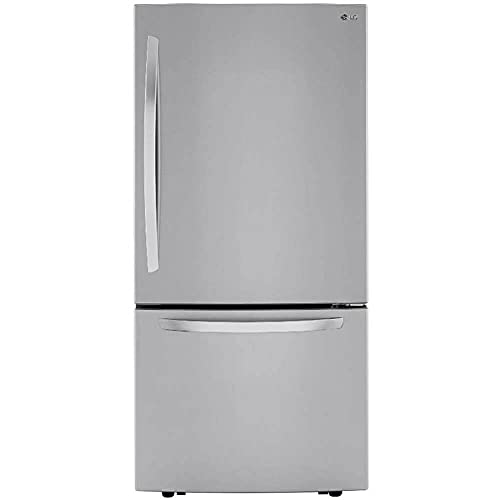
LG packs 26 cubic feet into the LRDCS2603S, more than most French door refrigerators offer, while keeping the simpler single-door-plus-drawer layout. The PrintProof stainless finish resists fingerprints better than standard stainless, a detail useful in households with kids. At 33 inches wide, it needs the same footprint as the Whirlpool WRB322DMBM despite holding noticeably more food.
Pros
- 26 cu ft capacity rivals many French door models
- PrintProof finish resists fingerprints and smudges
- Same footprint as smaller-capacity competitors
Cons
- Single door still means reaching across for items on cold days
- Heavier than Whirlpool’s comparable 22 cu ft model, two movers recommended
Samsung RF18A5101SR
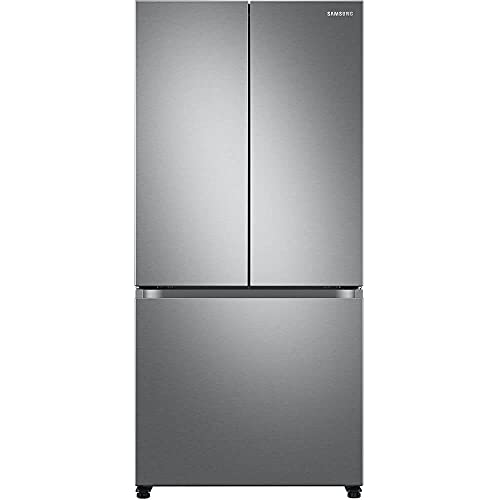
Samsung’s RF18A5101SR fits flush with standard counters at a counter-depth build, holding 17.5 cubic feet across a 3-door French door layout. Wi-Fi connectivity lets owners check internal temperature and get door-left-open alerts from a phone app. Spillproof glass shelves and a humidity-controlled crisper round out a layout aimed at buyers who want smart features without the largest capacity.
Pros
- Counter-depth design sits flush with surrounding cabinets
- Smartphone alerts catch a door left open
- Humidity-controlled crisper keeps produce fresher longer
Cons
- 17.5 cu ft capacity trails the Whirlpool and LG models here
- Counter-depth design costs more per cubic foot than standard-depth

GE GBE21DYKFS
GE’s GBE21DYKFS trims the price without cutting core features, holding 20.9 cubic feet in a 30 inch wide frame. It skips smart connectivity and upgraded shelving in favor of a straightforward layout that covers daily use. Reviewers call it GE’s most affordable bottom freezer model while still including adjustable glass shelves and a factory ice maker connection.
Pros
- Lower cost than GE’s upgraded bottom freezer models
- 20.9 cu ft covers most households’ daily needs
- Adjustable glass shelves fit taller items
Cons
- No smart connectivity or app features
- Narrower 30 inch width holds less than the 33 inch LG and Whirlpool models

Midea MRB19B7AWW
Midea rates the MRB19B7AWW as garage-ready, meaning its compressor and insulation keep working in temperature swings that would strain a standard refrigerator. The 18.7 cubic foot capacity splits into 13.1 cubic feet of fresh food and 5.6 cubic feet of freezer space across two drawer levels. A reversible door lets owners switch the swing direction to fit tight garage layouts.
Pros
- Garage-ready rating handles temperature swings standard fridges can’t
- Reversible door fits tighter garage or laundry room layouts
- Two-level freezer drawers organize frozen goods better than one bin
Cons
- 13.1 cu ft fresh food space is modest for a full household
- White finish only, no stainless option in this model
Insignia NS-RBM18SS0
Insignia’s NS-RBM18SS0 keeps the layout simple: 18.6 cubic feet, a freestanding 30 inch body, reversible doors and two separate freezer drawers for easier sorting. It carries ENERGY STAR certification despite sitting at the lower end of the price range for stainless bottom freezer models. Owners report it works well as a straightforward replacement unit without extra smart features to configure.
Pros
- Two separate freezer drawers simplify sorting frozen food
- ENERGY STAR certified despite a lower price point
- Reversible doors suit tighter kitchen layouts
Cons
- No smart features or Wi-Fi connectivity
- 18.6 cu ft capacity suits smaller households, not large families
What matters most
What to measure before you shop Width and depth decide what fits before capacity even enters the conversation. Standard bottom freezer refrigerators run 30 to 33 inches wide, and swapping between those sizes can mean a few cubic feet of difference in either direction. Door swing clearance matters too, especially in galley kitchens where a reversible door like Midea’s or Insignia’s solves a layout problem a fixed-swing door can’t. Measure the doorway path into the kitchen as well, since a 33 inch refrigerator can be too wide to turn through a narrow hallway.
Counter-depth versus standard-depth models Standard-depth refrigerators extend several inches past kitchen cabinets, which adds capacity but leaves the fridge jutting into the walking path. Counter-depth models like the Samsung RF18A5101SR sit flush with surrounding cabinets at the cost of some cubic footage. That tradeoff makes sense in smaller kitchens where the extra few inches matter more than a few extra cubic feet. Larger kitchens rarely need to make that compromise and can take the capacity gain from a standard-depth model instead.
Picking a bottom freezer for a large household Large households do better with capacity figures at the high end, like the LG LRDCS2603S’s 26 cubic feet or GE’s steadier-running GDE25EYKFS. More fresh food space matters more than freezer space for families buying groceries weekly rather than stocking up monthly. Adjustable glass shelves also help more in a busy household, since taller items like pitchers and sheet pans need the extra clearance more often than in a smaller household.
Choosing a model for a garage or secondary fridge A garage or basement refrigerator faces temperature swings a kitchen unit never sees, which is where Midea’s garage-ready rating on the MRB19B7AWW matters. Standard refrigerators can struggle to maintain internal temperature when the surrounding air drops below a certain point in winter, risking food safety. Budget models like the Insignia NS-RBM18SS0 work fine as a simple secondary fridge in a climate-controlled space, but a true garage installation calls for the garage-rated compressor and insulation instead.
Compared at a glance
| # | Model | Capacity | Best for | Score | Price |
|---|---|---|---|---|---|
| 1 | Whirlpool WRB322DMBM | 22 cu ft | Best overall for most kitchens | 9.2 | Check price |
| 2 | GE GDE25EYKFS | Approximately 25 cu ft | Best for steady, even temperatures | 9.0 | Check price |
| 3 | LG LRDCS2603S | 26 cu ft | Best for maximum capacity in a single-door body | 9.1 | Check price |
| 4 | Samsung RF18A5101SR | 17.5 cu ft | Best counter-depth smart refrigerator | 8.9 | Check price |
| 5 | GE GBE21DYKFS | 20.9 cu ft | Best value for a full-size kitchen | 8.7 | Check price |
| 6 | Midea MRB19B7AWW | 18.7 cu ft total | Best for garages and secondary kitchens | 8.5 | Check price |
| 7 | Insignia NS-RBM18SS0 | 18.6 cu ft | Best simple stainless option on a budget | 8.4 | Check price |
Good to know
What is the difference between a bottom freezer and a top freezer refrigerator?
A bottom freezer places the freezer drawer at floor level and the fresh food section at eye level, which puts the items used daily within easier reach. A top freezer reverses that layout, which some owners prefer for freezer access but most find less convenient for everyday fresh food use.
Are bottom freezer refrigerators more energy efficient?
Many are, since cold air naturally sinks and a bottom freezer takes advantage of that tendency with less compressor work than some top freezer designs. ENERGY STAR certification, found on most models in this roundup, is the more reliable indicator than freezer position alone.
How much capacity does a family of four need?
Appliance guidelines generally suggest 20 to 25 cubic feet for a household of four, though grocery shopping frequency changes that estimate. Families shopping weekly can often get by with less than families who stock up monthly.
Can a bottom freezer refrigerator fit a counter-depth kitchen?
Only counter-depth models, like the Samsung RF18A5101SR, sit flush with standard cabinets. Standard-depth bottom freezer refrigerators extend several inches past the counter edge and will look out of place in a counter-depth kitchen layout.
Do bottom freezer refrigerators come with an ice maker?
Most do, either factory-installed like the Whirlpool WRB322DMBM or as a connection point for an ice maker kit sold separately on some budget models. Check the specific listing, since not every budget model includes the ice maker itself.
Is a garage-ready refrigerator necessary for a garage?
It helps significantly. A garage-ready model, such as the Midea MRB19B7AWW, is built to keep working through temperature swings a standard kitchen refrigerator isn’t designed to handle, which protects both the food and the compressor.
What does PrintProof or fingerprint-resistant finish mean?
It is a coating applied over stainless steel that resists smudges and fingerprints better than plain stainless. LG calls its version PrintProof, while other brands use different names for a similar coating.
How wide is a standard bottom freezer refrigerator?
Most models run 30 to 33 inches wide. Measure the available cutout space and the path into the kitchen before choosing between those two common widths.
Which bottom freezer refrigerator has the most capacity?
The LG LRDCS2603S offers 26 cubic feet in this roundup, more than most French door refrigerators and noticeably more than other 33 inch bottom freezer models.
Do smart refrigerator features matter in a bottom freezer model?
They add convenience, such as door-left-open alerts on the Samsung RF18A5101SR, but they are not essential. Buyers who don’t want to manage an app can get the same core cooling performance from a non-connected model.
The verdict
Most kitchens are well served by the Whirlpool WRB322DMBM, which covers everyday capacity needs with SpillGuard shelves and an included ice maker without an oversized footprint. Larger households should step up to the LG LRDCS2603S for its 26 cubic feet in the same 33 inch width, since the extra room costs little in terms of kitchen space. Anyone working with a counter-depth kitchen layout should skip both and choose the Samsung RF18A5101SR, which sits flush with the cabinets and adds smart alerts the others don’t offer.
Dana Whitfield
Dana spent eight years buying and merchandising for a regional kitchenware retailer before moving into editorial work. She has handled thousands of SKUs across cookware, small appliances and kitchen organization, and focuses on the practical differences that matter once a product is actually in daily use.