Bluetooth Battery Chargers Mechanics Actually Use
CTEK CS ONE Gen 2 handles most bench work, with polarity free clamps and automatic profile selection. Victron Blue Smart IP65 12V 10A logs voltage and current history, so a suspect battery shows itself. Mobile techs carry the CTEK CS FREE, which runs from USB-C.
CTEK CS ONE Gen 2 fits a workshop bench that sees mixed vehicles daily. Either clamp lands on either terminal, so a rushed connection under a wheel arch cannot reverse polarity. Output stops near 8A, which leaves a deeply flat truck battery charging overnight.
Genuine Bluetooth chargers number in the dozens, not the hundreds, so the shortlist builds itself fast. We compared rated current, app data depth, supported chemistries, ingress ratings and input type. Owner reports then settled the questions specifications never answer, mainly app pairing reliability and clamp durability.
The shortlist, ranked

CTEK CS ONE (Gen 2)
Polarity free clamps remove any need to identify red and black at the terminal. Adaptive charging reads battery state and selects its own profile, so nobody guesses at a mode switch. Wi-Fi sits alongside Bluetooth, letting a charge get checked from the front office.
Pros
- Reversed connection is impossible at the clamp
- Chooses its charge profile without user input
- Wi-Fi reach covers a whole workshop
Cons
- 8A leaves large flat batteries charging overnight
- Manual control is thinner than Victron offers

Victron Energy Blue Smart IP65 Charger 12V 10A
VictronConnect graphs voltage and current live, then keeps recent charge cycles on file. Ten amps returns a 60Ah car battery to full inside a working day without stressing it. Sealed to IP65, the case ignores bench dust and drifting brake cleaner.
Pros
- Charge history exposes a failing cell
- Storage mode covers vehicles laid up for months
- Carries UL1236 certification for North America
Cons
- Menu depth confuses first time owners
- Very flat lithium packs can refuse to start

CTEK CS FREE
Four jobs share one housing: charging, maintenance, a boost start and USB-C power out. Input arrives over USB-C, so a laptop brick or power bank runs it where no mains outlet exists. ADAPTIVE BOOST feeds a battery enough to crank rather than dumping raw current across the terminals.
Pros
- Works on a driveway with no mains supply
- Boost start needs no donor vehicle
- Slim enough for a service van drawer
Cons
- Charge current is low for bench duty
- Rated output demands a capable USB-C supply
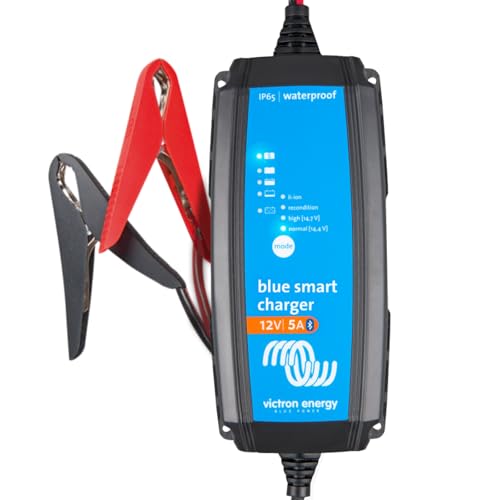
Victron Energy Blue Smart IP65 Charger 12V 5A
Five amps matches motorcycle, ATV and lawn tractor batteries in the 8Ah to 14Ah range. Storage mode drops to a lower holding voltage, which suits a bike parked from November to March. VictronConnect runs it exactly like the larger units, so one phone watches several chargers.
Pros
- Current sized correctly for small batteries
- Storage voltage avoids winter overcharging
- Shares one app with the rest of the range
Cons
- Too slow for car and truck batteries
- Clamps are lighter than shop grade leads

Victron Energy Blue Smart IP67 Charger 12V 25A
Twenty five amps brings a 200Ah deep cycle bank back inside a working day rather than a weekend. Potted electronics and an IP67 shell allow mounting in an engine bay or beside a bilge. Reporting matches the IP65 models, charge history graphs included.
Pros
- Fast recovery on boat and RV banks
- Sealed for permanent vehicle mounting
- Runs lead acid and lithium profiles
Cons
- Heavy to carry between bays
- More charger than one car battery needs

Victron Energy Orion-Tr Smart 12/12-30A Isolated DC-DC Charger
Alternator voltage goes in and a proper multi stage charge comes out for the auxiliary battery. Galvanic isolation keeps starter and house circuits separate, which protects sensitive electronics in a camper build. Engine detection, voltage limits and profiles all live in the app instead of DIP switches.
Pros
- Charges a second battery while driving
- Isolation shields the starter circuit
- Every charge parameter stays adjustable
Cons
- Correct wiring and fusing take real install time
- No mains input, so bench use is out

Renogy 12V 40A DC-DC On-Board Battery Charger
Two sources feed one output here, the alternator and a solar array through a built in controller. Forty amps refills a lithium house bank in a van or overland build without an idle hour. Bluetooth arrives only with Renogy’s BT-2 module, a separate purchase worth planning into the build.
Pros
- Solar and alternator share one controller
- High output suits large house banks
- Lithium profile selectable on the unit
Cons
- BT-2 Bluetooth module is not included
- Heavy gauge cable is required at 40A
How to choose
What Bluetooth actually adds to a charger Connectivity does not move electrons faster. An app adds evidence instead: live voltage, current, charge stage and a history you can scroll afterwards. A battery that reaches absorption in ten minutes and parks there has lost capacity, and a two colour LED will never say so. Range is the catch. Bluetooth reaches across a workshop but not across a yard, which is why CTEK added Wi-Fi to the CS ONE.
How much charge current you actually need Charge current near 10 percent of capacity in amp hours is the safe working figure. A 60Ah car battery wants roughly 6A, comfortably inside the Blue Smart IP65 12V 10A. Motorcycle batteries around 12Ah belong on the 5A version instead. Deep cycle banks past 150Ah justify 25A, or one recharge occupies an entire weekend. Pushing harder than the rule shortens lead acid life, while going gentler only costs time.
Chargers built for a working bay Shop conditions punish equipment. IP65 is the sensible floor, because dust, solvent mist and a knock off the bench are routine. Lead length decides whether a charger reaches a battery under a rear seat or in a boot well. Polarity free clamps on the CS ONE earn their keep in a busy bay, since they delete the one mistake that kills fuses and chargers. Worth saying plainly: NOCO Genius units carry no app at all, and plenty of shops run them happily.
Charging from the alternator in a van or truck Dual battery builds call for a different tool. DC-DC chargers such as the Orion-Tr Smart convert alternator voltage into a real multi stage profile, which a split charge relay cannot do for lithium. Smart alternators on newer vehicles vary output to save fuel, making that conversion close to mandatory. Renogy’s 40A unit folds in a solar input, letting a roof panel and the engine share one controller. Fuse both ends of cable that size, no exceptions.
How they stack up
| # | Model | Output | Best for | Score | Price |
|---|---|---|---|---|---|
| 1 | CTEK CS ONE (Gen 2) | 12V, up to 8A | Best overall | 9.4 | Check price |
| 2 | Victron Energy Blue Smart IP65 Charger 12V 10A | 12V, 10A | Best value | 9.2 | Check price |
| 3 | CTEK CS FREE | Charge, maintain, boost, USB-C power | Best for mobile work | 9.0 | Check price |
| 4 | Victron Energy Blue Smart IP65 Charger 12V 5A | 12V, 5A | Best for motorcycles and powersports | 8.8 | Check price |
| 5 | Victron Energy Blue Smart IP67 Charger 12V 25A | 12V, 25A | Best for large battery banks | 8.6 | Check price |
| 6 | Victron Energy Orion-Tr Smart 12/12-30A Isolated DC-DC Charger | Alternator, 12V | Best for dual battery setups | 8.3 | Check price |
| 7 | Renogy 12V 40A DC-DC On-Board Battery Charger | 12V, 40A | Best for solar and alternator combined | 8.0 | Check price |
Common questions
Do any battery chargers really have Bluetooth?
Only a handful do. Victron builds it into the entire Blue Smart range, and CTEK offers it on the CS ONE and CS FREE. Most rivals, NOCO and Battery Tender included, still communicate through LED colours alone.
What size battery charger do mechanics need?
Between 10A and 15A covers general car work at a sensible pace. Powersports batteries want 5A or less to avoid heat damage. Deep cycle and dual battery banks justify a 25A unit such as the Blue Smart IP67 12V 25A.
Can a Bluetooth charger handle lithium batteries?
Yes, once the right profile is selected. LiFePO4 modes on Victron and CTEK units use a different absorption voltage and skip desulfation entirely. Leaving a lead acid profile running on a lithium pack risks damaging cells.
What is the difference between a battery charger and a DC-DC charger?
Bench chargers plug into mains power and serve one battery at a time. DC-DC units like the Orion-Tr Smart draw from the alternator while the engine runs. Their job is charging a second battery to a full multi stage profile on the move.
Is it safe to leave a smart charger connected all the time?
Long term connection is the intended use on modern units. Once charging completes, output drops to a float or storage voltage that holds without boiling electrolyte. Check terminals for corrosion every few weeks on a permanently connected vehicle.
Will a smart charger revive a completely dead battery?
Sometimes, though not always. Many smart chargers refuse to start below a few volts because they cannot detect a battery at all. Victron includes a recovery function for deeply discharged cells, but a battery that will not hold charge afterwards has failed internally.
CTEK vs Victron: which is better for workshop use?
CTEK wins on speed of use, thanks to polarity free clamps and automatic profile selection. Victron returns more data, more manual control and a model range that scales to 25A and beyond. Shops handling varied vehicles often keep one of each on the bench.
How far does Bluetooth reach on these chargers?
Roughly 20 to 30 feet indoors, less once a vehicle body or a brick wall sits between phone and charger. Walking to the next bay usually drops the connection. Only the CS ONE adds Wi-Fi, which extends monitoring across the whole building.
Can you charge a car battery through the OBD port?
Not properly. Some chargers include an OBD lead so radio and ECU memory survive a battery swap. That path carries very limited current and exists for memory saving only. Real charging happens at the terminals or the designated jump points.
Which Bluetooth charger suits a camper van build?
Alternator charging is the core need, which points at the Orion-Tr Smart 12/12-30A. Builds with roof panels save a component by choosing the Renogy 40A unit and its combined solar input. A mains charger still helps when the van sits on shore power.
Our take
Buy the CTEK CS ONE Gen 2 for a bench that sees a different vehicle every hour, mainly because polarity free clamps remove a mistake that costs real money. Diagnostic work pulls the other way, and the Victron Blue Smart IP65 12V 10A is the better tool there, since charge history reveals a tired battery before it strands anyone. Van and camper builders should skip both and wire in the Orion-Tr Smart, because alternator charging answers a different question entirely.
Tony Russo
Tony trained as an automotive technician and spent years in service and parts retail before moving into writing. He focuses on garage tools, car care products and accessories from a hands-on maintenance perspective.