Bird Toys vs Small Pet Toys: What Actually Holds Up
JW Pet Insight Activitoy Birdie Basketball draws the most active play from budgies and uses almost no cage room. Penn-Plax Bird Life Trapeze covers swinging and doubles as a moving perch. Kaytee Nut Knot Nibbler gives small beaks safe fibre to strip. Two or three toys at a time is plenty.
Play type matters more than quantity. JW Pet Insight Activitoy Birdie Basketball reliably gets budgies moving, since dropping the ball through the hoop becomes a learnable trick. Swinging and perching come from the Penn-Plax Bird Life Trapeze, which replaces a fixed dowel with something that moves. Chewing is covered by the Kaytee Nut Knot Nibbler.
Cage size is the real constraint for budgies, finches and cockatiels. Add too much and the bird shuffles along a perch instead of flying end to end. Scale creates a safety problem too: macaw sized blocks are immovable to a budgie, and open jingle bells have slots that catch a small beak or tongue. We compared listed size class, hardware and materials, then weighed owner reports on which toys stayed in use rather than being ignored after a week.
Our top picks

JW Pet Insight Activitoy Birdie Basketball
A small plastic hoop and a light ball turn into a trick most budgies work out on their own. Picking the ball up and dropping it through gives immediate feedback, which is why the behaviour sticks. It clips flat against the bars and steals no flight room. Running it under a tap cleans it in seconds.
Pros
- Builds into a trainable trick
- Flat mount uses almost no cage room
- Rinses clean and reuses indefinitely
Cons
- Gives beaks nothing to chew
- Shy birds need coaxing to start

Penn-Plax Bird Life Trapeze Bird Toy
Wooden bar, plastic beads and a bell make a swing that budgies and cockatiels accept within a day. Movement is the appeal, and it doubles as an extra perch without bolting another dowel across the cage. Check the bell clapper periodically, since that is the part that wears. Hanging from the cage top uses height rather than floor width.
Pros
- Works as a moving extra perch
- Birds accept the shape quickly
- Cheap to replace when worn
Cons
- Bell clapper needs regular checking
- Uses headroom in short cages
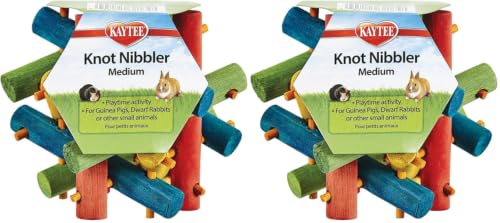
Kaytee Nut Knot Nibbler Chew Toy
Natural fibre knotted around wood gives a texture a small beak can pick apart without splintering. Chewing keeps beaks in trim and burns the restless energy that turns into feather plucking. Destruction happens slowly here, unlike palm leaf toys that vanish in days. No dyes or coatings sit on the surface.
Pros
- Meets a real chewing need
- Uncoated natural materials throughout
- Outlasts palm leaf shredders
Cons
- Loose fibres need trimming back
- Some birds never take an interest
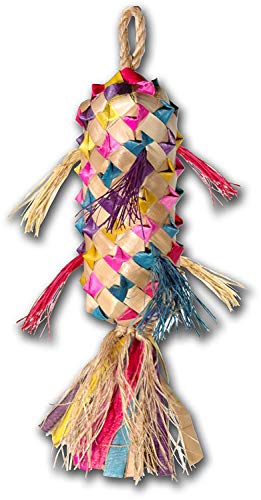
Planet Pleasures Small Pinata Bird Toy
Palm leaf woven small enough that a budgie can make visible progress rather than giving up. Stuffing millet inside converts shredding into foraging, which is how wild budgies spend much of the day. Expect to replace it regularly, since this is a consumable by design. Unbleached fibre means nothing dyed ends up in the crop.
Pros
- Scaled so small beaks make progress
- Holds millet for foraging practice
- Unbleached natural palm fibre
Cons
- Shredded within days by keen chewers
- Drops debris into the cage tray

Prevue Pet Products Naturals Coco Hideaway
A hollowed coconut shell on a fibre rope gives a shy bird somewhere to tuck away from household traffic. Bolder birds treat the curved shell as a climbing surface instead. Shell walls hold up to small beaks far better than cardboard or woven grass. Hens prone to hormonal behaviour may start treating any enclosed space as a nest site.
Pros
- Retreat for nervous or newly rehomed birds
- Shell resists chewing damage
- Curved surface works for climbing
Cons
- Can trigger nesting behaviour in hens
- Rope hanger frays and needs checking

Living World Junglewood Bird Ladder with Bell
Hardwood rungs bridge the gap between perch levels in a tall cage, where small birds otherwise camp at the top and ignore the lower half. A bell at the end supplies the reason to make the climb. Metal clips lock it to the bars so it does not swing underfoot. Rungs sit close enough for budgie stride length.
Pros
- Opens up unused vertical space
- Hardwood rungs take daily use
- Clips hold it steady against the bars
Cons
- Occupies a run of bar space
- Bell noise carries in quiet rooms

JW Pet Activitoy Hourglass Bird Toy
Beads rattle inside a small plastic hourglass whenever a bird pushes it, and the clip fits the bars in seconds. Treat it as a rotation piece rather than the main attraction, pairing it with something to shred. Hard plastic takes a dishwasher cycle without warping. Footprint is tiny, so it fits cages already close to full.
Pros
- Costs little and installs instantly
- Dishwasher safe hard plastic
- Barely touches the cage footprint
Cons
- Novelty fades within a week or two
- No chewing or foraging value
What matters most
What to look for in a small bird toy Size class comes first: buy toys explicitly listed for budgies, finches or cockatiels. Materials should be untreated hardwood, palm leaf, plain cotton, vegetable tanned leather or stainless steel. Hardware needs a closed clip and no zinc plating. After that, ask which type of play it covers, because a cage of five rattle toys still leaves a bird with nothing to shred.
How much cage space should toys take up? Leave a clear flight path from one end of the cage to the other. Toys belong along the sides and at the ends, not dangling through the middle where a budgie needs to fly. Two or three at a time, rotated every week or two, gives more genuine enrichment than six crowding the bars. Watch the bird move around after adding anything new.
Which toys suit shredders, climbers and nervous birds? Shredders want palm leaf pinatas and knotted fibre, replaced as they go. Climbers use ladders and swings that turn vertical space into a route. Nervous or newly rehomed birds settle faster with a coconut shell or similar retreat, though hens prone to hormonal behaviour should skip enclosed spaces. Foragers do best with millet hidden inside something they must work through.
How to introduce new toys and inspect old ones Sudden additions in the centre of the cage cause most fear responses. Park the toy outside the bars for a few days, then move it just inside, then to its final spot. Weekly, take each toy in hand and pull on the hardware. Trim frayed fibre, and retire anything with a cracked bead, a sharp edge or an exposed wire regardless of remaining life.
The lineup, side by side
| # | Model | Type | Best for | Score | Price |
|---|---|---|---|---|---|
| 1 | JW Pet Insight Activitoy Birdie Basketball | Interactive play toy | Best overall | 9.4 | Check price |
| 2 | Penn-Plax Bird Life Trapeze Bird Toy | Swing with beads and bell | Best swing | 9.2 | Check price |
| 3 | Kaytee Nut Knot Nibbler Chew Toy | Chew and shred toy | Best for chewing | 9.0 | Check price |
| 4 | Planet Pleasures Small Pinata Bird Toy | Natural palm leaf | Best for foraging | 8.8 | Check price |
| 5 | Prevue Pet Products Naturals Coco Hideaway | Natural coconut shell | Best for nervous birds | 8.6 | Check price |
| 6 | Living World Junglewood Bird Ladder with Bell | Climbing ladder | Best for tall cages | 8.3 | Check price |
| 7 | JW Pet Activitoy Hourglass Bird Toy | Bar mounted rattle toy | Best budget filler | 8.0 | Check price |
Frequently asked questions
How many toys should a budgie have in its cage?
Two or three at once, swapped out every week or two. Beyond that, a standard budgie cage loses the open span a bird needs to fly rather than clamber. Rotation keeps novelty up without buying more.
Are mirrors bad for budgies?
Many keepers avoid them with single birds. A budgie can bond with its reflection and start regurgitating or displaying at it for hours. Remove the mirror if that behaviour appears, and offer foraging or shredding toys instead.
Which materials are safe for small bird toys?
Untreated hardwood, palm leaf, plain cotton rope, vegetable tanned leather and stainless steel are the reliable staples. Avoid zinc plated clips, cedar, painted or varnished wood, and anything with long loose threads.
Are bells safe for budgies and cockatiels?
Closed bells with a secure clapper are generally fine. Open jingle designs have wide slots that trap a beak or tongue, so leave those out. Check the clapper every week, since a loose one can be swallowed.
How often should small bird toys be replaced?
Shredding toys go when they are used up, often within a week or two. Durable toys last months, but condition sets the timing. Retire anything frayed, cracked, sharp or with hardware that has worked loose.
What should I do if my bird is scared of a new toy?
Leave it outside the cage in view for a few days, then move it just inside the bars, then into position. Introducing it at the centre of the cage all at once is what usually causes panic.
Do small birds need foraging toys?
They benefit noticeably. Wild budgies spend much of the day searching for seed, so hiding millet in a shreddable toy gives that instinct an outlet. Cage boredom and feather plucking both drop when foraging is available.
Can you make bird toys from household items?
Yes, within limits. Plain cardboard, unbleached paper, untreated wicker and wooden lolly sticks all shred safely. Skip anything printed, glued, varnished or finished in metallic paint, and never use string long enough to wrap a toe.
Chew toys or interactive toys: which matter more?
Both, for different reasons. Chewing keeps the beak trimmed and burns nervous energy, while interactive toys supply mental work and often become tricks. A cage with only one type leaves the other need unmet.
Are toys made for large parrots safe for budgies?
No. Heavy blocks and thick chain are immovable to a small bird and can trap a beak or foot. Link and bell gaps sized for a macaw are exactly the wrong scale. Buy toys listed for small birds.
Our pick
JW Pet Insight Activitoy Birdie Basketball takes the top spot because small birds genuinely play with it and it costs almost no cage room. Pairing it with the Penn-Plax Bird Life Trapeze covers movement and adds a second perch, while the Kaytee Nut Knot Nibbler handles chewing. Rotate those three every week or two and a budgie cage stays interesting without getting crowded.
Olivia Hartley
Olivia spent several years working at an animal shelter and a pet-supply retailer before joining the editorial team. She researches pet gear with an emphasis on safety, comfort and the fine print that owners often miss.


