What Makes a Bird Perch Safe and Comfortable?
JW Pet Insight Sand Perch takes the top spot for filing nails without scouring the foot pad. Polly’s Pet Products Sand Walk Perch is the value grooming choice, thanks to a smoother underside. Super Bird Creations Java Wood Perch brings natural branching shape for larger parrots.
Healthy cages run several perch types rather than one. JW Pet Insight Sand Perch handles grooming, Super Bird Creations Java Wood Perch handles natural variation, and Polly’s Pet Products Sand Walk Perch covers both at a gentler grit. Sizes below span finches through large parrots.
Perches look interchangeable and are not. Matching smooth dowels hold a foot in one position all day, which is a documented cause of pressure sores. We compared diameter ranges, surface textures, materials and mounting hardware, then weighed owner reports on nail wear, cleaning and whether each perch survives determined chewing.
What to look for
What to look for when comparing bird perches Three attributes decide the outcome: diameter, surface and material. Diameter sets how the toes sit, surface decides whether nails wear or feet do, and material determines how long the perch survives a beak. Mounting hardware is the quiet fourth factor, since a perch that spins under a landing bird gets avoided. Stainless bolts and wing nuts beat friction fit ends in any cage that gets moved.
How many perch types a cage really needs Aim for at least three different perches, even in a modest cage. One natural branch handles varied grip, one grooming perch handles nails, and one plain dowel fills a height the others cannot reach. Stagger them so the bird climbs rather than hops between two fixed points. Keep every perch clear of food and water bowls below.
Best perch materials for heavy chewers Chewing strength varies more than body size suggests. Caiques and conures work through soft pine in weeks, while java wood and mineral coated composites last months under the same beak. Coconut fibre sits at the opposite end and exists to be destroyed, which is fine as long as it is treated as a consumable. Skip painted or pressure treated lumber entirely, whatever the packaging claims.
Are sand and mineral grooming perches worth it? For most cages, yes, with one placement rule. Grooming surfaces wear nails down gradually and cut how often trimming is needed. Never make one the highest perch, because birds sleep at the top and would spend the night on grit. Mount it at mid height along a route the bird uses often. Modern textured coatings are noticeably kinder than the rough concrete style they replaced.
What we recommend
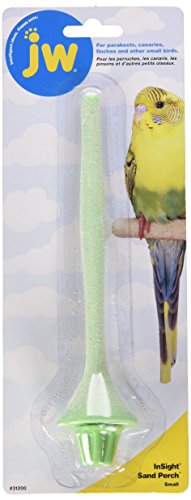
JW Pet Insight Sand Perch
Fine sand coats a shaped core here, so nails wear down through normal movement instead of monthly trims. Because the profile is gently irregular, grip position changes along the length and pressure never settles on one spot. Owners report far less abrasion than old concrete perches caused.
Pros
- Files nails without harsh abrasion
- Varied diameter spreads foot pressure
- Wipes clean without soaking
Cons
- Should never be the only perch in a cage
- Coating thins with heavy use

Polly’s Pet Products Sand Walk Perch
Polly’s splits the surface: textured on top, smoother underneath. That detail matters, because the foot pad rests on the kinder face while nails meet the grit. Several diameters are offered, so the perch can be matched to species rather than approximated.
Pros
- Split surface protects foot pads
- Diameter range covers most species
- Mineral coating resists wear
Cons
- Heavier than a wooden perch of the same length
- Wrong diameter undoes the design benefit
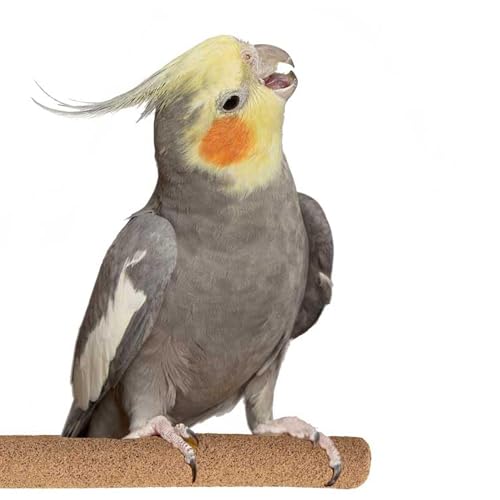
Super Bird Creations Java Wood Perch
Java wood is dense, bird safe and naturally uneven, giving multiple thicknesses and angles on one piece. Hardness is the real advantage, since it outlasts soft pine under a working beak. Nothing bolt in gets closer to a wild branch without sourcing and sterilising your own.
Pros
- Multiple diameters and angles in one piece
- Dense grain resists chewing damage
- Scales up to medium and large parrots
Cons
- Irregular form is awkward to position
- Porous surface needs scrubbing, not wiping
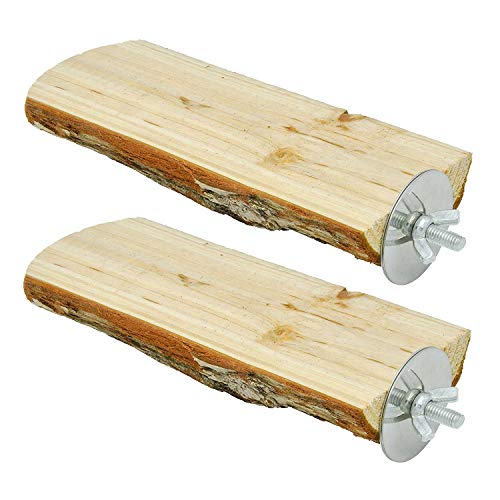
Niteangel Natural Wood Bird Perch
Bark stays on these branch perches, which gives budgies, cockatiels and finches textured footing plus something safe to nibble. Multi packs make it easy to build variety across a whole cage at once. Softer wood is the trade, so enthusiastic chewers will go through them.
Pros
- Bark texture suits small feet
- Several perches arrive per pack
- Safe for gentle chewing
Cons
- Soft wood wears faster than java
- Shed bark adds tray cleanup
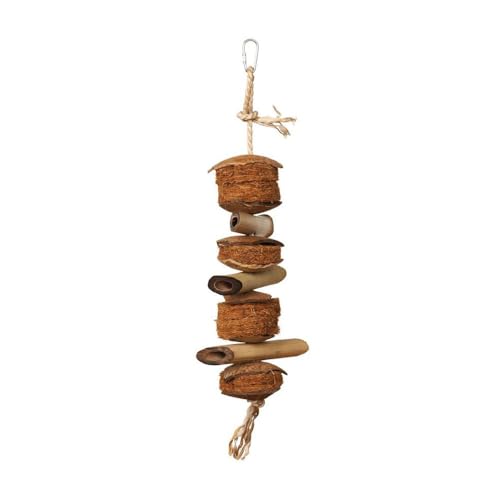
Prevue Pet Products Naturals Coco Perch
Coconut fibre and shell give a bird something to shred as well as stand on, which occupies a beak that would otherwise find the cage bars. Treat it as enrichment first and a resting spot second. Destruction is the point, so plan on replacing it rather than keeping it.
Pros
- Combines a perch with a chewing outlet
- Natural fibre and shell textures
- Draws out foraging behaviour
Cons
- Shreds down and needs replacing
- Loose fibre falls into the cage tray

Bwogue Bird Perch Stand
Freestanding perches give a bird a defined spot outside the cage, which helps with socialising and keeps beaks off furniture. Food and water cups plus a catch tray come fitted. Supervised sessions are the use case, not hours of unattended time.
Pros
- Defines a landing spot outside the cage
- Catch tray contains most of the mess
- Moves easily between rooms
Cons
- Not built for unsupervised use
- Lighter frames can tip under big parrots

Penn-Plax Bird Life Wooden Perch
Plain hardwood dowels fill gaps in a cage layout, useful as a secondary resting spot at a different height. Diameter is uniform, so this complements varied perches rather than replacing them. Owners report keeping a spare on hand for the day a chewed perch has to come out.
Pros
- Adds a cage level in minutes
- Standard bolts fit most cage bars
- Smooth surface cleans quickly
Cons
- Uniform diameter adds no grip variation
- Sanded wood gets slippery when damp
How they compare
| # | Model | Surface | Best for | Score | Price |
|---|---|---|---|---|---|
| 1 | JW Pet Insight Sand Perch | Fine sand textured coating | Best overall | 9.4 | Check price |
| 2 | Polly’s Pet Products Sand Walk Perch | Textured top, smoother underside | Best value grooming perch | 9.2 | Check price |
| 3 | Super Bird Creations Java Wood Perch | Java hardwood | Best natural shape | 9.0 | Check price |
| 4 | Niteangel Natural Wood Bird Perch | Natural branch with bark | Best for small birds | 8.8 | Check price |
| 5 | Prevue Pet Products Naturals Coco Perch | Coconut fibre and shell | Best for foraging birds | 8.6 | Check price |
| 6 | Bwogue Bird Perch Stand | Free standing table top perch | Best out of cage perch | 8.3 | Check price |
| 7 | Penn-Plax Bird Life Wooden Perch | Smooth hardwood dowel | Best budget option | 8.0 | Check price |
Common questions
How many perches does a bird cage need?
At least three of differing diameter and texture, set at staggered heights. Add more only while the bird can still stretch both wings and turn without brushing anything.
Is java wood better than a natural branch perch?
Java wood is denser, so it survives chewing much longer and holds its shape. Bark covered branches give more surface texture and a nibbling outlet but wear out sooner. Many cages run one of each.
What perch diameter suits a cockatiel?
Roughly three quarters of an inch works for a main perch, with thinner and thicker options around it. Toes should wrap most of the way around without meeting underneath or lying flat.
Which perch materials should you avoid?
Skip painted or treated wood, cherry and other fruit woods with toxic components, and smooth plastic dowels that offer no grip. Java wood, known safe branches and mineral coated perches are the dependable choices.
How do you clean bird perches properly?
Scrub wood with hot water and a bird safe cleaner, rinse, then dry fully before refitting. Mineral and sand perches wipe down. Coconut fibre gets replaced rather than deep cleaned, since fibres trap moisture.
Will a grooming perch replace nail trimming?
It reduces frequency rather than removing the job. Check nails monthly and trim once they curl far enough to catch on fabric or cage bars.
How often should perches be replaced?
Retire anything splintering, heavily soiled or chewed through. Soft branches may last a few months with active chewers, while java wood and mineral perches run far longer.
Are rope perches safe for parrots?
Safe while the weave holds, risky once it frays. Loose strands catch toes, so trim as fibres appear and replace the perch when the core loosens.
Can a coconut fibre perch be the main perch?
No. Treat it as enrichment beside a solid resting perch, because the material breaks down by design and offers no stable roosting surface overnight.
Final word
JW Pet Insight Sand Perch is the single best addition to most cages, since it conditions nails without punishing the foot. Pair it with the Super Bird Creations Java Wood Perch for natural diameter variation, and add a Niteangel branch when the cage holds small birds. Variety across the cage, not any one product, is what keeps feet healthy.
Olivia Hartley
Olivia spent several years working at an animal shelter and a pet-supply retailer before joining the editorial team. She researches pet gear with an emphasis on safety, comfort and the fine print that owners often miss.