How to Choose Bike Lights That Handle Outdoor Rides
NiteRider Lumina Max 2500 leads for unlit roads and singletrack, holding output steady on a mount that keeps its aim. Cygolite Metro Plus 800 covers city commuting with six modes and a daytime flash. Lezyne Macro Drive 1400+ suits long night rides on USB-C.
For roads without street lighting, the NiteRider Lumina Max 2500 is the pick. Cygolite Metro Plus 800 covers city commuting and daytime visibility. Riders out for hours after dark should look at the Lezyne Macro Drive 1400+.
Comparing bike lights is awkward because quoted lumens are often peak figures held for seconds, and beam shape decides how much of that output lands on the road. We compared published output and runtime charts, beam patterns, IP ratings, mount designs and charging ports. Owner feedback filled the gaps, especially on mounts slipping, batteries fading in the cold and how each light behaves after a winter of commuting.
What matters most
What to look for in a bike light for outdoor use Five things decide whether a light works outdoors: sustained output, beam shape, runtime in the mode you actually ride, a mount that holds aim, and sealing against weather. Listings quote peak lumens, which many lights hold only until the housing warms up. Read the runtime chart next to the headline number. Check the IP rating too, because winter riding means spray, grit and hose washing.
How many lumens do you need on unlit roads and trails? Around 400 to 800 lumens covers lit streets and towpaths. Unlit country lanes want 800 or more. Fast singletrack descents are where 1500 lumens and up earn their weight. Beam shape shifts all of those numbers, though. A shaped road beam at 800 lumens can light tarmac better than a 2000 lumen round flood, since the flood scatters output into hedges and oncoming faces.
Runtime, cold weather and charging between rides Published maximum runtime comes from the lowest mode, which almost nobody rides in. Look at the middle setting instead. Lithium cells lose capacity near freezing, so a light rated for three hours may give closer to two in January. Charging indoors at room temperature protects that capacity. Riders doing long winter nights often run two lights rather than trusting one battery.
Mounts, IP ratings and pairing a rear light Mounts fail long before LEDs do. Silicone straps are quick to fit but perish after a couple of seasons, while bracket clamps hold aim better over broken surfaces. On sealing, IPX4 handles rain, IP65 covers hose spray, and IP67 survives brief immersion. Whatever runs up front, add a rear light in daytime flash. Traffic approaching from behind is the bigger risk in most urban riding.
What we recommend

NiteRider Lumina Max 2500
Output holds steady here rather than sagging after two minutes, because the housing pulls heat away from the LED. Beam spread covers trail width, yet the hot spot sits low enough to spare oncoming riders. Bar clamp keeps its aim across washboard gravel and root sections.
Pros
- Sustained brightness, not a peak-only figure
- Beam works on tarmac and singletrack
- Clamp holds aim on rough ground
Cons
- Heavier than a commuter light
- Runtime drops sharply on the top mode

Cygolite Metro Plus 800
Six modes cover more ground than the lumen figure suggests, from a daytime running flash to a low steady setting that stretches across a whole evening. Output lands where it helps on tarmac and towpaths without washing out riders coming the other way. Rubber strap survives being pulled off at every stop.
Pros
- Daytime flash reads clearly in traffic
- Low steady mode runs for hours
- Strap mount handles daily removal
Cons
- Underpowered for fast descents
- Beam narrower than trail lights

Lezyne Macro Drive 1400+
Machined aluminium doubles as a heatsink, so mid power settings run long before any step down. USB-C means one cable charges the light, a phone and most head units. Mode memory returns to your last setting instead of starting at full output.
Pros
- Long runtime at usable mid settings
- Charges from a USB-C cable
- Alloy shell shrugs off pannier knocks
Cons
- Mount takes patience to fit
- Button is small in winter gloves

Knog Blinder 900 Front Light
Flash patterns here aim at drivers rather than dark tarmac, and they cut through low winter sun. Silicone strap stretches over aero and round bars, so no bracket is needed. IP67 sealing takes road grit and a hose wash without complaint.
Pros
- Daytime flash is genuinely conspicuous
- Fits aero and round handlebars
- IP67 rating handles heavy rain
Cons
- Beam is not shaped for unlit trails
- Silicone strap perishes over years

BLITZU Gator 390
Front and rear units arrive together, covering the legal minimum in one purchase. Straps stretch on without tools, so moving the pair to a second bike takes a minute. Lit streets and shared paths are where this set belongs, not unlit country lanes.
Pros
- Front and rear lights in one set
- Fits without tools or brackets
- Enough output for lit streets
Cons
- Modest output for dark roads
- Plastic housing feels light
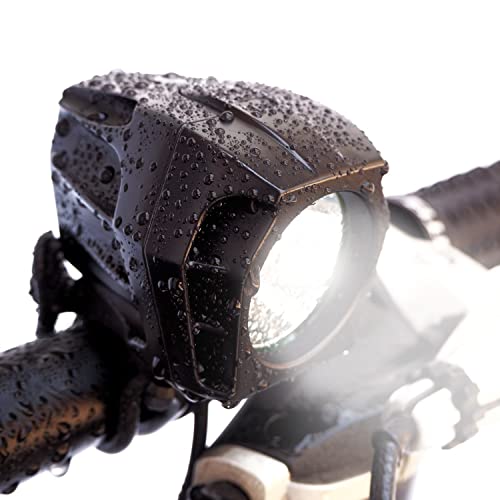
Bright Eyes Rechargeable 1600 Lumen Bike Light
External battery packs went out of fashion, yet they still deliver runtime a self contained light cannot match. A cable runs from the bar unit back to a pack strapped on the frame or stem. Touring and long winter loops are where that tradeoff pays off.
Pros
- Runtime measured in hours, not minutes
- Battery pack can be replaced later
- Strong output for night touring
Cons
- Cable routing adds clutter
- Bulkier than a self contained light

Ascher USB Rechargeable Bike Light Set
Visibility rather than illumination is the job this set does. Silicone straps let both lights hop between a commuter, a child’s bike and a borrowed frame in seconds. Steady and flashing modes cover dusk rides home from work or the shops.
Pros
- Swaps between bikes in seconds
- Charges from any USB port
- Small enough for a jacket pocket
Cons
- Output too low for unlit roads
- Straps stretch after a season
The lineup, side by side
| # | Model | Max output | Best for | Score | Price |
|---|---|---|---|---|---|
| 1 | NiteRider Lumina Max 2500 | 2500 lumens | Best overall | 9.4 | Check price |
| 2 | Cygolite Metro Plus 800 | 800 lumens | Best value | 9.2 | Check price |
| 3 | Lezyne Macro Drive 1400+ | 1400 lumens | Best for long night rides | 9.0 | Check price |
| 4 | Knog Blinder 900 Front Light | 900 lumens | Best for daytime visibility | 8.7 | Check price |
| 5 | BLITZU Gator 390 | Front and rear included | Best budget | 8.5 | Check price |
| 6 | Bright Eyes Rechargeable 1600 Lumen Bike Light | 1600 lumens | Best for extended battery life | 8.3 | Check price |
| 7 | Ascher USB Rechargeable Bike Light Set | Front and rear lights | Best for casual riders | 8.0 | Check price |
Good to know
Is 1000 lumens enough for mountain biking at night?
On flowing trail at moderate speed, yes. Steep or technical descents reward 1500 lumens and up, because you need to read the ground further ahead. Many riders split output between a bar light and a helmet light.
Should a bike light flash or stay steady?
Steady lights your own path and is the courteous choice on shared trails. Daytime flash is the more effective mode for being noticed in traffic. Some places restrict flashing front lights after dark, so check local rules.
Do rechargeable bike lights work in cold weather?
They work, but expect shorter runtime once temperatures drop near freezing. Store the light indoors between rides. Charging at room temperature rather than in a cold garage helps the cells hold capacity.
Can I leave bike lights on the bike outside?
Water resistant lights handle rain fine. Theft is the real problem, since strap mounted lights come off in seconds for anyone walking past. Straps also degrade faster under constant sun and frost.
What does IP67 mean on a bike light?
First digit covers dust, second covers water. IP67 means fully dust tight and able to survive temporary immersion. For most riding, IPX4 or better is enough to handle rain and puddle spray.
Which is better, a helmet light or a handlebar light?
Handlebar lights show ground texture and holes because the light comes in at a low angle. Helmet lights point wherever you look, which helps in corners. Trail riders often run one of each.
Why does my bike light get dimmer during a ride?
Most lights step output down as the housing heats up or the battery drains, protecting the LED and stretching runtime. Better designs taper gradually instead of dropping in one jump. Metal bodies manage that heat more effectively than plastic.
How do you aim a bike light correctly?
Tilt the beam so its brightest part lands on the road a few bike lengths ahead, not at eye level. Check the aim after your first rough ride, since mounts settle. Aiming too high blinds oncoming traffic and lights up less of the surface.
Are front and rear bike lights required by law?
In most countries a white front light and a red rear light are required after dark. Some places also require reflectors. Rules on flashing modes and minimum output vary by region, so check what applies where you ride.
How long do rechargeable bike lights last before the battery fades?
Lithium cells typically hold useful capacity for a few hundred charge cycles, which is several seasons of commuting. Storing the light part charged rather than flat extends that. Lights with a replaceable pack, like external battery setups, outlive sealed units.
The bottom line
Choose the NiteRider Lumina Max 2500 when the road has no street lighting, since it holds output while cheaper lights step down early. Commuters get more useful modes from the Cygolite Metro Plus 800, including a daytime flash. For rides that run late into the night, the Lezyne Macro Drive 1400+ keeps mid power going longest.
Derek Holt
Derek has a background coaching recreational and amateur athletes and has worked the sales floor at specialty fitness retailers. He focuses on equipment durability, ergonomics and realistic use cases rather than marketing claims.