Benchtop Belt Sanders That Make Short Work of Big Jobs
The WEN 6502T stands out as the top pick for most hobbyists because it offers a strong motor and a large table at a budget price, but its plastic base can feel less stable under heavy pressure.
A benchtop belt sander is a stationary tool that shapes, smooths, and finishes wood or metal. Unlike handheld sanders, it gives you both hands free to control the workpiece with precision.
This guide compares seven popular models, from budget-friendly to professional grade. We looked at specifications, owner feedback, and practical use cases to help you choose.
The top picks, ranked
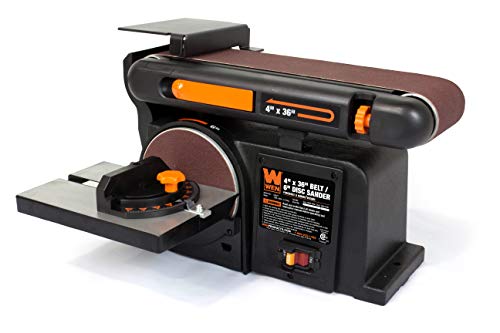
WEN 6502T 4 x 36 Inch Belt Sander
The WEN 6502T is a compact benchtop belt sander with a 4 x 36 inch belt and a 5 inch disc sander. Its 3.5 amp motor delivers enough power for most home shop tasks like shaping wood and sharpening tools.
Pros
- Affordable price point
- Two-in-one belt and disc sander
- Tool-free belt tension release
Cons
- Plastic base can vibrate under heavy use
- Miter gauge is not very accurate

Jet J-41002 1 x 42 Inch Belt Sander
The Jet J-41002 is a compact belt sander with a 1 x 42 inch belt, ideal for sharpening chisels, plane blades, and knives. It offers a flat platen and a contoured platen for various tasks, and it runs quietly and smoothly.
Pros
- Precise sharpening capability
- Low vibration operation
- Quick belt change system
Cons
- Narrow belt limits large stock removal
- Higher price for the size

Delta 31-255 6 x 48 Inch Belt Sander
The Delta 31-255 is a full-size benchtop belt sander with a 6 x 48 inch belt, backed by a powerful 1 HP motor. It features a cast-iron table that tilts and bevels, and it handles large workpieces with ease.
Pros
- Powerful motor for demanding tasks
- Large belt and table for bigger pieces
- Sturdy cast-iron construction
Cons
- Expensive
- Requires a dedicated space due to size

POWERTEC 71007 4 x 36 Inch Belt Sander
The POWERTEC 71007 combines a 4 x 36 inch belt with a 6 inch disc sander, powered by a 3.5 amp motor. It offers a large cast-iron table, adjustable belt tracking, and a dust collection port.
Pros
- Two sanding surfaces in one
- Smooth belt tracking adjustment
- Dust collection works well
Cons
- Belt can drift if not aligned
- No speed adjustment

Grizzly H6070 4 x 36 Inch Belt Sander
The Grizzly H6070 is a no-frills benchtop belt sander with a 4 x 36 inch belt and a 5 inch disc. It has a simple, sturdy design with a cast-iron table and a 3.5 amp motor.
Pros
- Sturdy cast-iron construction
- Straightforward operation
- Good value for the price
Cons
- No belt speed adjustment
- Dust collection could be better

Rikon 50-121 1 x 30 Inch Belt Sander
The Rikon 50-121 is a compact benchtop belt sander with a 1 x 30 inch belt, perfect for small projects and sharpening. It has a 1/3 HP motor and a quick-release belt system.
Pros
- Small footprint fits tight spaces
- Quick belt changes
- Smooth and quiet operation
Cons
- Limited to small workpieces
- Not for heavy stock removal

Buck Tool BG-15 6 x 48 Inch Belt Sander
The Buck Tool BG-15 is a professional benchtop belt sander with a 6 x 48 inch belt and a 1.5 HP motor. It features a heavy-duty steel frame, a cast-iron table, and a dynamic braking system for safety.
Pros
- Extremely powerful and durable
- Large capacity for big projects
- Safety features like braking
Cons
- Very expensive
- Heavy and takes up significant space
Side by side
| # | Model | Belt Size | Best for | Score | Price |
|---|---|---|---|---|---|
| 1 | WEN 6502T 4 x 36 Inch Belt Sander | 4 x 36 inches | Budget-conscious hobbyists | 9.0 | Check price |
| 2 | Jet J-41002 1 x 42 Inch Belt Sander | 1 x 42 inches | Sharpening and small detail work | 9.2 | Check price |
| 3 | Delta 31-255 6 x 48 Inch Belt Sander | 6 x 48 inches | Heavy-duty stock removal | 9.4 | Check price |
| 4 | POWERTEC 71007 4 x 36 Inch Belt Sander | 4 x 36 inches | Versatility with disc sander | 8.8 | Check price |
| 5 | Grizzly H6070 4 x 36 Inch Belt Sander | 4 x 36 inches | Workshops needing a reliable basic sander | 8.5 | Check price |
| 6 | Rikon 50-121 1 x 30 Inch Belt Sander | 1 x 30 inches | Small shops with limited space | 8.2 | Check price |
| 7 | Buck Tool BG-15 6 x 48 Inch Belt Sander | 6 x 48 inches | Industrial-grade durability | 9.1 | Check price |
How to choose
Good to know
What is the difference between a benchtop belt sander and a handheld belt sander?
A benchtop sander is stationary, allowing you to bring the workpiece to the tool. It offers more stability and precision. A handheld sander is portable and used on large surfaces that can’t be moved.
Can I use a benchtop belt sander for sharpening tools?
Yes, especially models with a 1 inch wide belt. They are excellent for sharpening chisels, plane blades, and knives. Use a fine grit belt and a light touch to avoid overheating the metal.
What safety gear should I wear when using a benchtop belt sander?
Always wear safety glasses to protect your eyes from flying debris. A dust mask is also recommended to avoid inhaling fine particles. Hearing protection is wise if the sander is loud.
How do I change the belt on a benchtop belt sander?
Most models have a lever or knob to release tension on the belt. Slide the old belt off, place the new belt on, and adjust tracking. Refer to your manual for specific steps, as it varies by brand.
Can I sand metal with a benchtop belt sander?
Yes, but you need the appropriate belt grit and material. Aluminum oxide belts work for wood, while zirconia or ceramic belts are better for metal. Always check the manufacturer’s recommendations.
What is the best belt speed for sanding?
Higher speeds (around 3,000 SFPM) remove material faster but can burn wood. Lower speeds (around 2,000 SFPM) are better for finishing and sharpening. Some sanders offer variable speed, but most are fixed.
Do I need a dust collector or can I use a shop vac?
A shop vac with a HEPA filter works well if you attach it to the dust port. Many benchtop sanders have a 2.5 inch port that fits standard vacuum hoses. A dedicated dust collector provides more airflow for larger tools.
How much space does a benchtop belt sander take?
Compact models with a 1 x 30 inch belt are about 20 inches wide. Larger 6 x 48 inch models can be over 30 inches long. Always measure your workspace before buying.
What is the advantage of having a disc sander attached?
A disc sander offers a different sanding action, useful for shaping curves and sanding end grain. Having both on one tool saves space and money, as you get two functions for the price of one.
Can I use a benchtop belt sander for resawing?
No, belt sanders are not designed for cutting or resawing. They only remove material through abrasion. For resawing, use a bandsaw or table saw.
Our take
For most woodworkers and DIYers, the WEN 6502T offers the best balance of performance and price. If you need professional-grade power and capacity, the Delta 31-255 is worth the investment. Choose the Jet J-41002 if sharpening is your main task.
Jake Monroe
Jake worked as a residential contractor for over a decade before shifting to full-time writing. He evaluates power tools, hand tools and workshop gear through the lens of someone who has actually used them on job sites, not just read the box.