Battery Powered Generators for Quiet Backup Power
Jackery’s Explorer 1000 v2 balances 1070Wh, 1500W output and 23.8 pounds better than anything else here. Need speed and room to grow? EcoFlow’s Delta 2 refills in about 80 minutes and expands to 3040Wh. Anker’s SOLIX C1000 stores 1056Wh and reaches full in roughly 58 minutes.
Jackery Explorer 1000 v2 is the easiest all round pick, with 1070Wh and 1500W in a 23.8 pound case. EcoFlow Delta 2 suits anyone who needs a fast turnaround or plans to add capacity later. Anker SOLIX C1000 stores 1056Wh and refills quicker than either, which matters between back to back trips.
Headline capacity alone does not tell you runtime, because conversion losses and standby draw both take a cut. Recharge time varies far more than the spec sheets suggest, from under an hour to several. We compared published watt-hour ratings, continuous and surge AC output, wall and solar input limits, port layouts and weight, alongside what owners report about real charge times and fan noise under load.
What to look for
How many watt-hours do you actually need? Watt-hours measure stored energy, so dividing by a device’s wattage gives rough runtime. A 1000Wh station runs a 100W fan for close to ten hours before conversion losses are counted. Phones, lights and a laptop stay comfortable on 256Wh to 500Wh. CPAP machines, mini fridges and cordless tool chargers push you into the 1000Wh class, where the Jackery, EcoFlow, Anker and Bluetti units sit.
What AC output and ports should you look for? Match continuous wattage to your heaviest single device, then check that the surge figure covers motors spiking at startup. A fridge compressor can draw three times its running wattage for a second. Port mix matters just as much: USB-C Power Delivery charges laptops without a brick, 12V sockets run car accessories, and a wireless pad saves a cable. Count the outlets you will genuinely use rather than the total on the box.
How fast can a power station recharge? Wall recharge now spans roughly 58 minutes on the Anker SOLIX C1000 to about 1.7 hours on the Jackery Explorer 1000 v2. That gap decides whether you can refill between two days of use. For off grid trips, check maximum solar input in watts, since a higher ceiling means fewer daylight hours spent waiting. Panels almost always come separately, so budget for them alongside the unit.
How long do LiFePO4 cells last? Lithium iron phosphate cells are commonly rated for several thousand cycles, several times what older lithium-ion packs manage. Heat tolerance is better too, which matters in a car boot in August. Every station listed here uses LiFePO4, so lifespan is no longer the deciding factor between them. Store the unit around half to full charge in a cool place, and top it up every few months.
The top picks, ranked

Jackery Explorer 1000 v2
A 1070Wh LiFePO4 pack inside a 23.8 pound case is the ratio that makes this one easy to recommend. 1500W continuous covers a coffee maker, a small fridge or a circular saw, with 2000W of surge headroom for startup spikes. Wall recharge finishes in roughly 1.7 hours, so a Friday evening plug-in is ready before the car is loaded.
Pros
- 1070Wh carried in under 24 pounds
- 1500W runs full size kitchen appliances
- LiFePO4 cells rated for thousands of cycles
Cons
- Solar panels are a separate purchase
- Fewer outlets than the Bluetti AC180
EcoFlow Delta 2
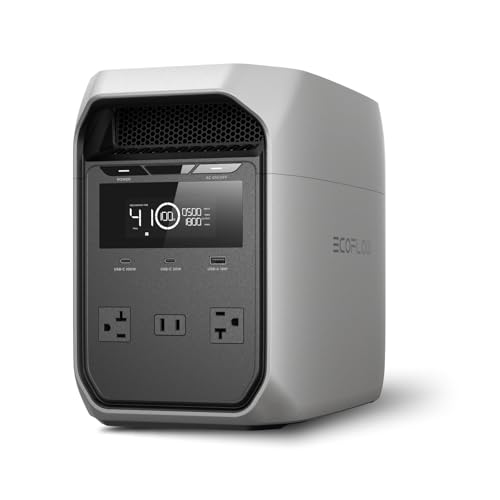
Delta 2 refills from a wall outlet in about 80 minutes, which changes how you plan a weekend. Its 1024Wh base grows to 3040Wh with add-on batteries, so the unit outlives your first guess at what you need. X-Boost stretches 1800W continuous to 2700W for resistive loads such as a kettle.
Pros
- Full recharge inside an hour and a half
- Capacity nearly triples with expansion batteries
- Six AC outlets plus USB-C Power Delivery
Cons
- Cooling fans get loud above 1000W draw
- Heavier than the Jackery at similar capacity

Anker SOLIX C1000
Fifty-eight minutes from empty to full is the headline, and 1056Wh sits behind it. Anker keeps the footprint compact and stackable, which matters in a car boot or a hall cupboard. SurgePad lifts 1800W to 2400W so tools that spike on startup do not trip the inverter.
Pros
- 1056Wh in a compact stackable case
- Fastest wall recharge in this group
- SurgePad absorbs motor startup spikes
Cons
- No wireless charging pad on top
- Display reports less detail than rivals

Bluetti AC180
1152Wh is the largest pack in this lineup, and the port array matches it: AC, USB-C, USB-A and a wireless pad on the lid. Power Lifting mode raises 1800W to 2700W for resistive loads. Around 35 pounds is what that capacity costs you at the tailgate, and the fans are clearly audible under real load.
Pros
- Largest capacity here at 1152Wh
- Wireless pad charges a phone with no cable
- Power Lifting covers high draw resistive gear
Cons
- 35 pounds makes it a two hand carry
- Fan noise climbs quickly under load

Goal Zero Yeti 500
At 12.9 pounds this is the station you actually carry to a campsite rather than wheel to the car. 499Wh covers phones, cameras, headlamps and a laptop across a long weekend. AC output stops at 300W, which rules out kettles, heaters and most power tools.
Pros
- 12.9 pounds carries comfortably in one hand
- USB-C Power Delivery charges a laptop directly
- Simple front panel with no menu diving
Cons
- 300W ceiling excludes heating appliances
- 499Wh runs short for household backup

EcoFlow River 2
256Wh and 7.7 pounds place this in the day pack category rather than the home backup one. Wall recharge takes about an hour, which suits a unit topped up between trips. 300W continuous keeps phones, a router and LED lights alive through a short cut.
Pros
- Light enough for a day pack at 7.7 pounds
- Refills in roughly an hour from a wall outlet
- X-Boost stretches output to 600W
Cons
- 256Wh empties fast on anything large
- Not enough to keep a fridge cold

Jackery Explorer 240 v2
Jackery pairs 256Wh of LiFePO4 with a 7.5 pound body aimed at one or two nights out. Phones, headlamps, a drone battery and a tablet all fit inside that energy budget. Wall recharge takes about 1.5 hours and the unit stays quiet at light draw.
Pros
- Lightest unit here at 7.5 pounds
- LiFePO4 chemistry at an entry capacity
- Near silent under small loads
Cons
- 300W ceiling limits it to small devices
- One night of use before it needs a refill
Compared at a glance
| # | Model | Capacity | Best for | Score | Price |
|---|---|---|---|---|---|
| 1 | Jackery Explorer 1000 v2 | 1070Wh LiFePO4 | Best overall | 9.4 | Check price |
| 2 | EcoFlow Delta 2 | 1024Wh LiFePO4 | Best for fast recharge | 9.2 | Check price |
| 3 | Anker SOLIX C1000 | 1056Wh LiFePO4 | Best value | 9.0 | Check price |
| 4 | Bluetti AC180 | 1152Wh LiFePO4 | Best for many devices | 8.8 | Check price |
| 5 | Goal Zero Yeti 500 | 499Wh LiFePO4 | Best for portability | 8.6 | Check price |
| 6 | EcoFlow River 2 | 256Wh LiFePO4 | Best budget | 8.3 | Check price |
| 7 | Jackery Explorer 240 v2 | 256Wh LiFePO4 | Best for overnight trips | 8.0 | Check price |
Frequently asked questions
Can a battery generator power a house during an outage?
It runs essentials, not a whole house. Lights, a router, phones and a small fridge are realistic on a 1000Wh unit with at least 1500W output, such as the Jackery Explorer 1000 v2. Central heating, electric ovens and well pumps are beyond every model here.
Are battery powered generators safe to use indoors?
Yes. No combustion means no carbon monoxide, which is what makes gas generators dangerous inside. Apartments, garages and bedrooms are all fine, though leaving airflow around the fan vents keeps the unit cooler under load.
How long will a 1000Wh station run a fridge?
A modern compact fridge averaging 60W draws roughly 1440Wh a day, but it cycles rather than running constantly. In practice a 1000Wh unit keeps one cold for around 12 to 18 hours depending on ambient temperature and how often the door opens.
Can I recharge one with solar panels?
Most accept solar through a compatible cable, and panels are nearly always sold separately. Check the maximum solar input in watts before buying an array, since exceeding it wastes panel capacity and falling well short means a full day of charging.
Will a battery generator run a CPAP machine overnight?
A CPAP without a heated humidifier draws relatively little, so 499Wh from a Goal Zero Yeti 500 often covers a full night. Switching the humidifier on can double consumption, which is where a 1000Wh class unit earns its weight.
What does watt-hours mean in plain terms?
It is the size of the fuel tank. Divide watt-hours by a device’s wattage for approximate runtime. A 1000Wh station running a 50W item lasts around twenty hours before inverter losses trim the figure by roughly ten to fifteen percent.
Can you use a power station while it is charging?
Many support pass-through charging, so devices stay powered while the unit refills. Check the manual first, because a few smaller stations discourage heavy loads during charging and it generates extra heat inside the case either way.
How should a battery generator be stored?
Cool, dry and away from direct sun. Recharge it every few months so the pack never sits deeply discharged. Manufacturer guidance generally points to storing between half and full charge rather than empty.
Which battery powered generator is best for camping?
Weight decides it. Goal Zero Yeti 500 at 12.9 pounds and Jackery Explorer 240 v2 at 7.5 pounds are the ones you carry from a car park to a pitch. Choose the Jackery Explorer 1000 v2 instead when the trip involves an RV or a base camp.
Final word
Jackery Explorer 1000 v2 is the safest all round choice, thanks to 1070Wh, 1500W of output and a weight you can still carry one handed for short distances. Pick EcoFlow Delta 2 when refill speed and future expansion to 3040Wh matter more than a few pounds. Anker SOLIX C1000 makes sense for anyone refilling between back to back weekends, since it reaches full in under an hour.
Sierra Daniels
Sierra's background is in landscape design and nursery retail. She focuses on lawn and garden equipment, outdoor furniture and gear durability, weighing published specs against how materials actually hold up outside.