Basic Calculators That Cover School, Office and Pocket Use
The Casio HS-8VA leads for most desks, pairing solar-plus-battery power with a large, easy-to-read display. Students often need the Texas Instruments TI-108 instead, since many schools approve it for testing. Sharp’s EL-244TB adds memory keys and a tilted screen at a lower price, making it the value pick.
The Casio HS-8VA suits most desks best, combining solar-plus-battery power with a large eight-digit display. It skips a memory key, so anyone tracking running subtotals should look elsewhere on this list.
Basic calculator still spans desktop tax models, classroom-approved units and wallet-thin cards. We compared listed specifications, power source and owner feedback on durability to sort seven current models by real use case.
What to look for
What to look for in a basic calculator Power source matters more than it sounds, since solar-only models slow down in dim rooms while solar-plus-battery designs like twin power keep working anywhere. Display size and tilt affect comfort during long sessions. Function keys vary too: some models add tax, markup or memory keys that a strict four-function unit leaves out. Size determines whether a calculator lives on a desk, in a bag or inside a wallet.
Which calculator fits a classroom Schools often specify an approved model for standardized testing, and the Texas Instruments TI-108 appears on many of those lists. A slide case matters here since the calculator travels in a backpack daily. Large buttons help younger students still building fine motor control. Solar-only response can lag in a dim classroom corner, so battery backup adds reliability.
Best for office and small business math Retail and invoicing math benefits from tax and markup keys, which the Casio MS-80B includes but a pocket model usually skips. A tilted display reduces neck strain during long stretches at a register. Memory keys let you hold a subtotal while entering the next line item. Desktop models also resist sliding off a counter during busy shifts.
Best for pocket, bag or low-vision use A credit-card-thin model like the Casio SL-300SV fits a wallet or planner without adding bulk. Jumbo-digit models like the Victor 908 sit at the opposite end, built for readability rather than a slim profile. Solar-only power suits occasional use, since brief light exposure rarely drains a wallet calculator. Anyone with low vision benefits more from screen size than from thinness.
The top picks, ranked

Casio HS-8VA
Solar cells paired with a battery keep this eight-digit calculator running in dim rooms. Percent and square root keys cover most household and office math without extra buttons. A 4.5 by 2.8 inch body sits flat on a desk or slides into a drawer.
Pros
- Solar-plus-battery power skips frequent replacements
- Eight-digit display stays readable across a desk
- Percent and square root keys speed common math
Cons
- No memory key for running totals
- Lacks dedicated tax keys for invoicing

Texas Instruments TI-108
Texas Instruments built this model for elementary classrooms, and many schools list it as approved for testing. A slide-on hard case shields the screen inside a backpack. Large buttons suit smaller hands still learning basic operations.
Pros
- Approved for classroom testing at many schools
- Slide case protects the screen in a bag
- Large buttons suit younger students’ hands
Cons
- No shortcut keys beyond basic percent
- Solar response slows down in dim rooms

Sharp EL-244TB
Twin power combines solar cells with a battery, so the display stays lit even indoors. A tilted screen cuts glare during long homework sessions. Memory keys handle running subtotals that many basic models skip.
Pros
- Twin power keeps working in low light
- Tilted display cuts glare at a desk
- Memory keys store running subtotals
Cons
- Housing feels lightweight compared to rivals
- No protective cover included in the box
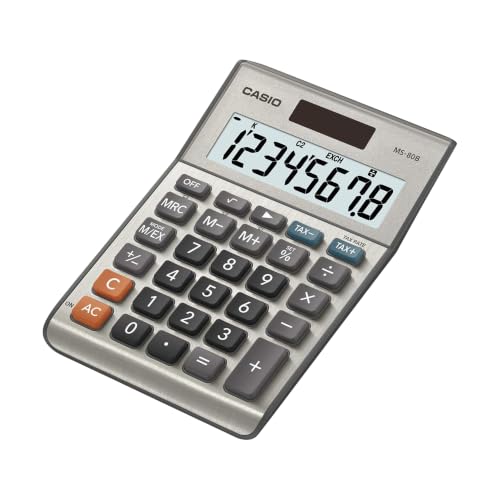
Casio MS-80B
Tax and markup keys handle invoicing math that pocket calculators skip entirely. An eight-digit tilted display sits flat for daily desk use. Plastic housing keeps the unit stable during repeated keystrokes.
Pros
- Tax and markup keys suit small business math
- Tilted screen improves visibility on a desk
- Memory function stores running subtotals
Cons
- Larger footprint than pocket-sized models
- No cover included for storage or transport
Victor 908
Jumbo digits on this desktop calculator read clearly from across a room. Solar cells with battery backup keep it running without cords. A sign-change key simplifies negative entries for tracking expenses by hand.
Pros
- Jumbo digits help low vision users read entries
- Desktop size stays put on a surface
- Sign-change key simplifies negative numbers
Cons
- Too bulky to carry in a bag or pocket
- No slide cover protects the display

Casio SL-300SV
Credit-card thinness lets this calculator slide into a wallet or planner. Solar power alone runs the display, cutting out battery costs entirely. Four functions plus percent keep it simple for quick math on the go.
Pros
- Wallet-thin body fits a planner or purse
- Solar-only power removes battery costs
- Covers quick everyday math without extra keys
Cons
- No memory or advanced percent shortcuts
- Small buttons challenge larger fingers

Texas Instruments TI-1706 SV
Solar power with a battery backup means this handheld rarely needs replacing. Percent and sign-change keys cover typical daily math. A compact size fits a desk drawer or backpack pocket without added bulk.
Pros
- Solar-plus-battery power works almost anywhere
- Compact size fits a desk drawer easily
- Percent and sign-change cover common tasks
Cons
- Display has no tilt adjustment option
- No cover included for screen protection
How they compare
| # | Model | Power source | Best for | Score | Price |
|---|---|---|---|---|---|
| 1 | Casio HS-8VA | Solar with battery backup | Best overall | 9.4 | Check price |
| 2 | Texas Instruments TI-108 | Solar with battery backup | Best for students | 9.2 | Check price |
| 3 | Sharp EL-244TB | Twin power (solar + battery) | Best value | 9.0 | Check price |
| 4 | Casio MS-80B | Solar with battery backup | Best for office and small business desks | 8.7 | Check price |
| 5 | Victor 908 | 8-digit jumbo LCD | Best for large display and low vision | 8.5 | Check price |
| 6 | Casio SL-300SV | Solar only | Best for portability | 8.2 | Check price |
| 7 | Texas Instruments TI-1706 SV | Solar with battery backup | Best budget | 8.0 | Check price |
Questions worth asking
What is the difference between a basic and a scientific calculator?
A basic calculator handles four functions plus percent, square root and sometimes memory. Scientific models add trigonometry, logarithms and exponent keys for algebra and higher math.
Do solar calculators work without direct light?
Most solar models include a battery backup that kicks in under low light, based on manufacturer specifications. Solar-only models like the Casio SL-300SV need at least ambient room light to function reliably.
Which basic calculator is best for elementary school?
The Texas Instruments TI-108 is commonly approved for classroom testing and ships with a protective slide case for backpack use.
Can a basic calculator handle tax and markup math?
Not all of them. The Casio MS-80B adds dedicated tax and markup or markdown keys, while pocket models like the SL-300SV stick to four functions plus percent.
Is a physical calculator more reliable than a phone app?
Owners often report preferring a physical calculator for speed and battery independence, since a dedicated device does not compete with notifications or app switching.
How long do solar calculators typically last?
Manufacturer listings suggest solar cells and battery backups last for years of daily use, since solar-only models have no removable battery to wear out.
Which calculator works best for older adults or low vision?
Jumbo-digit models like the Victor 908 are built around larger displays and keys, which owner reviews note as easier to read from a distance.
Desktop calculator vs handheld, which suits an office better?
Desktop models like the Casio MS-80B stay put on a surface and add business-specific keys, while handheld models like the HS-8VA suit shared use or moving between desks.
What size calculator fits in a wallet or planner?
Credit-card-thin models like the Casio SL-300SV are built specifically for that footprint, trading memory functions and extra keys for a slim profile.
Our take
The Casio HS-8VA covers the widest range of everyday math with solar backup and a readable display, making it the pick for most homes and desks. Students should choose the Texas Instruments TI-108 for its classroom approval, while anyone billing customers should pick the Casio MS-80B instead for its tax and markup keys.
Marcus Chen
Marcus covered consumer electronics for enthusiast tech publications for six years before joining ChoiceCrest. He specializes in translating manufacturer spec sheets into plain-language buying advice, with a focus on audio, computing accessories and smart-home gear.


