Which ball head holds your lens without creeping?
Manfrotto MHXPRO-BHQ2 fits most DSLR and mirrorless kits, holding 10 kg on a 500 g magnesium body. SIRUI K-20X adds margin for telephoto work at 25 kg. Really Right Stuff BH-55 resists creep under 500mm primes. All three take Arca-Swiss compatible plates.
Manfrotto MHXPRO-BHQ2 suits most photographers running a full frame body with a zoom up to 200mm. Magnesium keeps the head near 500 g while the rating stays at 10 kg. A dedicated friction dial sets drag separately from the main lock, so a heavy lens stays put during framing. Wet knobs turn slippery, which is its weakest point.
Ratings in this category get quoted loosely. Manufacturers measure payload with the arm upright, never tipped to the angle where leverage doubles. We compared published load figures, ball diameters, clamp types and housing materials. Owner reports on drift, knob placement and plate security filled in what the spec sheets leave out.
What we recommend

Manfrotto MHXPRO-BHQ2 XPRO Ball Head
Magnesium housing keeps the weight near 500 g against a 10 kg rating. Friction sits on its own dial beneath the main lock, so drag for a 70-200mm stays set while the ball still moves. Three bubble levels read from different faces, which helps when legs sit on a slope.
Pros
- Separate friction dial stops sag with long lenses
- 200PL-PRO plate drops straight into Arca-Swiss clamps
- Bubble levels on three faces cover horizon and vertical framing
Cons
- Knobs turn slippery once wet
- Panning base offers no drag adjustment
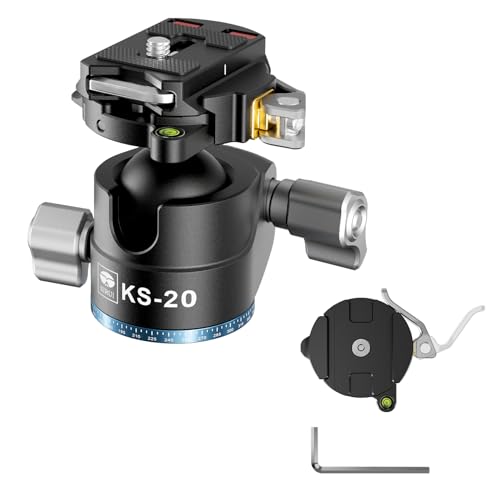
SIRUI K-20X Ball Head
A 44 mm ball delivers holding margin most hobby kits never reach. SIRUI cuts a Y shaped groove into the socket, so the arm drops vertical from either side. Panning rotation locks separately from ball friction. Owners describe the main knob as needing a firm turn compared with lighter heads.
Pros
- 25 kg rating covers telephoto work without a gimbal
- Screw knob clamp accepts third party plates of varying width
- Two drop notches make vertical framing quicker
Cons
- Main lock takes noticeable force
- At 520 g it eats into a travel weight budget

Really Right Stuff BH-55 Ball Head
Stainless ball inside an aluminium housing puts durability ahead of weight. At 55 mm, that ball resists creep under a 500mm prime where smaller heads begin to nod. Lever clamps suit photographers swapping bodies constantly, while the screw knob version copes better with plates of varying width.
Pros
- No visible droop under long glass
- Panning base carries degree markings for multi-row panoramas
- Replaceable clamp means the head can be serviced
Cons
- Heaviest pick here at roughly 800 g
- Lever clamp needs tuning for non-standard plates

Leofoto LH-40 Ball Head
At 390 g, this aluminium head leaves payload budget for the camera on carbon travel legs. Leofoto adds a safety stop screw to the clamp, blocking a plate from sliding clear if the knob backs off. Its 40 mm ball carries a 20 kg rating. Thick anodising shrugs off pack and trail scuffs.
Pros
- 20 kg rating out of a 390 g body
- Safety stop keeps plates from sliding out
- Low profile packs flat against folded legs
Cons
- Knob markings wear with heavy use
- Friction range is narrower than the Manfrotto

Benro IB2 Ball Head
Benro aims the IB2 at full frame bodies carrying a 24-70mm or similar standard zoom. Magnesium holds it to 430 g against an 18 kg rating. A base panning lock lets you swing through a panorama without touching the ball. Its PU-50 plate has anti twist flanges and fits any Arca-Swiss clamp.
Pros
- Independent 360 degree panning base
- Plate ships with the head rather than sold separately
- Light for an 18 kg rating
Cons
- One drop notch limits vertical angles
- Friction dial is small and fiddly with gloves
Manfrotto 496RC2 Compact Ball Head
One knob handles lock and release together, which helps anyone new to tripod work. RC2 plates click into a spring latch instead of sliding through a clamp, so mounting is quick in low light. Payload stops at 6 kg. That covers a crop body with a kit zoom, not a 300mm prime.
Pros
- Spring latch mounting works fast in the dark
- 360 g body fits small travel legs
- 200PL-14 plates are widely stocked and easy to replace
Cons
- RC2 plates will not fit Arca-Swiss clamps
- No separate friction control

JOBY BallHead 3K
Roughly 140 g of aluminium alloy, sized for small mirrorless bodies and GorillaPod 3K legs. Its clamp takes Arca-Swiss compatible plates, so one L bracket serves both the GorillaPod and a full size tripod. Load tops out at 3 kg, enough for a body wearing a pancake or standard zoom.
Pros
- Lightest head here at about 140 g
- Bubble level built into the clamp
- Mounts directly on GorillaPod 3K legs
Cons
- 3 kg ceiling rules out telephoto lenses
- Small knobs are hard to grip in cold weather
Before you buy
What to look for in a ball head Three numbers frame the decision: payload, head weight and ball diameter. Bigger balls resist creep because locking surface grows faster than the load pressing on it. Clamp standard matters just as much. Arca-Swiss dovetails come closest to a universal fitting, and most L brackets, telephoto feet and slider carriages use that profile. Manfrotto RC2 runs a separate plate system, so switching brands means buying plates again. Check whether friction has its own dial or shares the main lock, since that one detail decides how easily you compose with heavy glass.
How much payload do you actually need? Ratings are measured with the arm upright, not tipped to 45 degrees where leverage roughly doubles. Read a published figure as an optimistic ceiling. Owner feedback points to a simple rule: pick a head rated for about double your heaviest body and lens together. That margin is what prevents slow droop during a long exposure. Friction control does the rest, holding the load while you frame rather than forcing you to fight a fully locked ball. A 2 kg kit therefore sits fine on the 6 kg Manfrotto 496RC2, while a 4 kg telephoto rig wants the SIRUI K-20X or larger.
Best ball heads for travel and hiking Weight budgets tighten fast once legs, head, spare batteries and filters go into a pack. Leofoto LH-40 and JOBY BallHead 3K mark the two ends of that range at 390 g and 140 g. Hiking with the camera already mounted? Prioritise a clamp with a safety stop, because a knock can back a knob off. Low profile housings pack flatter against folded carbon legs too. Anyone flying with cabin luggage will feel the gap between the LH-40 at 390 g and the BH-55 near 800 g.
Telephoto, panoramas and when a ball head stops working Long glass exposes a weak head within seconds. Really Right Stuff BH-55 and SIRUI K-20X pair large balls with separate panning locks, which multi-row panoramas need. Rotating on a dedicated base keeps a levelled horizon intact between frames. Birders working past 400mm should still budget for a gimbal, since no ball head follows a moving subject smoothly at that focal length. Video hits a similar wall: a ball head pans on a plain bearing, so starts and stops show visible jerks.
Compared at a glance
| # | Model | Payload | Best for | Score | Price |
|---|---|---|---|---|---|
| 1 | Manfrotto MHXPRO-BHQ2 XPRO Ball Head | 10 kg | Best overall | 9.4 | Check price |
| 2 | SIRUI K-20X Ball Head | 25 kg | Best value | 9.2 | Check price |
| 3 | Really Right Stuff BH-55 Ball Head | 23 kg | Best for heavy telephoto lenses | 9.0 | Check price |
| 4 | Leofoto LH-40 Ball Head | 20 kg | Best for travel tripods | 8.8 | Check price |
| 5 | Benro IB2 Ball Head | 18 kg | Best for mid-size DSLR kits | 8.6 | Check price |
| 6 | Manfrotto 496RC2 Compact Ball Head | 6 kg | Best budget | 8.3 | Check price |
| 7 | JOBY BallHead 3K | 3 kg | Best for compact mirrorless | 8.0 | Check price |
Good to know
What is the best ball head for a DSLR?
Manfrotto MHXPRO-BHQ2 covers a full frame DSLR with a standard zoom, rating 10 kg at 500 g. Move up to the BH-55 only when lenses over 300mm go on regularly.
How much payload does a ball head need?
Add body, heaviest lens, bracket and flash, then double the total. A 2 kg kit stays stable on a 6 kg head, and that spare margin matters most once the arm tips sideways.
Is Arca-Swiss compatible the same as Arca-Swiss?
Not quite. Arca-Swiss describes a dovetail profile rather than an enforced standard, so widths drift between brands. Screw knob clamps absorb that variation; lever clamps often need adjusting first.
Ball head vs pan tilt head: which is better?
Ball heads reposition faster and pack smaller, which suits landscape, travel and event work. Pan tilt heads move one axis at a time, so architecture, macro and product shooters get finer control.
Why does my ball head slip under load?
Either the load sits above the practical rating, or grease has migrated from the stem onto the ball. Owners report that a wipe with isopropyl alcohol restores grip on heads that gripped fine when new.
Can you use a ball head for video?
Static shots and timelapse work fine. Smooth panning needs a fluid head with adjustable drag, because a plain bearing produces a visible jerk at the start and end of every move.
Does a heavier ball head mean better quality?
Weight usually tracks ball size and housing thickness, though not reliably. Leofoto LH-40 reaches 20 kg at 390 g through machining, while plated zinc heads add bulk and still creep.
Do I need a separate panning lock?
Panoramas and subject tracking need one. Base rotation lets the camera swing while the horizon stays level, something a single pivot cannot manage once the ball is loose.
Which ball head is best for travel?
Leofoto LH-40 balances a 20 kg rating against 390 g and adds a safety stop in the clamp. Mirrorless shooters travelling light can drop to the 140 g JOBY BallHead 3K instead.
Our pick
Buy the Manfrotto MHXPRO-BHQ2 unless your lens list runs long. Its 10 kg rating, 500 g magnesium body and separate friction dial cover full frame work, and the 200PL-PRO plate fits Arca-Swiss clamps you already own. Telephoto shooters should step up to the Really Right Stuff BH-55, whose 55 mm ball simply does not nod under a 500mm prime. Counting grams for a carbon travel tripod? Leofoto LH-40 is the smarter buy.
Marcus Chen
Marcus covered consumer electronics for enthusiast tech publications for six years before joining ChoiceCrest. He specializes in translating manufacturer spec sheets into plain-language buying advice, with a focus on audio, computing accessories and smart-home gear.


