Musical Toys That Help Babies Explore Sound and Rhythm
Baby Einstein Take Along Tunes suits the youngest hands, with one large button and seven classical melodies. Fisher-Price Kick and Play Piano Gym stretches from newborn kicking through to standing play. Munchkin Mozart Magic Cube earns a place once a baby sits up and starts choosing sounds deliberately.
Baby Einstein Take Along Tunes is the musical toy to put in a nappy bag first, small enough for a pram and simple enough for a three month old. Fisher-Price Kick and Play Piano Gym keeps earning its floor space from newborn through to standing. Munchkin Mozart Magic Cube fits the stage where a baby starts making deliberate choices.
Sound toys are hard to judge from a listing. Bright lights and constant noise appeal to babies and wear on everyone else, and measured volume varies far more than packaging admits. We compared stated age ranges, volume switches, battery compartment design, sound quality and cleanability, then weighed those against what parents report about how long each toy holds a child’s attention.
What we recommend

Baby Einstein Take Along Tunes Musical Toy
One large button plays seven classical melodies, and that simplicity is the point for a baby still learning cause and effect. Lights travel along the top while music plays, holding attention without flooding the senses. Parents report it survives repeated launches from a pram, and the fixed volume sits at a level adults can live with.
Pros
- Simple enough for a three month old to trigger
- Palm sized handle fits prams and nappy bags
- Screw secured battery door
Cons
- One melody set becomes repetitive for adults
- No volume adjustment

Fisher-Price Kick and Play Piano Gym
A baby kicks the piano panel while lying down, presses it by hand once sitting, then uses it freestanding after crawling starts. Three stages of use explain why this stays in rotation longer than most sound toys. Machine washing handles the inevitable mess, though the arches claim meaningful floor space in a small room.
Pros
- Three play modes cover the whole first year
- Mat goes through a washing machine
- Piano panel detaches for travel
Cons
- Arches occupy a lot of floor space
- Hanging toys are basic beside the piano
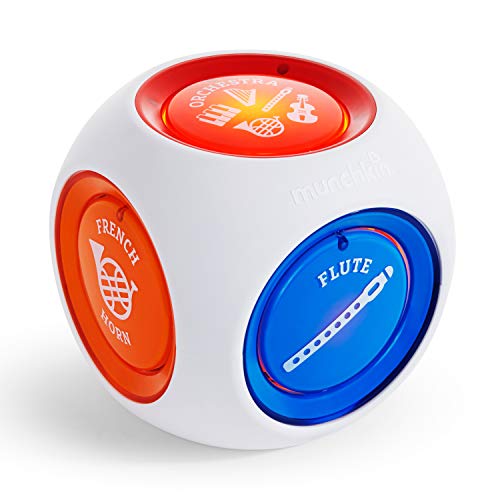
Munchkin Mozart Magic Cube
Each face adds or removes one instrument from a Mozart composition, so pressing a specific side changes the music in a predictable way. Few baby toys teach something genuinely musical rather than simply making noise. Chunky proportions need two hands, which puts this squarely in the sitting stage, and a volume switch keeps the layered sound reasonable.
Pros
- Layered instruments teach real cause and effect
- Volume switch fitted as standard
- Recordings sound cleaner than typical baby toys
Cons
- Chunky shape needs two hands
- Faces need a firm press for younger babies

VTech Baby Lil’ Critters Moosical Beads
A soft bodied cow carries a bead ring, an internal rattle and a light up nose, propped easily in front of a baby on their front. Mixed textures give a young baby several things to explore in one object. Songs turn catchy in the way that becomes a problem by week three, so the two level volume switch does a lot of work.
Pros
- Textures and beads suit early exploration
- Two level volume switch
- Nose light glows softly rather than harshly
Cons
- Song loop gets old quickly
- Fabric body is harder to clean thoroughly

Hape Pound and Tap Bench with Slide Out Xylophone
Balls hammered through the top roll onto an eight note xylophone below, which slides out for separate play with a mallet. Acoustic notes never loop and never need a battery change. Hammering demands coordination that infants have not built yet, so this belongs to the second year rather than the first.
Pros
- Real notes instead of recorded loops
- Nothing to power or replace
- Wood construction handles hard use
Cons
- Too advanced for babies under a year
- Hammer and balls disappear under furniture

B. toys Meowsic Keyboard
Proper keys, several instrument voices, a record function and a small microphone sit inside a cat shaped shell. Instrument voices sound closer to music than most toy keyboards manage. Size keeps it in a playroom rather than a nappy bag, and the microphone mostly serves volume experiments.
Pros
- Weighted style keys encourage real playing
- Record and playback holds attention
- Adjustable volume control fitted
Cons
- Too advanced for babies under one
- Large footprint to store

VTech Sit-to-Stand Learning Walker
A detachable panel covers the musical toy role while the frame supports a baby learning to walk, which folds two purchases into one. Piano keys, a shape sorter and spinning rollers keep the panel useful during the sitting months. Wheels roll fast on hard floors, so most parents use the slower speed setting until steps steady.
Pros
- Serves as both a sound panel and a walker
- Two speed setting slows the wheels
- Useful from nine months to three years
Cons
- Rolls quickly on hard flooring
- Bulky to store between uses
How they compare
| # | Model | Age range | Best for | Score | Price |
|---|---|---|---|---|---|
| 1 | Baby Einstein Take Along Tunes Musical Toy | From around 3 months | Best overall | 9.4 | Check price |
| 2 | Fisher-Price Kick and Play Piano Gym | Newborn to toddler | Best for newborns | 9.2 | Check price |
| 3 | Munchkin Mozart Magic Cube | From around 6 months | Best for cause and effect | 9.0 | Check price |
| 4 | VTech Baby Lil’ Critters Moosical Beads | 3 to 24 months | Best for tummy time | 8.8 | Check price |
| 5 | Hape Pound and Tap Bench with Slide Out Xylophone | From around 12 months | Best wooden option | 8.6 | Check price |
| 6 | B. toys Meowsic Keyboard | From around 18 months | Best for older babies | 8.3 | Check price |
| 7 | VTech Sit-to-Stand Learning Walker | 9 to 36 months | Best for cruising babies | 8.0 | Check price |
Before you buy
How do you match a musical toy to your baby’s stage? Newborns respond to sound and contrast but cannot press anything deliberately, which is why play gyms and rattles fit that window. Around four to six months, single large buttons start to click. Sitting babies manage cubes and other two handed toys. Pounding benches and keyboards need coordination that arrives closer to a year. Buying ahead is fine, but a toy demanding skills a baby lacks simply gets ignored.
How loud is too loud for a baby toy? Baby toys often measure louder than parents expect, and small ears sit closer to the speaker than adult ones. Prioritise models with a volume switch. When a toy lacks one, tape across the speaker grille is the standard household fix. Toys held near the face deserve the most scrutiny, since effective volume at that distance far exceeds how it sounds across a room.
Wooden or electronic: which musical toys last longer? Wooden instruments produce real notes, never repeat a loop and outlive several sets of batteries. They also need a grip and a swing, so they arrive later. Electronic toys work from three months because a light press produces an instant response. One of each covers the range well. Acoustic toys tend to stay interesting into the toddler years, while electronic ones peak earlier.
How should you clean musical toys and check batteries? Everything a baby holds ends up in their mouth, so hard plastic that wipes down is easier to live with than fabric needing a wash cycle. Many soft toys hide a removable sound module in a pouch, which lets the fabric go in the machine. Confirm battery doors close with a screw rather than a clip, because button and AA cells are a serious hazard if a compartment opens. Toys taking common cell sizes save frustration later.
Common questions
At what age can a baby use musical toys?
Sound toys work from birth when an adult operates them. Deliberate button pressing usually begins between four and six months. Toys needing a grip and a hammer generally suit twelve months and up.
Are musical toys too loud for babies?
Some are. Toys held close to the face pose the main concern, since volume falls off sharply with distance. Choose models with a volume switch, or tape over the speaker grille on ones without.
Do musical toys help a baby’s development?
They support cause and effect learning and sound discrimination. Pound benches and keyboards add hand eye coordination on top. Most of the benefit comes from an adult playing alongside rather than the toy running alone.
Which is better, wooden or electronic musical toys?
Wooden instruments make real notes with no repeating loop, which many parents prefer, but they need coordination. Electronic toys respond to a light press, so they work months earlier. Owning one of each covers the whole first two years.
How do you clean fabric musical toys?
Check first whether the sound module lifts out through a pouch. If it does, the fabric shell usually takes a gentle machine wash. If the electronics are sealed in, wipe the surface with a damp cloth and mild soap instead.
Are battery compartments on baby toys safe?
Reputable brands secure them with a screw specifically so a child cannot open one. Verify the screw is present and tight when unpacking a new toy. Check it again every time you change cells.
How many musical toys does a baby need?
Two or three offering different experiences is plenty at once. Rotating toys in and out of a cupboard keeps them feeling new. A large permanent collection tends to hold attention less well than a small rotating one.
What is the best musical toy for travel?
Baby Einstein Take Along Tunes, because it hangs or clips easily, needs one hand and works with a single button. For longer trips, the detachable panel from the Fisher-Price gym packs flat in a case.
Which musical toys work best for tummy time?
Soft toys that can be propped upright at eye level, such as the VTech Moosical Beads, give a baby a reason to lift their head. Play gym arches with hanging sound toys work for the same reason.
The bottom line
Baby Einstein Take Along Tunes is the easiest first musical toy to recommend, simple enough for a three month old and light enough to travel everywhere. Fisher-Price Kick and Play Piano Gym justifies its floor space by adapting from newborn kicking to standing play. Add Munchkin Mozart Magic Cube once a baby sits up and starts experimenting with which face changes the music.
Rachel Simmons
Rachel previously worked in child-product retail and brings a practical, detail-first eye to gear reviews, focusing on safety standards, ease of use and the fine print that matters most for new caregivers.


