Automatic Pet Feeders for Multi-Pet Homes and Odd Schedules
The PetSafe Smart Feed Automatic Dog and Cat Feeder gives the most reliable app-based scheduling for single-pet homes. SureFeed Microchip Pet Feeder suits multi-pet households where food needs to be restricted by animal, and Cat Mate C500 fits owners who want a simple timer without relying on WiFi.
The PetSafe Smart Feed Automatic Dog and Cat Feeder leads this group, because its app control allows remote schedule changes and portion adjustments from anywhere, which matters for unpredictable work schedules. It depends on a stable WiFi connection to function remotely, so homes with unreliable internet may prefer a feeder that runs independently on battery power instead.
We compared portion dispensing accuracy, app versus manual scheduling, how each feeder handles multi-pet households, and reliance on WiFi versus standalone battery operation.
The shortlist, ranked

PetSafe Smart Feed Automatic Dog and Cat Feeder
This feeder connects to WiFi and an app, letting an owner adjust feeding times and portion sizes remotely or trigger an extra feeding on the spot. A large hopper capacity reduces how often it needs refilling.
Pros
- Remote schedule and portion changes from anywhere with signal
- Large hopper capacity reduces refill frequency
- Battery backup keeps feeding on schedule during power outages
Cons
- Full remote functionality depends on a stable WiFi connection
- Higher price point than basic timer feeders

Petlibro Granary Automatic Feeder
Petlibro offers app scheduling similar to premium feeders at a lower price point, with a desiccant compartment that helps keep dry food fresh longer. It covers most single-pet feeding needs without the cost of top-tier models.
Pros
- Strong feature set for a lower price than premium competitors
- Desiccant compartment helps maintain food freshness
- Battery backup covers short power interruptions
Cons
- App can be less polished than more established brands
- Hopper capacity is smaller than top-tier feeders
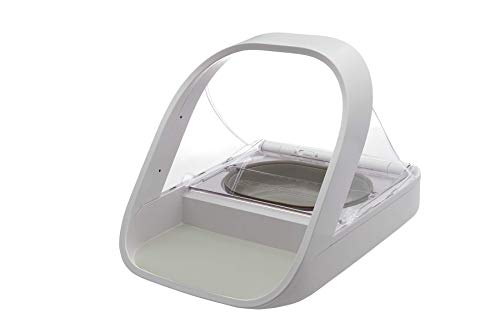
SureFeed Microchip Pet Feeder
SureFeed reads a pet’s microchip or an included RFID collar tag to unlock the bowl lid only for the assigned pet, solving food stealing in multi-pet homes. The lid stays closed to any other pet, including ones on a special diet.
Pros
- Prevents food stealing between pets with different diets
- Works with existing microchips, no extra collar required for chipped pets
- Battery operation avoids WiFi dependency entirely
Cons
- Does not dispense scheduled portions on its own, mainly restricts access
- Requires training pets to use the recognition feature correctly

Cat Mate C500 Automatic Pet Feeder
The C500 dispenses up to five separate meals on a programmed timer without needing any app or WiFi connection. Ice packs can be added to keep wet food portions cool for longer between feedings.
Pros
- Works fully offline with no WiFi or app required
- Ice pack feature keeps wet food fresher between meals
- Simple to program directly on the unit
Cons
- No remote monitoring or schedule changes away from home
- Fewer total meals possible compared to continuous dry food hoppers

WOPET Automatic Pet Feeder
WOPET adds a built-in camera and voice recorder, letting an owner see a pet during feeding and record a voice message that plays at mealtime. It combines monitoring with scheduled dispensing in one unit.
Pros
- Built-in camera adds visual check-ins during feeding
- Voice recording feature can help calm an anxious pet
- Battery backup maintains schedule during power loss
Cons
- Camera quality is more basic than a dedicated pet camera
- More expensive than feeders without the camera feature

Arf Pets Automatic Cat Feeder
Arf Pets keeps its feeder straightforward, with a programmable timer and manual controls instead of an app. It suits owners who want basic automatic feeding without extra smart features.
Pros
- Lower price point than app-connected feeders
- Simple programming without needing a smartphone
- Battery operation avoids ongoing WiFi reliance
Cons
- No remote monitoring or schedule adjustment away from home
- Portion control is less precise than premium models

Honeyguaridan A36 Automatic Cat Feeder
Honeyguaridan focuses on finer portion adjustment increments than many competitors, aimed at cats on strict weight management plans. App control allows precise gram-level adjustments alongside scheduled feeding times.
Pros
- Precise portion increments suit cats needing strict diet control
- App allows detailed adjustment beyond basic cup measurements
- Battery backup covers short power outages
Cons
- Smaller hopper capacity than larger multi-pet feeders
- App setup takes more steps than simpler timer feeders
What to look for
App-Controlled Versus Standalone Timer Feeders App-connected feeders like PetSafe Smart Feed and Petlibro let an owner change schedules or trigger a feeding remotely, which suits unpredictable routines or travel. Standalone timer feeders like Cat Mate C500 or Arf Pets work fully offline, appealing to owners who want reliability without depending on WiFi staying connected. Choosing between the two often comes down to how much an owner values remote access versus simplicity.
Solving Food Stealing in Multi-Pet Homes A standard scheduled feeder dispenses food into an open bowl that any pet in the house can reach, which causes problems when pets are on different diets. SureFeed’s microchip recognition solves that specifically by keeping the bowl lid closed to any pet other than the one assigned. Households with pets of similar size and no dietary restrictions may not need this level of restriction at all.
Portion Accuracy for Weight Management Cats and dogs on a vet-recommended diet benefit from a feeder with finer portion control, like the Honeyguaridan A36’s gram-level adjustments, rather than rough cup measurements. Standard feeders dispense in broader increments that work fine for pets without strict calorie limits. Checking a feeder’s smallest portion increment matters more than its total hopper capacity for diet-focused households.
Power Reliability and Backup Options A feeder that loses power during a scheduled feeding can leave a pet without food until it is manually checked, which is why battery backup on plug-in models like PetSafe and WOPET matters. Fully battery-powered feeders like Cat Mate C500 and SureFeed avoid this issue entirely by never depending on a wall outlet. Checking battery life expectations helps avoid an unexpected missed feeding from dead batteries.
How they stack up
| # | Model | Capacity | Best for | Score | Price |
|---|---|---|---|---|---|
| 1 | PetSafe Smart Feed Automatic Dog and Cat Feeder | Up to 24 cups of dry food | Best Overall | 9.2 | Check price |
| 2 | Petlibro Granary Automatic Feeder | Up to 6 liters of dry food | Best Value | 8.8 | Check price |
| 3 | SureFeed Microchip Pet Feeder | Microchip or RFID tag recognition | Best for Multi-Pet Households | 9.0 | Check price |
| 4 | Cat Mate C500 Automatic Pet Feeder | Five individual meal compartments | Best Battery-Only, No WiFi Needed | 8.6 | Check price |
| 5 | WOPET Automatic Pet Feeder | Up to 6 liters of dry food | Best with Built-In Camera | 8.7 | Check price |
| 6 | Arf Pets Automatic Cat Feeder | Up to 6 liters of dry food | Best Budget Pick | 8.2 | Check price |
| 7 | Honeyguaridan A36 Automatic Cat Feeder | Up to 4.3 liters of dry food | Best for Portion Control Precision | 8.5 | Check price |
Questions worth asking
Do automatic feeders work for both wet and dry food?
Most feeders here are built for dry food, though Cat Mate’s multi-compartment design with ice packs also handles wet food portions safely.
Can I use an automatic feeder for more than one pet?
Standard scheduled feeders dispense into a shared bowl, which works if pets eat the same food, while SureFeed restricts bowl access by individual pet.
What happens if the feeder jams?
Most models have a manual override button to dispense food directly if a jam is suspected, along with cleaning the hopper to prevent future jams.
How long does the battery last in battery backup models?
Backup batteries typically last through several days of power outage, though actual time varies by feeding frequency and portion size.
Do I need WiFi for app-controlled feeders to work at all?
The feeder will still dispense on a preset schedule without WiFi, but remote changes and notifications require an active internet connection.
Can an automatic feeder help with weight management?
Yes, consistent portion sizes dispensed on schedule help prevent overfeeding, especially with feeders offering fine gram-level adjustments.
Is microchip feeder technology reliable?
SureFeed’s recognition system is generally reliable once a pet is trained to approach calmly, though very food-motivated pets may need a brief adjustment period.
How often do I need to refill a large capacity feeder?
A large hopper like PetSafe’s can last one to several weeks for a single cat, depending on portion size and feeding frequency.
Can these feeders dispense treats instead of regular meals?
Most are designed for regular kibble meals rather than treat dispensing, though portion size can be set small enough for treat-sized amounts.
Final word
The PetSafe Smart Feed Automatic Dog and Cat Feeder remains the strongest overall pick for most single-pet households wanting remote control and reliable scheduling. Multi-pet homes dealing with food stealing or separate diets should choose SureFeed Microchip Pet Feeder instead, since it solves access restriction in a way scheduled feeders cannot. Owners who want to avoid WiFi dependence entirely should pick the Cat Mate C500 over any app-connected model.
Olivia Hartley
Olivia spent several years working at an animal shelter and a pet-supply retailer before joining the editorial team. She researches pet gear with an emphasis on safety, comfort and the fine print that owners often miss.