Top Stud Finders with Auto-Ranging for Accurate Detection
The Franklin Sensors M100 is our top pick for most homeowners because it offers instant detection with 13 sensors and a clear LED display, but it lacks deep scanning for live wires. For professional contractors, the Bosch GMS120 is a reliable choice with its multi-detection modes, though it requires a bit more practice to interpret the signals.
Finding a stud behind drywall without hitting a pipe or wire can be a challenge. Auto-ranging stud finders simplify the task by automatically adjusting their sensitivity to the wall’s density. This feature ensures accurate detection even on textured or plastered walls.
Our roundup highlights the best auto-ranging stud finders available today. We’ve considered various budgets and needs, from basic models for DIYers to advanced tools for professionals. Each product has been analyzed for performance, ease of use, and value.
What matters most
The best picks, ranked

Franklin Sensors M100 Stud Finder
The Franklin Sensors M100 is praised for its intuitive interface and fast results. It uses 13 sensors to detect studs, metal, and live AC wires without needing to slide slowly. The LED lights illuminate to show the center and edges, making it easy for beginners.
Pros
- No sliding required, holds still to detect
- Clear visual display with center marking
- Detects live wires
Cons
- Not suitable for deep scanning
- Battery not included

Bosch GMS120 Digital Multi-Scanner
The Bosch GMS120 is a workhorse that scans wood, metal, and live wires. It has three detection modes and a bright display that shows signal strength. Owners report reliable performance on walls and floors, though it takes practice to interpret the different sounds and symbols.
Pros
- Three scanning modes
- Accurate metal detection
- Easy-to-read display
Cons
- Must slide slowly and evenly
- May give false positives on plaster
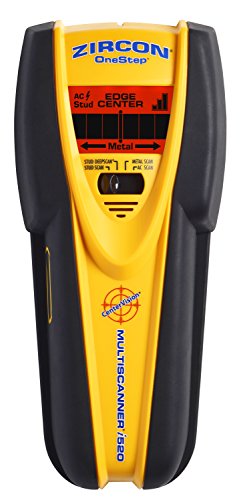
Zircon MultiScanner i520
The Zircon i520 offers automatic calibration and depth sensing. It has a Scan Center indicator that locates stud edges. It also detects live AC wires. Users like its compact size and simple operation, though some find the audio alerts a bit loud.
Pros
- Auto calibration for easy use
- Compact and lightweight
- Pinpoints center of stud
Cons
- No metal mode for deep metal
- Battery not included

DEWALT DCT1000S1 20V MAX Stud Detector
The DEWALT DCT1000S1 is a cordless stud finder that runs on DEWALT 20V batteries. It features a compact design and a backlit LCD that displays stud location. It also detects AC wires. This tool is great for jobsite use, but it costs more than battery-powered competitors.
Pros
- Rechargeable battery included
- Ergonomic grip
- Detects live wires
Cons
- Heavier than 9V models
- Higher initial cost

CH Hanson 03040 Stud Master
The CH Hanson Stud Master uses a magnetic system to locate screws or nails in studs. It requires no batteries and works on all surfaces. It’s a favorite among DIYers who want a no-fuss tool, but it only finds fasteners, not the stud edges.
Pros
- No batteries needed
- Works on any wall thickness
- Pocket-sized and affordable
Cons
- Only finds metal fasteners
- Not for locating studs without nails

Studpop Stud Finder
The Studpop is a smart stud finder that connects to your phone via Bluetooth. It uses radar technology to scan walls and provides a visual representation on your app. It detects studs, pipes, and wires. It’s innovative, but some users report a learning curve and the need to hold it perfectly still.
Pros
- Phone app provides detailed scans
- Rechargeable battery
- Can detect non-metallic objects
Cons
- Requires phone pairing
- Pricier than traditional finders

Laserliner Stud Finder Plus
The Laserliner Stud Finder Plus is an affordable option that detects wood and metal studs. It has a single button for operation and an LED display. It offers basic functionality without extra features like AC detection. Users find it reliable for simple tasks, but it may need several passes for accurate results.
Pros
- Low cost
- Simple operation
- Compact size
Cons
- Shallow detection depth
- No AC wire detection
Compared at a glance
| # | Model | Detection Depth | Best for | Score | Price |
|---|---|---|---|---|---|
| 1 | Franklin Sensors M100 Stud Finder | Up to 1.5 inches for wood, 3 inches for metal | Instant detection with wide sensor array | 9.4 | Check price |
| 2 | Bosch GMS120 Digital Multi-Scanner | Up to 3 inches for metal, 1.2 inches for wood | Multi-material scanning with metal and live wire detection | 9.2 | Check price |
| 3 | Zircon MultiScanner i520 | Up to 1.5 inches for wood | Automatic calibration and AC wire scanning | 9.0 | Check price |
| 4 | DEWALT DCT1000S1 20V MAX Stud Detector | Up to 1.5 inches | Cordless convenience with long battery life | 8.8 | Check price |
| 5 | CH Hanson 03040 Stud Master | Magnetic | Simple magnetic stud finder alternative | 8.5 | Check price |
| 6 | Studpop Stud Finder | Up to 3 inches | Non-invasive scanning with app connectivity | 8.3 | Check price |
| 7 | Laserliner Stud Finder Plus | Up to 0.75 inches for wood | Budget-friendly basic stud scanning | 8.0 | Check price |
Good to know
How deep can auto-ranging stud finders detect?
Most auto-ranging stud finders detect wood studs up to 1.5 inches deep and metal studs up to 3 inches. Models like the Bosch GMS120 and Franklin M100 offer these depths. For deeper scanning, you may need a specialized deep-scanning tool.
Can auto-ranging stud finders detect live wires?
Yes, many auto-ranging stud finders have a live wire detection mode. The Franklin M100, Bosch GMS120, Zircon i520, and DEWALT DCT1000S1 all include AC wire detection. This feature helps you avoid drilling into electrical lines.
Do I need to calibrate an auto-ranging stud finder?
No, auto-ranging stud finders automatically calibrate when you place them on the wall and press the button. This is a major advantage over manual models that require you to hold the button and wait for a calibration signal.
What is the difference between stud finders and multi-scanners?
Stud finders are designed primarily to locate wooden studs behind drywall. Multi-scanners, like the Bosch GMS120, can also detect metal and live wires, making them more versatile. Auto-ranging can be a feature of either type.
Can auto-ranging stud finders work on plaster walls?
Yes, but plaster walls are denser and may require a stud finder with a stronger signal. Auto-ranging helps by adjusting sensitivity. Some users report that magnetic finders are more reliable on plaster because they detect the nails behind the lath.
Why does my stud finder give false positives?
False positives can occur due to wall irregularities, metal lath, foil-backed insulation, or improper technique. Ensure the tool is flat on the wall, move slowly, and re-calibrate on a different spot. If problems persist, try a different detection mode or a magnetic finder.
How do I find the center of a stud?
Move the stud finder horizontally until it signals a stud. Mark that edge. Continue moving until it signals the other edge. The center is halfway between the two marks. Some models, like the Zircon i520, have a center-finding indicator that simplifies this.
Are more expensive stud finders worth it?
Higher-priced models often offer better build quality, more scanning modes, and greater accuracy. If you do frequent renovations or need to detect live wires, investing in a quality model like the Bosch GMS120 is worthwhile. For occasional use, a budget model may suffice.
Can stud finders detect metal studs?
Yes, many stud finders have a metal scanning mode. The Bosch GMS120 and Franklin M100 can detect metal studs. However, they may not differentiate between metal studs and other metal objects, so use caution.
Do stud finders work on ceilings?
Yes, stud finders can be used on ceilings to locate joists. Place the tool flat against the ceiling and scan. Ensure you are comfortable reaching overhead, as you need to move slowly and steadily.
The bottom line
For most homeowners, we recommend the Zircon MultiScanner i520 for its balance of price and features. It offers auto-calibration, AC detection, and reliable performance. If you require professional-grade accuracy and don’t mind spending more, the Bosch GMS120 is the best choice. For a budget-friendly option, the Laserliner Stud Finder Plus gets the job done, but with limitations.
Jake Monroe
Jake worked as a residential contractor for over a decade before shifting to full-time writing. He evaluates power tools, hand tools and workshop gear through the lens of someone who has actually used them on job sites, not just read the box.