7 Aquarium Heaters That Hold a Steady Temperature
Eheim Jager TruTemp takes the top spot for a narrow cycling range and a dial owners can recalibrate. Fluval E Series shows set point and actual water temperature together on an LCD. Aqueon Pro brings shatterproof construction to standard community tanks.
Eheim Jager TruTemp heads this list, with Fluval E Series close behind for visible feedback and Aqueon Pro covering tanks where glass is a liability. All three sell in wattages spanning nano tanks to four foot aquariums.
Wattage printed on the box says nothing about how tightly a thermostat holds its setting, which is the specification that actually matters. A heater stuck in the on position remains one of the fastest ways to lose a stocked tank. We compared published accuracy figures, wattage to volume guidance, cutout design and long term owner reports on drift.
The top picks, ranked

Eheim Jager TruTemp Aquarium Heater
Borosilicate glass and a tight cycling range have kept this model in freshwater recommendations for decades. Unlocking the collar lets the dial be reset against a reference thermometer, which almost no rival offers. Owners report tubes surviving many years provided the heater never runs in air.
Pros
- Narrow cycling range around the set point
- Dial recalibrates to a reference thermometer
- Wattage ladder covers nano to four foot tanks
Cons
- Glass body breaks in rough tanks
- No numeric readout on the unit

Fluval E Series Electronic Heater
Set point and actual water temperature appear together on a front LCD, and the panel flashes when the two separate. Dual sensors watch for the unit being lifted clear of the water. A moulded guard stops plecos and loaches pressing against the hot element.
Pros
- Water temperature visible without a thermometer
- Warns when readings drift from the set point
- Guard reduces contact burn risk
Cons
- Bulkier than a plain glass tube
- Display disappears behind dense planting
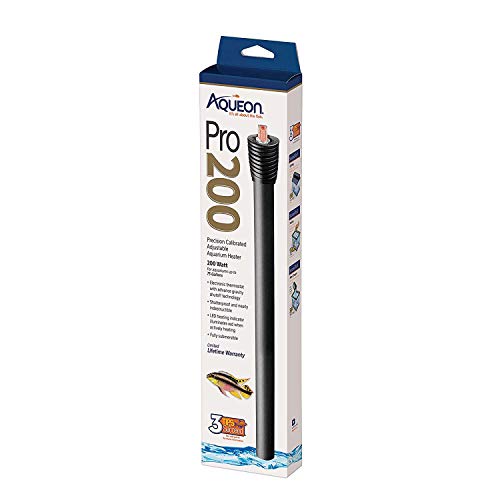
Aqueon Pro Adjustable Heater
Composite replaces glass around the element, which suits tanks holding cichlids, turtles or an enthusiastic pleco. Power cuts automatically if the body is exposed to air. An LED tells you at a glance whether the element is currently drawing current.
Pros
- Survives knocks that shatter glass
- Dry run protection is automatic
- Status light confirms cycling
Cons
- Cycling range is wider than the Jager
- Fully submersible only, no hang mount

Hygger Titanium Aquarium Heater
Wattages reach far higher than any glass tube here, which is what a tank past 50 gallons needs. Electronics sit in a controller outside the water, so adjustments never mean rolling a sleeve up. Titanium resists both impact and salt corrosion.
Pros
- High wattage options for big volumes
- Corrosion resistant in marine systems
- Controller adjusts without reaching into water
Cons
- Separate probe adds another cord to hide
- Lowest wattage is still large for a 20 gallon

Cobalt Aquatics Neo-Therm Heater
Flat thermoplastic construction hides behind driftwood and stem plants far more easily than a round tube. Setting the target uses a single touch control, with the reading shown on the body itself. Rated tolerance is tighter than most heaters in its wattage class.
Pros
- Slim shape disappears in an aquascape
- Tight rated temperature tolerance
- Reading visible on the body
Cons
- Costs more per watt than glass tubes
- Suction cups need periodic replacement

Tetra HT Submersible Aquarium Heater
Factory preset to a tropical figure, this heater has no dial to knock or misread. Red means heating and green means holding, which is the entire interface. Owners report it works best treated as a small tank or spare unit rather than scaled up.
Pros
- Nothing to misconfigure
- Useful as a backup heater
- Two colour light is unambiguous
Cons
- Target temperature cannot be changed
- Wrong choice for species needing a set range
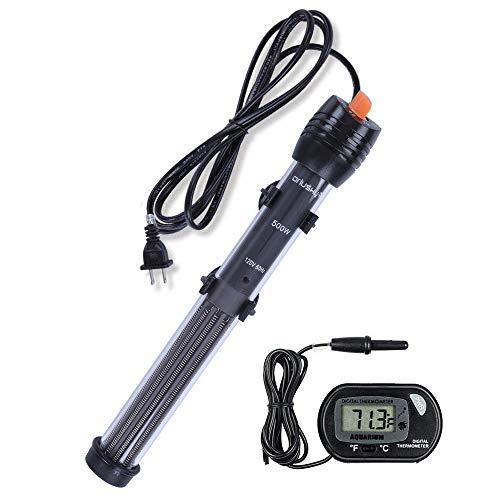
Orlushy Submersible Aquarium Heater
A clearly marked external dial makes setting a target obvious without opening the manual twice. Suction cup brackets allow horizontal or vertical mounting. Owners report checking the dial against a separate thermometer during the first week is worthwhile, since calibration varies unit to unit.
Pros
- Readable scale on an external dial
- Wattage range spans small to large tanks
- Mounts in either orientation
Cons
- Calibration varies between units
- Glass body needs careful handling
The lineup, side by side
| # | Model | Body | Best for | Score | Price |
|---|---|---|---|---|---|
| 1 | Eheim Jager TruTemp Aquarium Heater | Borosilicate glass | Best overall | 9.4 | Check price |
| 2 | Fluval E Series Electronic Heater | LCD set and actual temperature | Best for digital monitoring | 9.2 | Check price |
| 3 | Aqueon Pro Adjustable Heater | Shatterproof composite | Best value | 9.0 | Check price |
| 4 | Hygger Titanium Aquarium Heater | Titanium tube | Best for large tanks | 8.8 | Check price |
| 5 | Cobalt Aquatics Neo-Therm Heater | Flat thermoplastic | Best for planted tanks | 8.6 | Check price |
| 6 | Tetra HT Submersible Aquarium Heater | Preset non adjustable | Best budget | 8.3 | Check price |
| 7 | Orlushy Submersible Aquarium Heater | Explosion resistant glass | Best for first time keepers | 8.0 | Check price |
How to choose
How to size an aquarium heater to tank volume Three to five watts per gallon is the standard guidance, with the top of that range for rooms that cool overnight. Undersizing leaves the element running constantly and still losing ground in winter. Oversizing carries a different risk, since a stuck thermostat in a small tank raises temperature fast. Past 40 gallons, two half wattage heaters spread that risk sensibly.
Glass, composite and titanium bodies compared Glass gives accurate control at the lowest outlay, though it cracks when knocked or switched on in air. Composite shells survive rough tanks and curious pets with a small accuracy penalty. Titanium dominates large and marine systems because it resists salt and impact, but the metal tube has no thermostat of its own and needs an external controller.
Which heater safety features actually matter? Two are worth insisting on. Dry run protection cuts power when the element is exposed, which is what saves you after a water change went further than planned. An over temperature cutout stops a failed thermostat running the element continuously. A guard around the tube matters as a third consideration for plecos, loaches and other fish that rest against surfaces.
Placement, flow and even heating Sitting in still water, a heater warms a small pocket and reads that pocket rather than the tank. Position it near the filter outflow or a circulation pump so warmed water is carried around. Horizontal mounting low in the tank distributes heat better than vertical mounting. Every model in this roundup expects to be fully submerged.
Good to know
What wattage aquarium heater do I need?
Plan on three to five watts per gallon. A 20 gallon tank in a normally heated room suits a 100 watt heater, and colder rooms justify the upper end of the range.
Should I use two heaters instead of one?
Past roughly 40 gallons, many keepers prefer two units of half the wattage. One failing off leaves the tank warm enough to survive, and one sticking on lacks the power to overheat the volume alone.
Do aquarium heaters need to be fully submerged?
Nearly all modern heaters are fully submersible and should stay that way, since running an element in air cracks the tube quickly. Unplug before a water change and let it cool before lifting it out.
How accurate are the dials on aquarium heaters?
Dial markings are a starting point, not a measurement. Keep a separate thermometer in the tank and adjust until it reads correctly. Eheim Jager units allow the dial itself to be recalibrated to match.
What temperature should a tropical freshwater tank sit at?
Most common community species do well between roughly 24 and 26 degrees Celsius, around 75 to 79 Fahrenheit. Check the requirements of your least flexible species and set to that.
How long do aquarium heaters last?
Three to five years is commonly reported, with quality glass and titanium units running longer. Because failures arrive without warning, many keepers replace heaters preventively.
Can I use a freshwater heater in a saltwater tank?
Titanium is the safest choice for marine systems because it resists corrosion. Some glass and composite heaters carry a marine rating, so check the listing rather than assuming.
Why does my tank temperature keep fluctuating?
Usual causes are a heater sitting in still water, undersized wattage fighting a cold room, or a thermostat with a wide cycling range. Moving the heater beside the filter outflow fixes this more often than replacing it.
Is a titanium heater overkill for a small tank?
For anything under 30 gallons, yes. Titanium models start at wattages built for big volumes, and the external probe adds clutter a nano tank does not need.
Our pick
Eheim Jager TruTemp is the heater we would fit to most freshwater tanks, because a stable thermostat and a correctable dial address the failure that matters. Owners who want the water temperature visible without a separate thermometer are better served by Fluval E Series. Where glass is a liability, Aqueon Pro delivers the same job in a composite shell.
Olivia Hartley
Olivia spent several years working at an animal shelter and a pet-supply retailer before joining the editorial team. She researches pet gear with an emphasis on safety, comfort and the fine print that owners often miss.


