Dosing Pumps for Aquariums Compared by Accuracy and Setup
Kamoer F4 Pro Dosing Pump leads on calibration stability and per channel scheduling across four heads. Jebao DP-4 Auto Dosing Pump covers the same routine from a front panel for far less. Kamoer X1 Pro Dosing Pump is the tidiest single channel option here.
Kamoer F4 Pro Dosing Pump is the pick for reef keepers who want to set a routine and stop thinking about it. Jebao DP-4 Auto Dosing Pump handles the same four channel job with onboard programming. Kamoer X1 Pro Dosing Pump adds a single channel neatly to an existing setup.
A doser earns its place only by delivering the same small volume every single time. Head design, calibration method and peristaltic tubing wear decide that. Drift of a few milliliters a day swings alkalinity more than manual dosing ever did. We compared channel counts, calibration procedures, control interfaces and published dose ranges, alongside owner reports on tubing life, noise and long term accuracy.
Our top picks

Kamoer F4 Pro Dosing Pump
Four independent peristaltic heads run from an app, with per channel calibration and scheduling down to very small individual doses. Stepper motors hold accuracy between calibrations, which is the entire point of buying a doser. Owners report the app, not the hardware, is where the learning curve sits.
Pros
- Holds calibration well across months
- Fine control over dose size and timing
- Four channels in one compact housing
Cons
- App setup takes patience to learn
- Sits in the premium bracket for the class
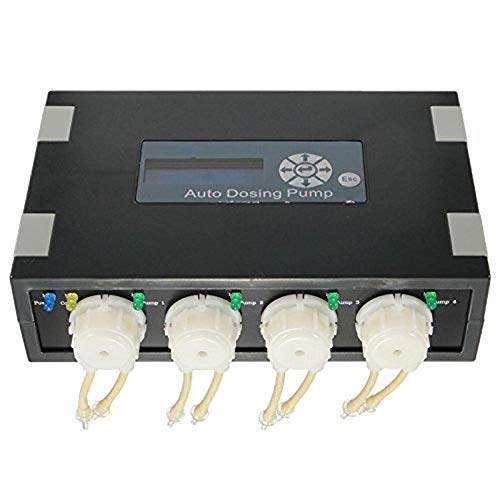
Jebao DP-4 Auto Dosing Pump
Programming happens entirely on the front panel, with no network or phone involved, which suits anyone who wants dosing without another app. Accuracy is solid once each channel is calibrated. Owners report checking and replacing the tubing periodically is what keeps that accuracy in place.
Pros
- Strong value for four channels
- Runs without an app or network
- Programming is quick once learned
Cons
- Tubing wears faster than premium pumps
- Interface design feels dated

Kamoer X1 Pro Dosing Pump
One head with Wi-Fi scheduling covers a single supplement, or adds a channel to a setup that has run out. Its footprint disappears inside a cabinet. Stacking several units builds a routine one element at a time, which a fixed four channel box cannot do.
Pros
- Small enough to hide anywhere in a stand
- Channels can be added one at a time
- App scheduling is clean and quick
Cons
- Higher cost per channel than multi head units
- Depends on a working network connection

Neptune Systems DOS Dosing Pump
Two fluid metering heads run under an Apex controller, which unlocks automated water changes and dosing driven by probe readings rather than a clock. Accuracy after calibration is among the best here. Without the controller, though, it makes little sense as a purchase.
Pros
- Responds to probe data instead of a fixed schedule
- Doubles as an automated water change pump
- Very accurate after calibration
Cons
- Needs an Apex controller to function
- Highest cost per channel in this group
Bubble Magus T11 Dosing Pump
Three channels match the classic reef routine of two part supplements plus one trace element, without paying for a head that sits idle. Running noise stays low enough for a display cabinet. Bubble Magus units are known for straightforward tubing replacement when accuracy starts to drift.
Pros
- Quiet enough for a living room cabinet
- Tubing swaps out without tools
- Channel count matches a two part routine
Cons
- No app or remote control
- Display is small and dim
hygger Aquarium Dosing Pump
Four channels aimed at planted tank fertilizer schedules rather than reef chemistry, with daily timing set on a clear display. Dose volumes suit liquid ferts, which go in at larger amounts than reef supplements. Tubing and bottle holders arrive in the box, so setup takes minutes.
Pros
- Dose range fits liquid fertilizer routines
- Everything needed ships in the box
- Display is readable across a room
Cons
- Less precise than reef focused pumps
- Limited number of doses per day

Poafamx 4 Channel Aquarium Dosing Pump
Four channels at the lowest outlay here, covering basic scheduled dosing on smaller tanks. Accuracy is acceptable for trace elements and fertilizers, provided calibration checks happen regularly. As a way to find out whether automated dosing fits your routine, it does the job.
Pros
- Cheapest route to four channels
- Setup takes very little time
- Compact case fits a small cabinet
Cons
- Needs recalibrating more often
- Supplied tubing is basic quality
What matters most
How many channels does your dosing routine need? Two part alkalinity and calcium dosing needs two channels. Adding magnesium or trace elements takes that to three or four. Single channel pumps such as the Kamoer X1 Pro let a routine grow one element at a time, and a failure only takes out one supplement. Multi head boxes are tidier and cheaper per channel. Consider automated water changes too, since those need different hardware such as the Neptune DOS.
Why splitting doses across the day matters One large daily dose swings alkalinity and pH noticeably, which is precisely what automation should prevent. Dividing the same daily volume into many small doses keeps parameters flat and lets corals grow steadily. Check how many separate doses per day a pump can schedule before buying, because budget units are often limited to a handful.
How to calibrate a dosing pump and keep it accurate Peristaltic tubing compresses and wears, so a pump calibrated in January will not deliver the same volume by summer. Calibrate each channel against a measuring cylinder when new, then repeat every couple of months. Owners consistently report tubing replacement as the single most effective fix once drift appears. Keeping a spare tubing set on hand turns that into a five minute job.
Plumbing a doser to avoid siphons and precipitation Mount the pump above the water line and loop each outlet upward before it drops into the sump, so nothing can siphon between doses. Drip the two part supplements into separate high flow areas, because dosing calcium and alkalinity at the same point causes precipitation and cloudy water. Rigid tubing holders make both jobs far easier to set up neatly.
Side by side
| # | Model | Channels | Best for | Score | Price |
|---|---|---|---|---|---|
| 1 | Kamoer F4 Pro Dosing Pump | Four independent heads | Best overall | 9.4 | Check price |
| 2 | Jebao DP-4 Auto Dosing Pump | Four | Best value | 9.2 | Check price |
| 3 | Kamoer X1 Pro Dosing Pump | One | Best single channel | 9.0 | Check price |
| 4 | Neptune Systems DOS Dosing Pump | Two metering heads | Best for controller integration | 8.8 | Check price |
| 5 | Bubble Magus T11 Dosing Pump | Three | Best three channel option | 8.6 | Check price |
| 6 | hygger Aquarium Dosing Pump | Four | Best for planted tanks | 8.3 | Check price |
| 7 | Poafamx 4 Channel Aquarium Dosing Pump | Four | Best budget | 8.0 | Check price |
Frequently asked questions
How many dosing channels do I need for a reef tank?
Two covers basic alkalinity and calcium. Three or four suits routines that add magnesium or trace elements. Buying one spare channel is common, since routines tend to grow rather than shrink.
How accurate are aquarium dosing pumps?
Good units hold within a small percentage of the set volume when calibrated. Accuracy drifts as peristaltic tubing wears, which is why periodic recalibration is part of owning one.
How often should I calibrate a dosing pump?
Every couple of months works for most setups, and always after replacing tubing. Owners report drift becoming measurable well before the tubing physically fails.
Can I dose two part supplements through one pump?
Use separate channels and separate entry points in high flow areas. Dosing calcium and alkalinity at the same spot causes precipitation that wastes both.
Do I need an aquarium controller to run a doser?
Not for scheduled dosing, since most pumps run their own timers. A controller adds reactive dosing based on probe readings, which pays off on larger or more demanding systems.
Why is my dosing pump delivering more than programmed?
Check for a siphon if the pump sits below the water line, then inspect the tubing for stretching or wear. Recalibrate once both have been ruled out.
How long does dosing pump tubing last?
Usage decides it, but planning on replacement once or twice a year is sensible for a pump running many doses daily. Keeping a spare set avoids downtime.
Are aquarium dosing pumps noisy?
Each dose produces a short whirring sound. Owners describe it as easy to ignore inside a cabinet, though frequent small doses mean it happens often through the day.
Can a dosing pump be used for planted tank fertilizers?
Yes, and volumes are usually larger than reef supplements. The hygger unit is built around that use case, while reef focused pumps handle it comfortably with room to spare.
Our take
Kamoer F4 Pro Dosing Pump is the buy for anyone wanting set and forget accuracy across four channels, and it holds calibration better than anything else here. Jebao DP-4 does the same core job for much less, at the cost of front panel programming and more frequent tubing changes. Apex owners should go straight to the Neptune Systems DOS.
Olivia Hartley
Olivia spent several years working at an animal shelter and a pet-supply retailer before joining the editorial team. She researches pet gear with an emphasis on safety, comfort and the fine print that owners often miss.

