Anamorphic Lens Picks for Full Frame and APS-C Rigs
SIRUI Venus 35mm T2.9 1.6x leads for full frame work, reaching a 2.4:1 frame with no crop. On APS-C bodies, SIRUI 50mm f/1.8 1.33x gathers more light for less outlay. Laowa Nanomorph 35mm T2.4 stays small enough to balance on a gimbal.
SIRUI Venus 35mm T2.9 1.6x suits full frame shooters who deliver in 2.4:1. Its 1.6x squeeze fills that ratio from a 16:9 sensor, so nothing gets trimmed. Mass is the catch, close to two and a half pounds before a follow focus goes on. APS-C owners spend less and carry less with the SIRUI 50mm f/1.8 1.33x.
Mount, image circle and squeeze ratio interact, so a lens can read well on a spec sheet and still vignette on your body. We compared published optical data, available mount plates, minimum focus distances and barrel weights. Owner feedback about flare consistency and gear rattle during focus pulls broke the close calls.
What we recommend

SIRUI Venus 35mm T2.9 1.6x Full Frame Anamorphic
Full frame coverage separates Venus from cheaper anamorphic primes. At 1.6x, a 16:9 sensor desqueezes straight to 2.4:1 with nothing cut from the top or bottom. Mount plates swap between Sony E, Canon RF, Leica L and Nikon Z, and both rings are geared for follow focus motors.
Pros
- Reaches a 2.4:1 delivery frame without cropping the sensor
- Mount plates swap instead of locking you to one body
- Front diameter matches the other Venus primes
Cons
- Near two and a half pounds, so long rigs want a lens support
- T2.9 runs short of light in dim interiors

SIRUI 50mm f/1.8 1.33x Anamorphic
Plenty of shooters meet anamorphic through this 50mm. Coverage stops at APS-C and Micro Four Thirds, yet f/1.8 returns the light slower cine primes give away. Blue horizontal streaks appear with no filter fitted, and a 67mm front thread accepts common diffusion.
Pros
- f/1.8 keeps handheld night work usable
- Sold in Sony E, Fuji X, MFT, Nikon Z and Canon RF mounts
- Light enough for a single handed gimbal
Cons
- Corners darken on full frame bodies
- 1.33x still needs a small crop to hit 2.39:1

Laowa Nanomorph 35mm T2.4 1.5x
Venus Optics built the Nanomorph line around barrel size, keeping it close to a normal photo prime. Coverage targets Super 35, which lines up with most cinema cameras and APS-C hybrids. Buyers choose a flare colour at checkout from silver, blue or amber.
Pros
- Compact barrel keeps a handheld rig balanced
- 1.5x lands between a gentle 1.33x and a full 2x look
- Cine style geared focus and iris rings
Cons
- Flare colour cannot change after purchase
- Image circle stops short of full frame

SIRUI Saturn 50mm T2.9 1.6x Carbon Fiber Anamorphic
Carbon fiber is the whole point of Saturn. Squeeze matches the metal Venus primes at 1.6x, but the barrel weighs about 15 ounces, roughly half as much. Every ounce forward shifts a gimbal balance point, so that saving shows up in tilt motor behaviour. Softness stays confined to the extreme corners wide open.
Pros
- About 15 ounces, which spares the gimbal tilt motor
- Full frame image circle in a travel sized barrel
- Front diameter matches the other Saturn primes
Cons
- Carbon shell feels less solid than machined metal
- Extreme corners soften at T2.9

Great Joy 35mm T2.9 1.8x Anamorphic
At 1.8x, oval bokeh and horizontal streaks read clearly in a single shot. Great Joy covers full frame and offers several mount versions. Length is what that squeeze costs, and the barrel rules out most compact cages.
Pros
- Strongest anamorphic character in this group
- Full frame image circle without stepping up to rental cine glass
- Geared rings drive standard follow focus units
Cons
- Minimum focus near 3.3 feet blocks tight insert shots
- Bulk makes a full day handheld tiring
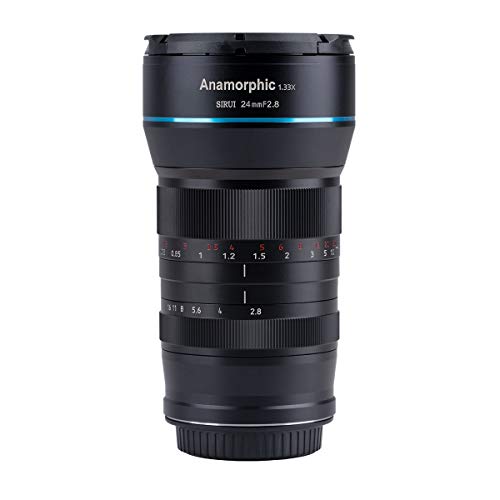
SIRUI 24mm f/2.8 1.33x Anamorphic
Wide anamorphics stay rare, so this 24mm fills a genuine gap for room tours, car interiors and small kitchens. Desqueezed on APS-C it frames close to an 18mm lens. Close focus near two feet lets a foreground object sit inside the shot.
Pros
- Frames a whole room without backing into a wall
- 67mm thread matches the 50mm f/1.8 filter set
- Two foot close focus supports foreground framing
Cons
- f/2.8 gathers less light than its 50mm sibling
- Straight lines bend near the edges at this focal length

Moment Anamorphic Lens 1.33x
Moment clips a 1.33x element to a phone through its bayonet case system. Gold and blue flare versions both produce oval highlights from a phone sensor. Mounting depends on owning a compatible Moment case, so count that in before ordering.
Pros
- Lowest barrier to shooting anamorphic footage
- Rides in a jacket pocket beside the phone
- Pairs with apps that desqueeze while recording
Cons
- Will not mount without a Moment bayonet case
- Small phone sensors limit background separation
Before you buy
What to look for in an anamorphic lens Four attributes decide the shortlist. Squeeze factor sets the final aspect ratio. Image circle governs whether the glass covers your sensor or darkens the corners. Mount matters twice, once for the body you own and again for the next one, which is why swappable plates on the Venus and Saturn lines earn their place. Everything ranked here focuses by hand, so budget for peaking or a follow focus. Flare colour is a look decision, fixed at purchase on the Nanomorph and left to filters on the SIRUI primes.
How squeeze factor changes the final frame Squeeze compresses horizontal detail onto the sensor, and editing software stretches it back. A 1.33x lens on a 16:9 camera desqueezes near 2.39:1 after a light crop. Move to 1.6x and the same sensor lands on 2.4:1 with nothing trimmed. Stronger ratios also pull highlights into ovals and widen streak flares. Past 1.5x the look reads as obviously cinematic, while 1.33x reads as gentle widescreen.
Full frame or APS-C: which lenses cover your sensor? Image circle is the first filter to apply, not the last. SIRUI f/1.8 and f/2.8 primes cover APS-C and Micro Four Thirds only, so full frame bodies need a crop mode. Venus, Saturn and Great Joy project a full frame circle. Nanomorph targets Super 35, which fits an FX30 or a cropped Blackmagic sensor. Recording mode deserves a check too, since open gate and 6K read more of the sensor than 4K and can reveal vignetting that 4K hides.
Gimbals, tight interiors and phone shooters Weight outranks optics once a gimbal carries the lens. Saturn sits near 15 ounces against roughly two and a half pounds for the metal Venus, which stops the tilt motor working hard all day. Interiors shift the priority to focal length, and the 24mm f/2.8 frames a room the 35mm cannot. Travel diaries and social clips survive fine on a phone adapter, especially when the footage ends up letterboxed and graded warm. Low light and subject separation are where phone optics give out, so anyone chasing background blur should skip the adapter and put the money toward the SIRUI 50mm f/1.8.
Side by side
| # | Model | Squeeze factor | Best for | Score | Price |
|---|---|---|---|---|---|
| 1 | SIRUI Venus 35mm T2.9 1.6x Full Frame Anamorphic | 1.6x | Best overall | 9.4 | Check price |
| 2 | SIRUI 50mm f/1.8 1.33x Anamorphic | 1.33x | Best value | 9.2 | Check price |
| 3 | Laowa Nanomorph 35mm T2.4 1.5x | 1.5x | Best for compact cine rigs | 9.0 | Check price |
| 4 | SIRUI Saturn 50mm T2.9 1.6x Carbon Fiber Anamorphic | 1.6x | Best for gimbal work | 8.8 | Check price |
| 5 | Great Joy 35mm T2.9 1.8x Anamorphic | 1.8x | Best for maximum squeeze | 8.5 | Check price |
| 6 | SIRUI 24mm f/2.8 1.33x Anamorphic | 1.33x | Best for interiors | 8.3 | Check price |
| 7 | Moment Anamorphic Lens 1.33x | 1.33x | Best budget | 8.0 | Check price |
Common questions
What does 1.33x squeeze actually mean?
Your camera records a horizontally compressed image. Stretching it back by 1.33 in the edit turns a 16:9 frame into roughly 2.39:1 after a light crop. Faces return to normal proportions once desqueezed.
Do anamorphic lenses work on full frame cameras?
Only when the image circle covers the sensor. SIRUI Venus, SIRUI Saturn and Great Joy options do. SIRUI f/1.8 and f/2.8 primes cover APS-C, so full frame bodies have to switch to crop mode.
Which anamorphic lens is best for beginners?
SIRUI 50mm f/1.8 1.33x. Five mounts, a fast aperture and a mild squeeze make it forgiving, because 1.33x does not magnify small focus errors the way stronger ratios do.
How do you desqueeze anamorphic footage?
Change the clip attributes in your editor. Premiere, Resolve and Final Cut each accept a pixel aspect ratio or a manual horizontal scale value matching the squeeze, such as 1.33 or 1.6.
Is 1.6x squeeze better than 1.33x?
Stronger, not automatically better. At 1.6x you reach 2.4:1 with no crop and throw wider flares. At 1.33x more pixels land on each face, and the lens stays easier to light and focus.
Can you autofocus an anamorphic lens?
No. Every pick here focuses manually, phone adapter included. Plan for focus peaking, a follow focus unit, or a stop of extra depth of field to cover small errors.
Are anamorphic lenses good for photography?
They work, though stills software rarely desqueezes on import. Portrait shooters like the oval bokeh. Manual focus plus an extra editing step makes anamorphic a deliberate choice rather than a default.
What is the cheapest way to get the anamorphic look?
A 1.33x phone adapter such as the Moment, paired with an app that desqueezes while recording. Owners report convincing oval highlights and streak flares in short social clips.
Anamorphic lens vs widescreen crop: is the lens worth it?
Cropping changes frame shape and nothing else. A lens changes the optics, adding oval bokeh, horizontal flares and a wider field for a given focal length. Crop when the ratio is all you need.
Do anamorphic lenses need a special filter or matte box?
None of the SIRUI or Laowa primes need a filter to flare. Matched front diameters across the Venus and Saturn lines let one matte box or filter set serve a whole kit, which saves buying rings twice.
The verdict
Take the SIRUI Venus 35mm T2.9 1.6x if you shoot full frame and want 2.4:1 straight out of camera. Gimbal operators should buy the carbon fiber Saturn instead, since halving barrel weight matters more than the last trace of corner sharpness. First time anamorphic buyers and anyone on APS-C get far more usable glass from the SIRUI 50mm f/1.8.
Marcus Chen
Marcus covered consumer electronics for enthusiast tech publications for six years before joining ChoiceCrest. He specializes in translating manufacturer spec sheets into plain-language buying advice, with a focus on audio, computing accessories and smart-home gear.