Which Air Fryer Actually Crisps Food Evenly?
Cosori Pro II pairs a square 5.8 quart basket with 1500 watts, and square baskets hold more flat food than round drums. Ninja AF101 covers couples at 4 quarts and 1550 watts. Chefman TurboFry handles snacks and small meals in 3.6 quarts.
Cosori Pro II leads for families, combining a square 5.8 quart basket with 1500 watts and nine presets. Ninja AF101 suits couples at 4 quarts, with a temperature range reaching down to 105 degrees Fahrenheit for dehydrating. Chefman TurboFry covers snacks and single meals in 3.6 quarts.
Shelf displays make air fryers look interchangeable, yet the details that decide daily satisfaction stay off the box. Usable basket area depends on shape as much as volume. Fan strength shapes how evenly food browns. Preset temperatures rarely match what a recipe wants. We compared published capacity, basket geometry, wattage, temperature range, preset count and footprint, then weighed those against what owners report about browning and cleanup after months of regular use.
Our top picks

Cosori Pro II Air Fryer (5.8-Quart)
Square basket geometry holds more fries, chicken thighs and flat vegetables than a round drum of the same 5.8 quart rating. A 1500 watt element with a strong fan browns evenly, so mid-cook shaking becomes optional rather than essential. Nine presets and a dishwasher-safe basket keep the routine simple.
Pros
- Square basket fits more flat food than round drums
- 1500 watts browns evenly with minimal shaking
- Basket and crisper plate go in the dishwasher
Cons
- Wider footprint than compact models
- Preset temperatures often need manual tweaking

Ninja AF101 Air Fryer (4-Quart)
Four quarts covers dinner for two without hogging counter width. Temperature spans 105 to 400 degrees Fahrenheit, which adds dehydrating to the usual crisping and roasting. A ceramic-coated basket and crisper plate wipe clean and survive the dishwasher.
Pros
- Preheats fast at 1550 watts
- 105 degree low end enables dehydrating
- Ceramic coating releases food cleanly
Cons
- 4 quarts is tight for a family of four
- Dial and button controls feel basic beside touchscreens
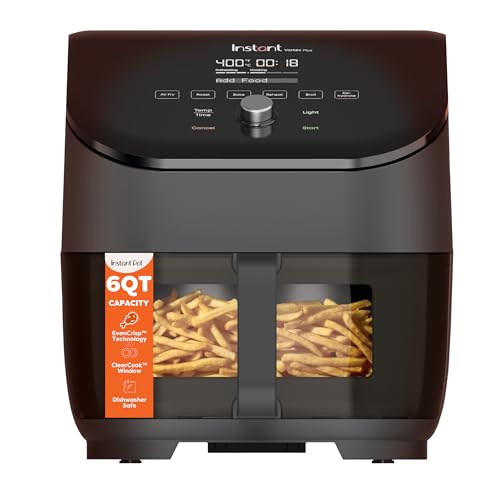
Instant Vortex Plus (6-Quart)
A viewing window lets you watch browning without pulling the drawer and interrupting the cook. Six one-touch programs cover the foods most people start with, and the touchscreen keeps them one press away. Six quarts handles family portions, though the window glass takes extra effort to keep clear.
Pros
- Window shows browning without opening the drawer
- Six clearly labeled one-touch programs
- 6 quarts covers family portions
Cons
- Window glass needs frequent cleaning
- Frequent beeps and prompts during a cook

Philips 3000 Series Air Fryer
Rapid Air circulation keeps browning consistent from batch to batch, and owners report the build lasts years rather than seasons. Capacity stops at 4.1 quarts, so this suits one or two people rather than a household. Controls stay uncluttered, with no preset list to scroll through.
Pros
- Build quality owners report lasting for years
- Rapid Air design cooks consistently batch to batch
- Uncluttered controls with nothing to learn
Cons
- 4.1 quarts is small for the footprint it occupies
- No preset programs at all
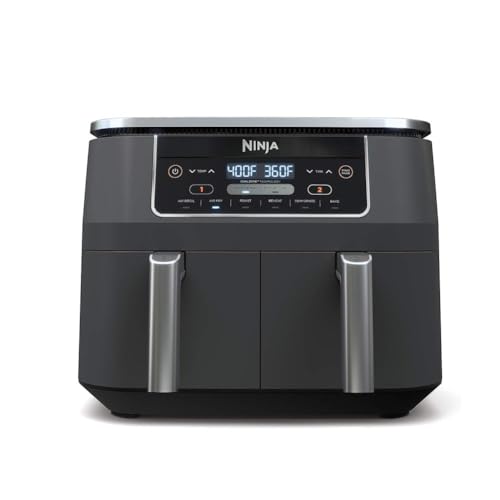
Ninja Foodi DualZone (8-Quart, 2-Basket)
Eight quarts split across two independent baskets, so a main and a side cook at different temperatures and finish together via Smart Finish. Match Cook mirrors settings across both drawers for a single large batch. That twin layout claims serious counter and cabinet space.
Pros
- Two baskets finish different foods together
- 1690 watts, highest output in this ranking
- Both baskets and crisper plates are dishwasher safe
Cons
- Needs generous counter and storage space
- Each individual basket is smaller than a 6 quart drawer
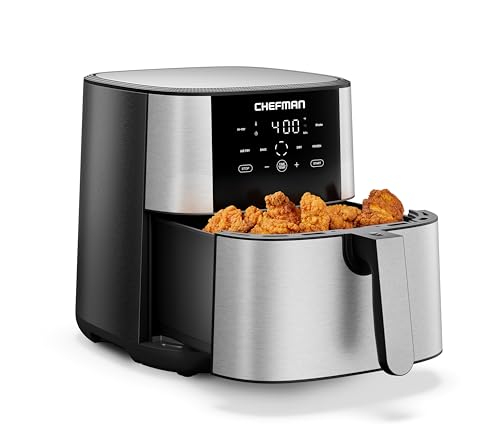
Chefman TurboFry Touch Air Fryer
A 3.6 quart basket handles wings, fries, frozen snacks and dinner for one or two. Digital touchscreen presets cover the common foods, which is unusual at this level. Output of 1300 watts browns more gently than the higher-wattage picks above it.
Pros
- Touchscreen presets at the lowest cost here
- 3.6 quart body fits a small counter
- Dishwasher-safe basket simplifies cleanup
Cons
- 1300 watts browns less aggressively
- Basket too small for family batches
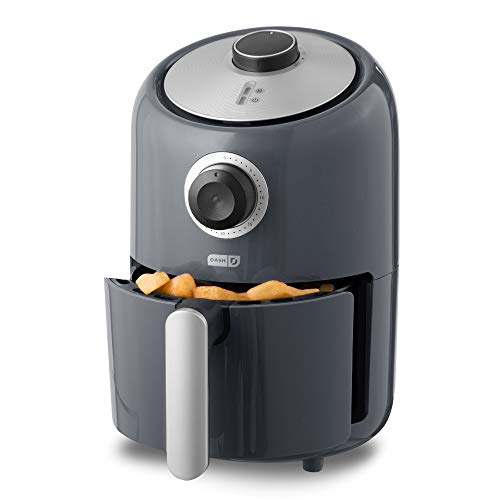
Dash Compact Air Fryer (2-Quart)
Two quarts and 1000 watts make this the pick for dorm rooms, RVs and kitchens with no spare counter run. Analog temperature and timer dials mean nothing to configure. Portions are genuinely single serve, so anything beyond one person means cooking in rounds.
Pros
- Fits dorm rooms, RVs and tiny counters
- Analog dials work with no learning curve
- Heats quickly for single servings
Cons
- 2 quarts serves one person at a time
- Analog dials lack precise temperature setting
Side by side
| # | Model | Capacity | Best for | Score | Price |
|---|---|---|---|---|---|
| 1 | Cosori Pro II Air Fryer (5.8-Quart) | 5.8 quarts | Best overall | 9.4 | Check price |
| 2 | Ninja AF101 Air Fryer (4-Quart) | 4 quarts | Best value | 9.2 | Check price |
| 3 | Instant Vortex Plus (6-Quart) | 6 quarts | Best for beginners | 9.0 | Check price |
| 4 | Philips 3000 Series Air Fryer | 4.1 quarts | Best premium | 8.7 | Check price |
| 5 | Ninja Foodi DualZone (8-Quart, 2-Basket) | 8 quarts total, two baskets | Best large capacity | 8.5 | Check price |
| 6 | Chefman TurboFry Touch Air Fryer | 3.6 quarts | Best budget | 8.2 | Check price |
| 7 | Dash Compact Air Fryer (2-Quart) | 2 quarts | Best compact | 8.0 | Check price |
What matters most
What size air fryer do you need? Household size sets the number, and basket shape adjusts it. Roughly 2 to 4 quarts feeds one or two people. Five to 6 quarts covers most families. Eight quarts or a dual-basket unit handles batch cooking and two dishes together. A square basket, as on the Cosori Pro II, holds more flat food than a round drum of identical rating, so shape matters as much as volume.
How wattage and basket shape affect crisping Higher wattage means faster preheating and more sustained heat when cold food lands in the basket. Models at 1500 watts and above tend to brown evenly with less shaking, while 1000 to 1300 watt units cook more gently. Fan design and airflow path matter alongside raw watts. If you cook several times a week, the higher-wattage models save real time.
Digital presets or analog dials: which suits you? Presets set a starting time and temperature for common foods, which helps anyone learning the appliance. Most owners still fine-tune them, since preset temperatures rarely match a specific recipe. Touchscreens make those adjustments easy. Analog dials, as on the Dash Compact, are simpler and cheaper but less precise. Choose based on who else in the house will operate it.
How to clean an air fryer without ruining the coating Wash the basket and crisper plate after every use, since grease residue causes both sticking and smoke. Skip metal utensils and abrasive pads on nonstick surfaces. Aerosol cooking sprays degrade coatings over time, so brush oil onto the food instead. Wipe the heating element area every few uses once the unit is cool, and never overfill the basket.
Frequently asked questions
What size air fryer is best for a family of four?
Five to 6 quarts covers most family meals, and 8 quart dual-basket units handle a main plus a side. Basket shape counts too, since square baskets hold more flat food than round ones of the same rating.
Do air fryers use a lot of electricity?
They draw 1000 to 1700 watts, similar to a microwave, but run for short periods and preheat far faster than a full oven. For small meals most owners find them more efficient than heating a conventional oven.
Is air-fried food actually healthier?
Circulating hot air replaces submersion in oil, so meals use far less added fat than deep frying. Ingredients still decide the nutrition, but the cooking method itself cuts fat considerably.
Can you put foil or parchment in an air fryer?
Yes, as long as it does not block airflow or touch the element, and food weighs it down. Never preheat with a loose liner inside, since it can lift into the heating element.
How do I stop food sticking to the basket?
Brush or spray oil onto the food rather than the coating, and avoid aerosol sprays that break down nonstick surfaces. Preheating briefly and leaving gaps between pieces also helps.
Why does my air fryer smoke?
Rendered fat dripping onto the hot element is the usual cause, common with bacon and fatty cuts. Add a splash of water to the drawer under the basket to catch grease, and clean residue between uses.
Can an air fryer replace an oven?
For small batches and crisp foods, often yes, and it cooks faster. Basket size rules out large roasts and multiple trays, so most owners run one alongside an oven rather than instead of it.
How often should I clean my air fryer?
Wash the basket and crisper plate after each use, and wipe the interior and element area every few cooks once cool. Most baskets are dishwasher safe, which keeps the routine short.
Which air fryer is best for a small kitchen or dorm?
Dash Compact at 2 quarts occupies the least counter space and needs only analog dials. Chefman TurboFry at 3.6 quarts is the next step up if you want presets and a little more room.
Cosori Pro II vs Ninja AF101: which should I choose?
Choose Cosori for a family, since 5.8 quarts in a square basket holds more flat food and nine presets speed up routine meals. Choose Ninja AF101 for two people, a tighter footprint and a dehydrate-capable temperature range.
Our pick
Cosori Pro II is the air fryer most kitchens should buy, since a square 5.8 quart basket and 1500 watts deliver even browning with little intervention. Ninja AF101 is the better fit for couples who want proven results in a narrower footprint. Chefman TurboFry covers snacks and small meals when counter space and budget are both tight.
Dana Whitfield
Dana spent eight years buying and merchandising for a regional kitchenware retailer before moving into editorial work. She has handled thousands of SKUs across cookware, small appliances and kitchen organization, and focuses on the practical differences that matter once a product is actually in daily use.