Agility Ladders That Sharpen Footwork Fast
The SKLZ Quick Ladder leads this comparison for its quick-release rungs that adjust spacing without retying knots. Coaches running team drills should consider the GoSports Agility Training Ladder instead for its extra length, while the Yes4All Speed Agility Ladder fits anyone training solo on a budget.
The SKLZ Quick Ladder stands out because its clip-style rungs slide to new positions in seconds, unlike ladders that need rungs retied by hand. Its main limitation is length, since it covers less ground than ladders built for full team drills.
We compared published length, rung material, anchoring method and included drill guides across each listing based on manufacturer specifications.
Before you buy
What to look for in an agility ladder Rung type decides adjustment speed, with clip-style rungs changing spacing faster than tied rungs. Length determines how many steps fit in one drill pass, which matters more for team practices than solo home use. Material durability affects how the ladder holds up to repeated cleat traffic on turf or grass.
Solo training versus team practice Solo athletes training in a driveway or backyard do fine with a standard-length ladder like the SKLZ Quick Ladder or Yes4All. Teams running multiple athletes through drills benefit from the extended length of the GoSports Agility Training Ladder. Coaches managing cleat traffic on turf should prioritize reinforced webbing like the Franklin Sports or Rogue Pro design.
Clip rungs versus tied rungs Clip-style rungs, used by the SKLZ and Yes4All, adjust spacing in seconds without retying knots. Tied rungs, found on the GoSports and Rogue Pro ladders, take longer to adjust but resist loosening under heavy repeated use. Facilities running the same spacing every session may prefer the simplicity of a fixed tied design.
Added drill tools and bundles The Trideer Agility Ladder bundle adds cones and a resistance parachute for athletes wanting more variety in one purchase. Most other ladders here focus solely on the ladder itself, keeping the package simpler and lighter to carry. Buyers should weigh whether added tools justify the extra bulk for their specific training space.
What we recommend
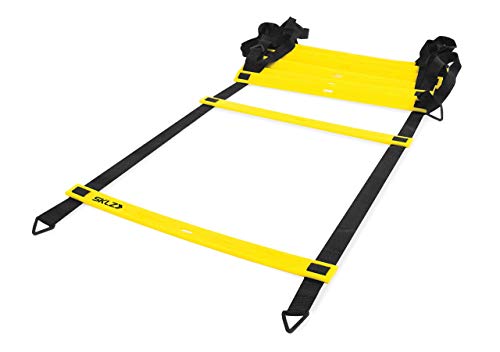
SKLZ Quick Ladder
Clip-style rungs slide along the side rails and lock into new positions without retying knots, a clear speed advantage over tied-rung ladders. Lightweight nylon webbing packs down small enough for a gym bag or car trunk. Ground stakes keep it anchored during fast lateral drills on grass.
Pros
- Clip rungs adjust spacing without retying knots
- Packs down small for easy transport
- Stays anchored during fast lateral movement with stakes
Cons
- Shorter overall length than ladders built for team drills
- Clip mechanism can loosen slightly after heavy repeated use

GoSports Agility Training Ladder
An extended length covers more ground than standard home-use ladders, suiting team practices running multiple athletes through drills back to back. Rungs tie in place rather than clip, which takes longer to adjust but holds position firmly during heavy use. It ships with a carrying bag for storage between practices.
Pros
- Extended length suits team practices with multiple athletes
- Tied rungs hold position firmly through heavy repeated use
- Carrying bag simplifies storage and transport
Cons
- Tied rungs take longer to adjust than clip-style designs
- Longer length needs more storage space when not folded
Franklin Sports Agility Ladder
Reinforced webbing holds up to repeated cleat traffic on grass and turf fields used for soccer and football training. Rungs clip in place for reasonably fast spacing changes between drill variations. A compact carrying pouch keeps it organized in a sports bag alongside other gear.
Pros
- Reinforced webbing withstands cleat traffic on turf and grass
- Clip rungs adjust faster than tied designs
- Compact pouch keeps it organized for travel
Cons
- Webbing feels less premium than the SKLZ under heavy daily use
- Ground stakes sold separately on some package versions
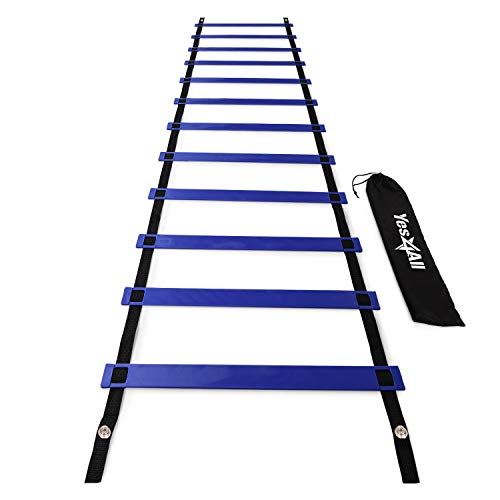
Yes4All Speed Agility Ladder
A straightforward clip-rung design keeps the price low while still allowing rung spacing adjustments for different drills. Lightweight construction makes it easy to carry to a park or driveway for solo training. Stakes included are lighter duty than those bundled with pricier team-focused ladders.
Pros
- Lower price than premium team-training ladders
- Lightweight design is easy to carry for solo workouts
- Clip rungs allow basic spacing adjustments
Cons
- Included stakes are lighter duty than premium competitors
- Webbing durability trails higher-priced options under heavy use
Trideer Agility Ladder
This listing bundles the ladder with cones and a resistance parachute, giving solo trainers more drill variety in one purchase. The ladder itself uses standard clip rungs comparable to other budget options. Bundle components add bulk to store compared to a ladder-only purchase.
Pros
- Bundle adds cones and a parachute for varied drills
- Good value for buyers wanting multiple training tools at once
- Clip rungs allow quick spacing changes
Cons
- Bundle components take up more storage space
- Individual piece quality trails single-purpose premium products

Rogue Pro Agility Ladder
Reinforced stitching along the side rails holds up to daily use in a commercial gym or training facility setting. Rungs tie in place, favoring durability over the quick adjustability of clip-style competitors. The heavier-duty build adds a bit more weight to carry than lightweight home-use ladders.
Pros
- Reinforced stitching withstands daily commercial gym use
- Tied rungs stay firmly in place under heavy traffic
- Built to outlast lighter home-use ladders
Cons
- Tied rungs adjust slower than clip-style designs
- Heavier build is less convenient to carry than lightweight options

ProsourceFit Agility Ladder
A compact design and included carry bag suit casual users training in a driveway or backyard rather than a team setting. Clip rungs allow basic adjustment without much hassle. It lacks the reinforced stitching that heavier-duty competitors use for commercial durability.
Pros
- Compact size suits casual backyard or driveway training
- Included carry bag simplifies storage
- Reasonable price for occasional use
Cons
- Less durable than reinforced ladders built for commercial gyms
- Standard length is shorter than team-drill ladders
How they compare
| # | Model | Length | Best for | Score | Price |
|---|---|---|---|---|---|
| 1 | SKLZ Quick Ladder | Adjustable, standard length | Best Overall for Adjustability | 9.1 | Check price |
| 2 | GoSports Agility Training Ladder | Extended, team-drill length | Best for Team Drills | 8.9 | Check price |
| 3 | Franklin Sports Agility Ladder | Standard multi-sport length | Best for Multi-Sport Training | 8.7 | Check price |
| 4 | Yes4All Speed Agility Ladder | Standard length | Best Budget | 8.4 | Check price |
| 5 | Trideer Agility Ladder | Standard length | Best Bundle Value | 8.2 | Check price |
| 6 | Rogue Pro Agility Ladder | Standard length | Best Heavy-Duty Build | 8.1 | Check price |
| 7 | ProsourceFit Agility Ladder | Standard length | Best for Casual Home Use | 8.0 | Check price |
Frequently asked questions
What is an agility ladder used for?
It trains footwork speed, coordination and quickness through structured stepping patterns used in sports conditioning and warmups.
How long should an agility ladder be for home use?
A standard length, like that on the SKLZ Quick Ladder or Yes4All, fits most driveways and backyards without needing extra space.
Do agility ladders need stakes to stay in place?
Stakes help on grass or turf during fast lateral drills, though many home users on hard surfaces skip them entirely.
Are clip-rung ladders better than tied-rung ladders?
Clip rungs like those on the SKLZ adjust faster, while tied rungs like the GoSports hold position more firmly under heavy repeated use.
Can agility ladder training improve sports performance?
Yes, footwork drills build coordination and reaction speed that carry over to sports requiring quick direction changes.
How often should athletes train with an agility ladder?
Two to three short sessions per week focused on form and speed is typical, often as part of a warmup routine.
What age is appropriate for agility ladder training?
Most youth athletes from around age 8 and up can safely use agility ladders with proper supervision and basic drill instruction.
Do agility ladders work on grass or only flat surfaces?
Most ladders, including the Franklin Sports and GoSports, work on grass and turf, with ground stakes helping keep them anchored.
Final word
The SKLZ Quick Ladder is the best pick for athletes who want fast rung adjustments without retying knots between drills. Coaches running full team practices should choose the GoSports Agility Training Ladder for its extra length. Buyers wanting more training tools in one purchase get good value from the Trideer Agility Ladder bundle.
Derek Holt
Derek has a background coaching recreational and amateur athletes and has worked the sales floor at specialty fitness retailers. He focuses on equipment durability, ergonomics and realistic use cases rather than marketing claims.
You might also need

Core Products Soft Foam Neck Brace: Gentle Support for $16.49?

Why Does a Punching Bag Need to Be the Right Weight for Your Size?

Why Does a Jump Rope’s Weight Change the Workout Difficulty?
