Adjustable Kettlebells That Save Space in a Home Gym
Bowflex SelectTech 840 leads for most home gyms, dialing six loads from 8 to 40 pounds in seconds. PowerBlock adds a steel welded handle for lifters past the beginner stage. Yes4All stacks real cast iron plates for the lowest entry point here.
Bowflex SelectTech 840 is the pick for most home gyms, covering 8 to 40 pounds across six dial settings. PowerBlock earns the nod from lifters who want a steel handle and a heavier starting load. Yes4All keeps cast iron plates and a traditional grip within reach of a first purchase.
Adjustment hardware decides everything about an adjustable bell. A loose plate stack rattles through swings, a fat housing digs into the forearm in the rack position, and a range that caps at 32 pounds stalls progress within months. We ranked these seven on published weight ranges, mechanism type, handle diameter and finish, plus recurring durability themes in verified owner reviews.
The top picks, ranked

Bowflex SelectTech 840
Six settings span 8 to 40 pounds, so one unit covers goblet squats, presses and swings. Turning the dial swaps loads in about two seconds, which keeps circuits moving. Molded housing sits wider than cast iron, and that width is noticeable in the rack position.
Pros
- Dial changes load in roughly two seconds
- Six increments cover pressing and swinging work
- Replaces six cast bells on one shelf
Cons
- Housing is wider than cast iron in the rack
- Plastic shell scuffs on bare concrete

PowerBlock Adjustable Kettlebell
Internal plates lock behind a pin, and the welded steel handle feels closer to a competition bell than any plastic shell here. Coverage runs 18 to 35 pounds, aimed at lifters already past the learning phase. Pin changes take a few seconds longer than a dial.
Pros
- Welded steel handle matches cast bell feel
- Pin lock holds firm through high-rep swings
- Compact core for the range it covers
Cons
- Pin adjustment is slower than a dial
- Range starts at 18 lb, heavy for a first bell

Yes4All Adjustable Kettlebell
Cast iron plates stack on a central post under a screw-secured base. Buyers get genuine cast weight and a traditional handle at the lowest entry point in this ranking. Unscrewing the base to change plates suits programs with few load changes per session.
Pros
- Cast iron construction survives garage floors
- Handle geometry matches a fixed bell
- Widest range at the entry level
Cons
- Base must be unscrewed for every change
- Plates can rattle at partial loads
JAXJOX KettlebellConnect 2.0
A motorized dock shifts the load electronically across six settings from 12 to 42 pounds. Its paired app logs reps, sets and power output for every session. Each change happens on the base, so that dock needs permanent floor or shelf space.
Pros
- App records reps, sets and power per session
- Electronic changes are quiet and quick
- Highest top weight in this ranking
Cons
- Dock must stay plugged in and accessible
- No adjustment away from the base
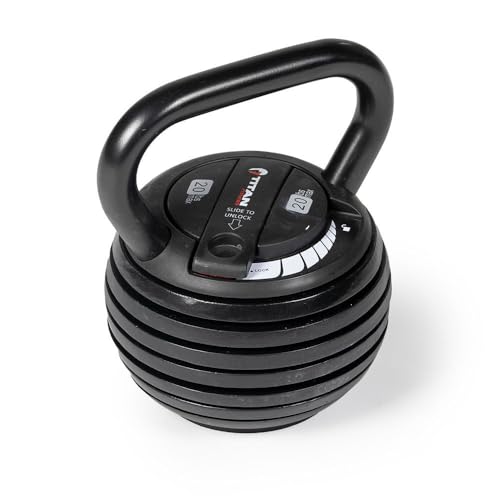
Titan Fitness Adjustable Kettlebell
Wide handle clears both hands, which matters on two-hand swings and heavy cleans. Internal plates sit behind a screw-secured base and stay silent under load. Manual adjustment means planning weight jumps around your program rather than between sets.
Pros
- Handle width fits both hands comfortably
- Plates stay silent through fast swings
- Gym-grade steel and hardware throughout
Cons
- Screw base is the slowest system here
- Empty core weighs more than dial units

Kettlebell Kings Adjustable Kettlebell
Handle diameter and smooth finish follow competition bell conventions, which helps through high-rep snatches and long sets. Plate placement keeps the center of gravity steady as load moves from 12 to 32 pounds. Top weight stops lower than every other pick here.
Pros
- Smooth handle reduces hotspots on long sets
- Balance stays consistent across settings
- Window clears a chalked hand easily
Cons
- Caps at 32 lb, lowest ceiling in this group
- Costs more than plate-stack rivals
ProForm Adjustable Kettlebell
Selector base moves between light and moderate settings from 12 to 35 pounds without tools. Simple operation and a contoured grip suit anyone still learning the hip hinge. That 35 pound ceiling arrives quickly once swing technique improves.
Pros
- No tools needed to change settings
- Light starting load suits new lifters
- Single unit stores under a desk
Cons
- Ceiling of 35 lb limits swing progression
- Housing feels light next to cast iron
Compared at a glance
| # | Model | Weight range | Best for | Score | Price |
|---|---|---|---|---|---|
| 1 | Bowflex SelectTech 840 | 8 to 40 lb | Best overall | 9.4 | Check price |
| 2 | PowerBlock Adjustable Kettlebell | 18 to 35 lb | Best weight range | 9.2 | Check price |
| 3 | Yes4All Adjustable Kettlebell | 10 to 40 lb | Best budget | 9.0 | Check price |
| 4 | JAXJOX KettlebellConnect 2.0 | 12 to 42 lb | Best for tracking reps | 8.7 | Check price |
| 5 | Titan Fitness Adjustable Kettlebell | 10 to 40 lb | Best for two-hand swings | 8.5 | Check price |
| 6 | Kettlebell Kings Adjustable Kettlebell | 12 to 32 lb | Best handle comfort | 8.2 | Check price |
| 7 | ProForm Adjustable Kettlebell | 12 to 35 lb | Best for beginners | 8.0 | Check price |
What to look for
What to look for in an adjustable kettlebell Four things decide the purchase: weight range, adjustment speed, handle geometry and stored footprint. Range should bracket your current working load and roughly double it. Handle width needs to clear both hands if swings are part of your program. Footprint matters because these units sit out permanently in most homes. Everything else is packaging.
How dial, plate and motorized adjustment differ Dial systems change load in about two seconds and suit circuits or supersets. Plate stacks and pin systems take longer but usually pair with a steel or cast handle that feels closer to a fixed bell. Motorized docks add rep logging and change weight electronically, at the cost of a permanent powered base. Match the mechanism to how often you change load mid-session.
Which weight range works for beginners and stronger lifters New lifters press and squat comfortably around 12 to 18 pounds, then swing 25 to 35 pounds within a few months. A bell spanning 10 to 40 pounds covers that whole arc. Lifters already swinging 40 pounds should look at fixed cast bells instead, since most adjustables cap around 42 pounds. Buying a narrow range to save shelf space usually means rebuying.
Storing an adjustable kettlebell in a small apartment One adjustable unit occupies roughly the shelf space of a single 40 pound bell. Dial models with plastic housings sit widest, while cast plate stacks sit tallest. Check base stability on carpet, since a top-heavy unit tips when nudged. Add a rubber mat under the training area: dropping any adjustable bell on hardwood damages both the floor and the mechanism.
Common questions
Are adjustable kettlebells as good as regular cast bells?
For swings, presses and squats at home, yes. Fixed cast bells keep a smoother, more consistent shape for snatches and heavy racked work. Adjustable models trade a little of that shape for six loads in one footprint.
What weight range should a beginner buy?
A span of roughly 10 to 40 pounds covers the first year. Light settings handle overhead presses and Turkish get-ups. Heavier settings carry swings and deadlifts once hip drive improves.
Can you drop an adjustable kettlebell?
Avoid it. Pins, dials and stacked plates loosen or crack on hard impact, and warranties rarely cover drop damage. Set the bell down under control on a rubber mat.
How fast can you change the weight?
Dial models take about two seconds. Pin systems need five to ten. Screw-secured plate stacks take a minute or more, and motorized docks require returning the bell to its base.
Do the plates rattle during swings?
Well-locked systems stay silent. Rattle usually appears on plate stacks at partial loads, where an unused plate sits loose in the housing. Snugging the base before each set fixes most of it.
Is one adjustable kettlebell enough?
For single-bell work, yes. Double cleans, double presses and double front squats need a matched pair, so buy two if your program includes them.
How heavy do adjustable kettlebells go?
Most cap between 32 and 42 pounds. JAXJOX reaches 42, and several stop at 40. Beyond that range you are into fixed cast bells or competition steel.
Do smart kettlebells need charging?
Motorized and app-connected models need mains power at the dock to change weight and sync data. Dial, pin and plate systems are fully mechanical and work anywhere.
Which adjustable kettlebell is best for small apartments?
Dial models like the Bowflex SelectTech 840 store in the space of one fixed bell and need no tools. Skip motorized docks if outlet access is limited.
Bowflex SelectTech 840 vs PowerBlock: which should I pick?
Bowflex changes faster and starts lighter at 8 pounds, which suits circuits and newer lifters. PowerBlock delivers a welded steel handle and starts at 18 pounds, which suits stronger hands and heavier swing work.
Our take
Bowflex SelectTech 840 covers the widest slice of home training, with six loads from 8 to 40 pounds and a two-second dial. PowerBlock is the better handle for lifters already swinging past 20 pounds. Yes4All delivers cast iron and a traditional grip for anyone building a first home setup.
Derek Holt
Derek has a background coaching recreational and amateur athletes and has worked the sales floor at specialty fitness retailers. He focuses on equipment durability, ergonomics and realistic use cases rather than marketing claims.