One Adjustable Cake Ring Replaces an Entire Shelf of Pans
Ateco’s adjustable stainless steel ring expands from about six to twelve inches, covering most home cake sizes in one tool. Norpro’s version costs less for occasional bakers. Fat Daddio’s ring suits mousse and entremet work where clean, bottomless release matters most.
Ateco’s adjustable stainless steel cake ring leads this list because its size range covers the most common home cake diameters in a single tool, replacing several fixed pans stacked in a cabinet. Norpro’s ring works just as well for anyone baking cakes occasionally and not ready to pay for Ateco’s heavier-gauge steel. Fat Daddio’s ring suits mousse and entremet desserts specifically, where a clean bottomless release matters more than it does for a simple baked cake.
An adjustable cake ring has no bottom, which is exactly the feature that lets it expand but also means it bakes differently than a fixed pan and needs a lined sheet underneath. We compared material, size range, and how each ring handles both baked batter and no-bake mousse work across seven options.
The best picks, ranked
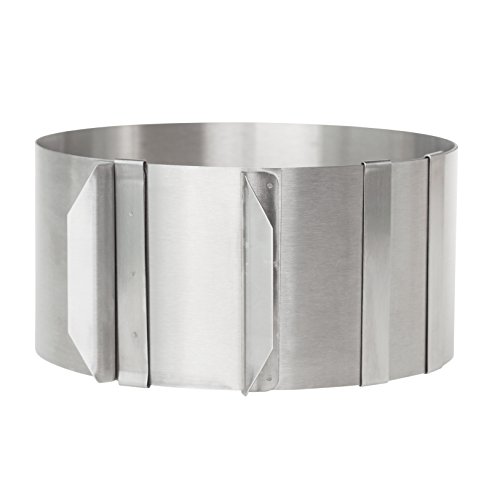
Ateco Adjustable Cake Ring
Ateco expands this ring from roughly six inches up to twelve inches, covering small celebration cakes through full-size layer cakes without buying separate pans. Stainless steel resists the dents and warping thinner rings develop after repeated use. A sliding lock holds the set diameter in place while batter goes in.
Pros
- Wide size range covers most cake diameters
- Stainless steel resists dents and warping
- Sliding lock holds the set size securely
Cons
- Needs a lined sheet pan since it has no bottom
- Costs more than basic adjustable rings

Fat Daddio’s Adjustable Cake Ring
Fat Daddio’s polishes the interior of this ring smoother than basic versions, which matters for mousse and entremet layers that need to release cleanly without a baked crust to grip the sides. Pastry chefs commonly reach for this brand’s rings for plated dessert work. It still handles baked cake batter when a bottom liner is added.
Pros
- Smooth finish releases mousse layers cleanly
- Trusted by professional pastry kitchens
- Adjusts to a precise diameter for plated desserts
Cons
- Pricier than general-purpose adjustable rings
- Smaller size range than Ateco’s widest setting

Wilton Adjust-N-Fit Round Cake Pan
Wilton coats this adjustable ring with a nonstick finish, aimed at home bakers more familiar with coated cake pans than bare stainless steel. It still has no bottom, so it sits on a lined sheet during baking like other adjustable rings. The nonstick surface makes initial cleanup easier for someone new to this style of pan.
Pros
- Nonstick coating eases cleanup
- Familiar coated-pan feel for new users
- Lower cost entry point into adjustable rings
Cons
- Nonstick coating can wear with repeated use
- Narrower size range than professional stainless rings
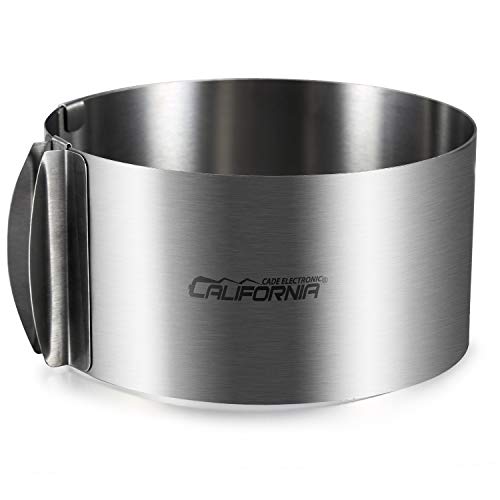
Norpro Adjustable Cake Ring
Norpro keeps this ring simple and stainless, aimed at bakers who need an adjustable size occasionally rather than every week. It covers a solid middle range of cake diameters without Ateco’s premium price. The sliding adjustment works the same way as pricier versions, just with a lighter gauge of steel.
Pros
- Lower cost than premium adjustable rings
- Stainless steel still resists rust
- Simple sliding adjustment
Cons
- Lighter gauge steel than Ateco’s version
- Narrower size range than top-tier rings

Gobel Adjustable Cake Ring
Gobel manufactures this ring from tinned steel, a material French bakeries have used for generations, giving it slightly better heat conduction than heavier stainless steel. Edges browning faster than a cake’s center is less of an issue with this thinner-wall construction. It needs drying immediately after washing to avoid the tin spotting.
Pros
- Faster, more even heat conduction while baking
- Traditional material used in French bakeries
- Lightweight compared to heavy stainless rings
Cons
- Needs thorough drying to prevent spotting
- Less rust-resistant than stainless steel long term

de Buyer Adjustable Round Cake Ring
de Buyer builds this ring to the same standard as its professional pastry equipment, using a heavier gauge of stainless steel than most home-market rings. Culinary schools and restaurant pastry stations commonly stock this brand. The thicker material holds its shape under repeated daily use better than lighter home versions.
Pros
- Heavier gauge steel holds shape under daily use
- Trusted in professional pastry kitchens
- Durable enough for repeated commercial washing
Cons
- Higher cost than most home-market rings
- Heavier to handle than lighter stainless options

Patisse Create Adjustable Round Cake Ring
Patisse coats this adjustable ring with a nonstick layer over its metal body, aimed at home bakers who want easier cake release without switching to parchment paper tricks. The coating handles both baked cakes and chilled mousse work reasonably well. Its size range sits closer to Wilton’s than Ateco’s widest setting.
Pros
- Nonstick coating simplifies cake release
- Works for both baked and no-bake desserts
- European bakeware brand with consistent sizing
Cons
- Coating wears faster than bare stainless steel
- Smaller maximum size than Ateco’s range
How to choose
What an adjustable ring does that a fixed pan cannot A fixed cake pan locks a baker into one diameter, while an adjustable ring like Ateco’s or Norpro’s expands and contracts to fit whatever size a recipe calls for. That flexibility replaces several pans taking up cabinet space with one tool, though it comes at the cost of having no bottom. Every adjustable ring needs a lined sheet pan or cake board underneath to hold batter or mousse in place.
Matching ring height to the recipe Taller layer cakes and multi-tier mousse builds need a ring with enough height to contain the full recipe, which is where Ateco’s and de Buyer’s deeper rings have an edge over shallower options. Shorter rings like some of Norpro’s or Wilton’s sizing work fine for a single-layer cake but risk overflow on a taller batter. Checking a ring’s height against a recipe’s total volume before baking avoids batter spilling over the sides.
Material differences: stainless, tinned steel, and nonstick Stainless steel rings from Ateco, Fat Daddio’s, and de Buyer resist rust indefinitely and need no special drying routine. Gobel’s tinned steel conducts heat faster but needs prompt drying after washing to avoid spotting. Nonstick-coated rings from Wilton and Patisse trade some of that heat performance for easier release, which matters more for delicate mousse layers than dense baked cakes.
Using a ring for baked cakes versus mousse and entremet work Baked cakes need the ring greased or lined and set on a lined sheet pan before batter goes in, since raw batter will seep under an unsealed bottom. Mousse and entremet desserts benefit from Fat Daddio’s smooth interior finish, which releases a chilled, unbaked layer without tearing the sides. Wrapping acetate strips inside the ring before adding mousse gives an even cleaner release than relying on the metal surface alone.
The lineup, side by side
| # | Model | Material | Best for | Score | Price |
|---|---|---|---|---|---|
| 1 | Ateco Adjustable Cake Ring | Stainless steel | Best overall for most home cake sizes | 9.2 | Check price |
| 2 | Fat Daddio’s Adjustable Cake Ring | Stainless steel | Best for mousse and entremet desserts | 9.0 | Check price |
| 3 | Wilton Adjust-N-Fit Round Cake Pan | Nonstick coated steel | Best for beginners replacing multiple pans | 8.7 | Check price |
| 4 | Norpro Adjustable Cake Ring | Stainless steel | Best budget value for occasional baking | 8.5 | Check price |
| 5 | Gobel Adjustable Cake Ring | Tinned steel | Best French tinned steel option | 8.4 | Check price |
| 6 | de Buyer Adjustable Round Cake Ring | Heavy-gauge stainless steel | Best heavy-gauge professional ring | 8.6 | Check price |
| 7 | Patisse Create Adjustable Round Cake Ring | Nonstick coated metal | Best nonstick-coated option for easy release | 8.3 | Check price |
Frequently asked questions
Does an adjustable cake ring need a bottom to bake with?
Yes, since the ring itself has no bottom, it needs to sit on a lined baking sheet or cake board to hold batter or mousse in place.
Will cake batter leak out from under an adjustable ring?
Thin batter can seep slightly at the bottom seam, so lining the sheet pan with parchment and setting the ring firmly against it reduces leakage.
What size range do most adjustable cake rings cover?
Most expand somewhere between six and twelve inches, with Ateco’s ring covering close to the widest range on this list.
Can an adjustable cake ring be used for cheesecake?
Yes, it works well for cheesecake, especially with acetate lining the interior to help release the chilled dessert cleanly from the ring.
Is stainless steel or nonstick better for an adjustable cake ring?
Stainless steel like Ateco’s or de Buyer’s lasts longer and resists rust, while nonstick options like Wilton’s or Patisse’s make release easier for delicate desserts.
Are adjustable cake rings dishwasher safe?
Stainless steel rings generally tolerate a dishwasher, but tinned steel rings like Gobel’s should be hand washed and dried promptly to prevent spotting.
Can an adjustable ring replace a springform pan?
It can for many recipes, though a springform pan’s sealed bottom makes it better suited to batters that need to bake without a liner underneath.
How do you store an adjustable cake ring?
Most fold flat or collapse to their smallest setting, taking up far less cabinet space than a stack of fixed round pans.
Does an adjustable ring work for multi-tier cakes?
Yes, using the same ring at different diameters across tiers is one of its main advantages over owning several fixed pans.
Can acetate sheets be used inside an adjustable cake ring?
Yes, lining the interior with acetate before adding mousse or cake batter helps the dessert release cleanly and keeps the sides smooth.
Our pick
Ateco’s adjustable cake ring is the strongest all-around pick for most home kitchens, since its size range covers nearly every cake diameter a typical baker needs. Anyone focused mainly on mousse or entremet desserts should choose Fat Daddio’s ring instead, since its smooth interior finish releases chilled layers more cleanly. Bakers just starting out with this style of pan, or working with a tighter budget, are better served by Wilton’s nonstick version or Norpro’s lower-cost stainless ring than by Ateco’s premium model.
Dana Whitfield
Dana spent eight years buying and merchandising for a regional kitchenware retailer before moving into editorial work. She has handled thousands of SKUs across cookware, small appliances and kitchen organization, and focuses on the practical differences that matter once a product is actually in daily use.


