Top Access Points for Lag-Free Gaming
For gaming, the TP-Link EAP670 stands out as the top pick because it offers Wi-Fi 6 speed, low latency, and multiple Gigabit ports for wired backhaul. Its main advantage is the combination of high performance and affordability. The main limitation is that it lacks a built-in controller, so management is via app or cloud.
When every millisecond counts, your wireless network can be the difference between victory and defeat. Gaming access points are designed to prioritize gaming traffic, reduce lag, and handle multiple devices without dropping frames.
We compared the latest models from leading brands to find access points that deliver stable, high-speed connections for competitive and casual gamers alike. Our comparison focuses on real-world performance, features, and value.
Before you buy
Our top picks

TP-Link EAP670
The TP-Link EAP670 is a Wi-Fi 6 access point that offers excellent throughput and low latency. It features OFDMA and MU-MIMO for efficient multi-device handling, and it supports PoE+ for easy installation. Users report stable connections even in congested environments.
Pros
- Strong performance for the price
- Supports PoE+ for flexible placement
- Advanced security features
Cons
- No built-in controller
- Lacks a second Ethernet port

Ubiquiti UniFi U6-LR
The Ubiquiti UniFi U6-LR is a long-range Wi-Fi 6 access point that provides extensive coverage and reliable performance. It integrates seamlessly with the UniFi ecosystem, allowing centralized management. Gamers appreciate its low latency and robust QoS features.
Pros
- Excellent range and coverage
- Seamless roaming with UniFi
- Active cooling for durability
Cons
- Controller software required
- PoE adapter not included

ASUS ZenWiFi AX Mini (XD4) Access Point
The ASUS ZenWiFi AX Mini can operate as an access point in a mesh system or standalone. It offers tri-band Wi-Fi 6 and AiMesh support, making it easy to expand coverage. Gamers benefit from its low latency and parental controls.
Pros
- Easy setup via app
- Flexible use as mesh node or AP
- Compact design
Cons
- Limited Ethernet ports
- Performance not as high as dedicated APs

NETGEAR WAX610
The NETGEAR WAX610 is a Wi-Fi 6 access point designed for small businesses but equally suitable for demanding gamers. It offers high performance, robust security, and flexible management options. Users report stable connections with minimal latency.
Pros
- High throughput
- PoE+ support
- Advanced security features
Cons
- Requires subscription for cloud management
- Setup may be complex for novices

Aruba Instant On AP22
The Aruba Instant On AP22 is a Wi-Fi 6 access point that combines enterprise-grade features with simple app-based management. It offers excellent performance and QoS capabilities, making it a solid choice for gamers who want hassle-free deployment.
Pros
- Intuitive mobile app
- Lifetime warranty
- Good performance for price
Cons
- No 2.5G Ethernet
- Limited advanced configuration on app

Cisco Business 140AC
The Cisco Business 140AC is an affordable Wi-Fi 5 access point that still delivers solid gaming performance. It supports MU-MIMO and beamforming, and it can be managed via the Cisco Business app or web interface. While not the latest standard, it offers great value.
Pros
- Low cost
- Dual Ethernet ports
- Reliable brand
Cons
- No Wi-Fi 6 support
- Lower max speeds
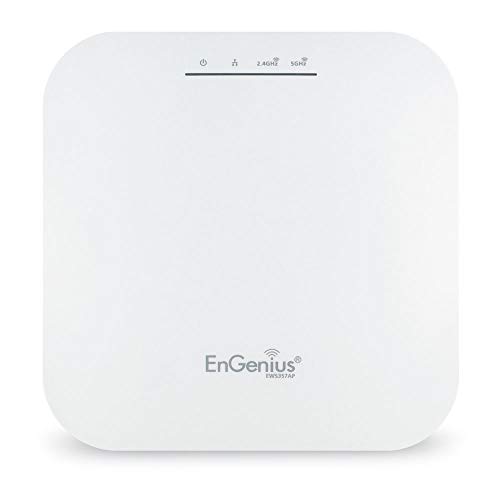
Engenius EWS357AP
The Engenius EWS357AP is a Wi-Fi 6 access point with a built-in controller for managing up to 50 APs. It offers excellent performance and granular control, appealing to tech-savvy gamers. However, its interface may be overwhelming for some.
Pros
- Built-in controller
- High throughput
- Robust QoS features
Cons
- Complex setup for beginners
- Requires PoE switch or injector
Compared at a glance
| # | Model | Wi-Fi standard | Best for | Score | Price |
|---|---|---|---|---|---|
| 1 | TP-Link EAP670 | Wi-Fi 6 (802.11ax) | Best overall for most gamers | 9.4 | Check price |
| 2 | Ubiquiti UniFi U6-LR | Wi-Fi 6 (802.11ax) | Best for large homes with many devices | 9.2 | Check price |
| 3 | ASUS ZenWiFi AX Mini (XD4) Access Point | Wi-Fi 6 (802.11ax) | Best for mesh expansion | 8.8 | Check price |
| 4 | NETGEAR WAX610 | Wi-Fi 6 (802.11ax) | Best for business-grade reliability | 8.7 | Check price |
| 5 | Aruba Instant On AP22 | Wi-Fi 6 (802.11ax) | Best for easy management and reliability | 8.5 | Check price |
| 6 | Cisco Business 140AC | Wi-Fi 5 (802.11ac) | Best for budget-conscious gamers | 8.3 | Check price |
| 7 | Engenius EWS357AP | Wi-Fi 6 (802.11ax) | Best for advanced users with PoE setup | 8.0 | Check price |
Frequently asked questions
Can I use any access point for gaming?
Yes, but gaming-specific features like QoS and high throughput can reduce lag. Access points with Wi-Fi 6 and multiple Ethernet ports are better suited for gaming.
Is a gaming router better than an access point?
A gaming router includes a router and switch, while an access point only provides wireless coverage. If you already have a good router, an AP can extend its reach. For whole-home gaming, a mesh system or multiple APs may be better.
How many access points do I need for gaming?
It depends on your home size and layout. One AP can cover a typical home, but larger homes may need two or more with seamless roaming.
Does an access point reduce ping?
An access point can reduce latency compared to a poorly positioned router, especially if it offers QoS and strong signal. However, your internet connection and distance to game servers affect ping more.
Can I use a PoE switch with any access point?
Only if the AP supports PoE. Check the specifications for PoE compatibility. Many business-grade APs support PoE, but consumer models often use power adapters.
What is the difference between a mesh system and an access point?
A mesh system includes multiple nodes that communicate wirelessly, while an access point connects to your router via Ethernet. APs generally offer better performance because of wired backhaul.
Do I need a Wi-Fi 6 access point for gaming?
Wi-Fi 6 is not required, but it provides lower latency and better performance in congested environments. If your devices support Wi-Fi 6, it’s worth the upgrade.
Can I manage an access point from my phone?
Many modern APs offer mobile apps for setup and management. Business-grade models often have both app and cloud options, while consumer ones may have basic apps.
Our take
For most gamers, the TP-Link EAP670 offers the best balance of price, performance, and features. If you need extensive coverage and have a UniFi setup, choose the Ubiquiti U6-LR. For a budget option, the Cisco Business 140AC is reliable despite being Wi-Fi 5. Prioritize Wi-Fi 6 for future-proofing.
Marcus Chen
Marcus covered consumer electronics for enthusiast tech publications for six years before joining ChoiceCrest. He specializes in translating manufacturer spec sheets into plain-language buying advice, with a focus on audio, computing accessories and smart-home gear.


